
Essentials
Reflections on the Evangelistic Opportunities of a School Chaplain
- Details
- Written by: Louise Davies
 I have been a School Chaplain for almost 9 years and am currently working at the New England Girls’ School (NEGS) in Armidale NSW. NEGS is both a day and boarding school, so the evangelistic opportunities I have do not end when the bell rings at the end of the day. They continue as I support and cheer on students at their weekend sporting events, taking students to Youth Group on a Friday night, or simply walking around the school grounds after school with my 2 dogs beside me allowing boarders to love them as they miss their own dogs back home. The role of a chaplain is wide and varied, and the evangelistic opportunities are endless.
I work in both the Junior and Senior School (Pre-K – Year 12) alongside staff, students, and families from a range of backgrounds and religions. Each week I teach Christian Studies to every student from Pre-K to Year 10, run independent chapel services and lunchtime groups for both the junior and senior students, and provide pastoral care to students, staff, and families.
I thought the best way to provide a glimpse into the daily opportunities I have is to detail for you two examples of interactions I have had.
Example 1
Emma* is a year 7 student who showed enthusiasm and a keenness to learn from day 1. Emma: I believe in God, and I believe that Jesus is God, but how can He be both God’s son and God at the same time?
Me: What a brilliant question! Everyone grab a Bible from the shelf. I want this side of the room to read this passage from Genesis 1, and this side of the room to read this passage from John 1.
(What followed was a discussion where the students were able to compare the passages and see how the Father, Son and Holy Spirit were there at the beginning of the world, and how the Word that John speaks about is actually Jesus.)
Kirrily*: I think my scripture teacher showed me a diagram for this. Can I draw it on the board? (Student then draws a diagram which gives the students a visual prompt as they begin to understand the complexities of the trinity.)
This interaction was in just my second lesson with them, and each lesson since has been an absolute joy. They do not all believe in God, however they are all respectful, inquisitive and are keen to ask the questions they have and discover the answers.
Example 2
The second example I will give is an interaction between myself and a Kindergarten class.
Context: In the junior school chapel we had been working through ‘The King, The Snake and The Promise’ where we see the big picture of the Bible.
Me: This story is all about what God did to fix the problem of sin. Let’s see if we can remember what we’ve been looking at in chapel, so we know where we are up to in God’s story. What is the first picture we looked at?
A range of students: from there the class then retell the story from creation to exile prompting each other as they went. They remembered every picture and used them to recall the story. I barely had to say a word to help them.
Their teacher and I looked at each other in disbelief because they had remembered so many details!
I have given you an example from both the Junior and Senior School. I did this intentionally. One of the most amazing things as a school chaplain at a Pre-K – 12 school is that there are students who remain at the same school for up to 14 years. So, they are being taught from God’s Word regularly and the chaplains can get to know them and their families.
When you see students in your class regularly each week, in chapel services, at sporting events, youth group etc., you don’t have to rush to get the message of Jesus out there thinking you will never see them again like other areas of ministry. There is time. I am a big believer in taking time to build up a positive rapport with the entire school community. This can happen over a number of years due to the nature of a school. I worked at my previous school for 8 years and was able to walk alongside families during their best days and their worst. I have rejoiced with them at the birth of a new child and mourned with them and helped with funeral arrangements at the death of a loved one. When you ‘do life’ together, the evangelistic opportunities come naturally. As a chaplain, the school community obviously know I am a Christian, they know I am there to teach students about Jesus, but I also hope they see my role as more than that. I am there to love and support staff, families and students day to day. Whether that is assisting a teacher for an hour or two if their class is unsettled, going to the Junior School Disco dressed up as a Disco Pelican (true story) to be an extra set of eyes for supervision, or cheering on students at the weekend sports. It is through these everyday things that the school gets to know me, and I them. When that evangelistic opportunity comes, either formally in a chapel service or informally during a discussion at recess, they tend to listen because they know there is trust there, not judgment. There is a relationship that has been built to support what can sometimes be a hard thing to hear.
I could write forever about all the joys as a chaplain, but there are of course challenges too. Students who have no interest in what I’m teaching, the emotional toll of often discussing hard topics and being asked the big questions, seeing students finish school without putting their trust in Jesus. However, the one thing that keeps me going (besides the support of many teachers and families) is knowing this isn’t my work, but God’s. I’m simply the vessel. I do not know what God has planned for the students in my care, but my prayer that I often pray at the beginning of each day on my way to school, is this:
Lord God,
I pray that on that final day when You return or call us home, many of my students, staff, and families, both past and present, will be rejoicing with me together in heaven. And may my work be done for Your glory.
Amen
*Names have been changed for confidentiality.
Lou Davies is the Chaplain of New England Girls’ School (NEGS) in Armidale NSW.
Essentials - Spring 2023
- Details
- Written by: Gavin Perkins
Essentials Spring 2023 pdf (2MB)
Essentials Winter 2023 pdf (2MB)
Essentials Autumn 2023 pdf (2MB)
Essentials Summer 2022 pdf (8MB)
Essentials Spring 2022 pdf (4MB)
Essentials Winter 2022 pdf (4MB)
Essentials Autumn 2022 pdf (1MB)
Essentials Summer2021 pdf (3MB)
Essentials Spring 2021 pdf (3MB)
Essentials Winter 2021 pdf (3MB)
Essentials Summer 2020 pdf (3MB)
Essentials Spring 2020 pdf (1MB)
Essentials Winter 2020 pdf (1MB)
Essentials Autumn 2020 pdf (4MB)
Essentials Summer 2019 pdf (8MB)
Essentials Spring 2019 pdf (5MB)
Essentials Winter 2019 pdf (5MB)
Essentials Autumn 2019 pdf (5MB)
Essentials Summer 2018 pdf (5MB)
Essentials Spring 2018 pdf (5MB)
Essentials Winter 2018 pdf (5MB)
Essentials Autumn 2018 pdf (5MB)
Book Review: Hire Right, First Time
- Details
- Written by: Paul Arnott
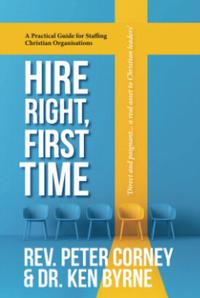 Hire Right, First Time
Peter Corney and Ken Byrne
Publisher, 2023
Reviewed by Paul Arnott
Reading Hire Right, First Time I’m discovering how many things I could have done better when hiring staff. While I am among those who wrote a commendation for this book, I will do my best to review it fairly. Hiring staff is one of the most difficult things any organisation can do. There are many pitfalls, as Corney and Byrne point out, not the least of which is that you don’t know who you’ve got until you’ve had them for six months. By then the probationary period is over and if you’ve made a mistake, it’s too late, which is why it’s so important to do all you can to get it right in the first place. The book is A Practical Guide for Staffing Christian Organisations, which means the process is potentially even more fraught, because of the values of Christian organisations. Corney and Byrne suggest that Christian organisations are by their nature tolerant: “The wish to extend God’s grace in Word and Deed is a deeply held value of the Gospel that can overshadow a hiring agency’s obligations to their existing clients and staff. The desire to do good can lead us to be short-sighted in assessing the risk that goes with a poor hiring choice.” The first chapter of Hire Right, First Time unpacks the many pitfalls of hiring for a Christian organisation. Chapter 2 highlights the importance of writing a position description, which accurately spells out what the job is designed to achieve. Chapter three details how to create what it calls “a compelling attraction strategy.” It isn’t enough to write a great position description, but also an ad that attracts people to the role.
One of the book’s most valuable ideas is contained in chapter 4 – the importance of a structured selection system. The system is a well-thought-out, clearly defined process that all applicants must complete. Chapters 5 and 7 highlight the importance of the interview, especially the role of really listening. Chapter 6 explains how to discover the beliefs and values of the candidate. Chapter 8 details how to do reference checks well and suggests they are often done poorly. Chapter 9 highlights the crucial importance of intuition in the hiring process. Chapter 10 explains how to make the final decision. The next two chapters detail how to keep your best staff and how to dismiss staff. The final chapter reveals how to detect candidates that have a history of child abuse. The book lives up to its claim to be a guide for staffing, as each chapter concludes with extremely practical, commonsense checklists to ensure the ground has been fully covered. Another rich resource is a comprehensive, free, downloadable User Guide. Hire Right, First Time is a potential goldmine for Christian organisations when hiring staff, indeed for any organisation seeking to hire right the first time.
Paul Arnott is the Executive Director of CMA’s Q4: Rethinking Retirement.
Originally published in The Melbourne Anglican in March 2023.
Book Review: Keeping Faith
- Details
- Written by: Stephen Hale
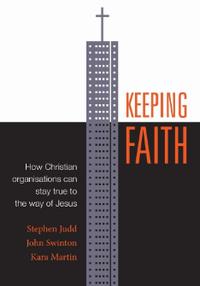 Keeping Faith: How Christian Organisations can stay true to the way of Jesus
Stephen Judd, John Swinton, Kara Martin
Acorn Press, 2023
Reviewed by Stephen Hale
This recently published book is an excellent resource for any who lead or serve on the Board of a Christian not for profit organisation or entity. The book is only 140 pages, but it is remarkably comprehensive and covers most of the ground you would want it to cover.
We all know of the organisations that started off Christian and are now very distant from the founding vision. So how do we ensure that doesn’t happen again? And even if you want to remain Christian, what does that mean and how do you make it a reality. None of these are easy questions to answer and the authors offer a very healthy perspective on what this might mean. This is especially important in the Australian context where a surprisingly large percentage of children go to faith-based schools and much of the welfare that governments fund is delivered by faith based organisations.
If you’re a Board member at some point you will be dealing with most of the issues covered in the book. At some point you with have to appoint a CEO and that will have significant on-going implications for the values of the organisation and whether it can stay true to the way of Jesus. A good friend of mine had a key role in a large health organisation which had thousands of staff. She worked with the Board to ensure that there was annual training for all staff (most of whom were not church goers) to enable alignment between their values and their practices. The outcomes were remarkable.
I strongly commend this book. It should be read and studied by all Board members as well key staff teams. It is a very useful resource to think thorough the hard questions that will enable the organisation to stay true to the way of Jesus. The book is thoughtful and challenging but also remarkably practical.
Stephen Hale
Bishop Stephen Hale is the Acting Vicar of St Mark’s Camberwell and Chair of EFAC Australia and EFAC Global
Global Implications from Lambeth 1998 Resolution 1:10
- Details
- Written by: Bishop Keith Sinclair
 Global Implications from Lambeth 1998 Resolution 1:10 and Actions Since
This is an abridged version of the address given by Bishop Keith on Tuesday 18th April at GAFCON 4 in Kigali, Rwanda.
Let me begin with the global implications of Resolution 1:10 from Lambeth 1998.
It is important to remember that 1998 was the last time all the Bishops of the Anglican Communion met together as one body to take counsel together. They followed the pattern of earlier conferences, praying under the word of God and sought to express the mind of the whole Anglican Communion, as part of the one, holy, catholic, apostolic church.
In Resolution 1:10 they sought to express that mind in relation to human sexuality. The whole resolution was passed overwhelmingly by 526 to 70. Given the overwhelming numbers and the clear summary of the teaching of Scripture, there might have been reason for confidence that this Resolution would now shape the life of the whole Anglican Communion. The main reason for confidence, however, was that 1:10 did no more and no less than attempt to faithfully summarise the teaching of scripture in relation to human sexuality.
It spelt out;
- In view of the teaching of Scripture (the basis of all that follows), upholding faithfulness in marriage between a man and a woman in lifelong union, believing that abstinence is right for those not called to marriage.
- What biblical holiness meant especially for those ordained and the authorised prayer ministry of the Church;
- It said we “cannot advise the legitimising or blessing of same sex unions nor ordaining those involved in same gender unions”;
- It recognised and committed the whole Church to “recognise(s) that there are among us persons who experience themselves as having a homosexual orientation” and “to listen to the experience of homosexual persons;
- The bishops wished to assure these people “that they are loved by God and that all baptised, believing and faithful persons, regardless of sexual orientation, are full members of the Body of Christ” AND
- And “while rejecting homosexual practice as incompatible with Scripture”, they called, “on all our people to minister pastorally and sensitively to all irrespective of sexual orientation and to condemn irrational fear of homosexuals, violence within marriage and any trivialisation and commercialisation of sex”.
These were bold statements even then, and rightly based on Scripture and the gospel. They called the church to be full of truth and grace built on the word of God.
The resolution in the matter of human sexuality was calling the whole church to the obedience of the whole gospel as revealed in the whole of scripture for the blessing of the whole world.
Brothers and Sisters if we are to commend this Resolution today as expressing the truth and grace of God in the Bible, as I hope we will, let us commit to fully live this truth and grace ourselves wherever we live and whatever our cultural context, acknowledging humbly our own sin, even as we call upon the whole Anglican Communion to live fully in this grace and truth now.
COUNTER CULTURAL CALL
I hope you will agree that Resolution 1:10 gives expression to the call of Romans 12:1-3 in relation to our obedience of faith in matters of human sexuality. All of us are called to remain faithful to the gospel and the word of God.
All of us may find that difficult in different ways according to our own culture.
Different parts of Lambeth 1.10 will challenge our different cultures in different ways, sometimes in difficult ways, but that is what will happen when we do not conform to this world but allow the Spirit of God to transform us by the renewing of our mind.
At all times and in all places we will find we have to be countercultural, including in relation to sexuality.
As we are faithful and where necessary counter-cultural as Lambeth 1:10 invites us following on from Romans 12, then we can by the grace of God transform our own culture.
CONSEQUENCES
But faithfulness and cultural transformation is not what happened after Lambeth 1998.
We have heard already of the reaction to this resolution in North America and the consequences in relation to the Instruments of Unity, the Archbishop of Canterbury, the admonishing response of the Global South, and the creation of GAFCON. We have heard of the necessity of drafting and approving the Jerusalem Declaration in 2008.
The well-known words of the Primates meeting of 2003 bear repeating, not least in considering the recent decision of the General Synod of the C of E, 20 years later, and the Lambeth Conference in 2022, when there were for the first time ever in the history of the Anglican Communion bishops present in same sex unions.
This was the Primates in 2003 in response to the consecration of one bishop and the blessing of same sex unions then “At this time we feel the profound pain and uncertainty shared by others about our Christian discipleship in the light of controversial decisions … to authorise a Public Rite of Blessing for those in committed same sex relationships, and by the 74th General Convention of the Episcopal Church (USA) to confirm the election of a priest in a committed same sex relationship to the office and work of a Bishop.”
And then “If his consecration proceeds, we recognise that we have reached a crucial and critical point in the life of the Anglican Communion and we have had to conclude that the future of the Communion itself will be put in jeopardy. This will tear the fabric of our Communion at its deepest level.”
We appear to be in a place where the Church of England is now proposing to do on the recommendation of the English House of Bishops and the Archbishop of Canterbury what the Primates said in 2003 should not be done.
INSTRUMENTS OF UNITY TO 2008?
Before we consider briefly what has happened now in the Church of England, it is worth asking ourselves how throughout the intervening period the so called instruments of unity have tried to find a way to repair this tear. Has there been an attempt to find a way to walk apart given that the divisions on both sides recognise this as not being adiaphora?
It soon became clear in North America before and after the consecration of Gene Robinson, that those arguing for a change in the doctrine and practise of the Anglican Communion believe this to be a matter of justice, invoking all the prophetic words on the subject in scripture in support. Those Provinces following TEC and the Anglican Church of Canada, in New Zealand, Brazil, Scotland, Wales have rejected Lambeth 1:10, and declared that the blessing of same sex unions is not contrary to the teaching of Scripture and those in such unions may be ordained and consecrated as Bishops.
A Commission was established in October 2003 by the Archbishop of Canterbury at the request of the Anglican Primates. As we now face the continuing consequences some of the Commissions’ comments still make for salutary reading; it said in 2004 “However, if realistic and visionary ways cannot be agreed to meet the levels of disagreement at present or to reach consensus on structures for encouraging greater understanding and communion in future it is doubtful if the Anglican Communion can continue in its present form.”
“Should the call to halt and find ways of continuing in our present communion not be heeded, then we shall have to begin to learn to walk apart.”
But these words were not heeded; the moral authority of Resolution 1:10 was not recognised and the tear worsened.
INSTRUMENTS OF UNITY 2008 TO LAMBETH 2022
What I find extraordinary is that since that time, nearly 20 years ago now, and with another Lambeth Conference in view (even delayed by the pandemic) there has not been another attempt made to repair the tear, no intra Provincial commissions to find a way forward even if it means finding a way to walk apart. Rather after the Primates Meeting in 2016 the Archbishop of Canterbury appealed to “good disagreement” which seemed to mean that both these convictions about the “teaching of scripture” could be permitted within the Anglican Communion without any decision being made between them. This view became explicit during the Lambeth Conference 2022. A call to reaffirm Resolution 1:10 seems to have been introduced into the Call on Human Dignity (at the last minute) only to be hastily withdrawn after protest.
Here is John Stott in his book “Same Sex Relationships” quoting Wolfhart Pannenberg (Professor of Theology at Munich) with approval “The biblical assessments of homosexual practise are unambiguous in their rejection!” He (Pannenberg) therefore concludes that a church which were to recognise same sex unions as equivalent to marriage “would cease to be the one, holy, catholic and apostolic church”.
For a tremendous assessment of the Lambeth Conference 2022, please see the superb Communique from the Global South and its reaffirmation of Lambeth 1:10 in its entirety, its call for a resetting of the Anglican Communion and its call for visible differentiation from those Provinces which have impaired communion by departing from the biblical faith.
CHURCH OF ENGLAND
What of the Church of England?
It seems that what was permitted at Lambeth 2022 is now being promoted within the Church of England. The plea for unity is made constantly without regard for the truth which is at the heart of Resolution 1:10, the teaching of scripture.
There are however still many orthodox and evangelical voices in the Church of England who uphold that truth and have not accepted the claim that unity can be divorced from it.
The church which God used to bring the gospel to so many parts of the world because of her faith in that scriptural revelation, now seems to have succumbed to the very cultural captivity it appealed to so many to renounce.
Formally it remains to be seen how the Bishops’ will respond to what has been said globally and in England. At the Lambeth Conference 2022 the Archbishop said “the validity of the resolution passed at the Lambeth Conference 1998, 1:10 is not in doubt and that whole resolution is still in existence.” The question on the lips of many in England and around the world is “valid to whom”? If this is still true, then surely the revised prayers and guidance which the Bishop’s will bring to Synod, must explicitly demonstrate they are within Resolution 1:10, which must mean there can be no blessings of sexual relationships outside heterosexual marriage. We are praying that the Archbishops and Bishops will draw back.
We await the final proposals, pastoral guidance and prayers in July or later this year. We are told that what is proposed is not a departure from the doctrine of the Church of England. The General Synod have required the Bishop’s to ensure that this is the case.
CONCLUSION
Let me finish with words from the prophet Jeremiah who has become a bit of a familiar friend over these last years. These words became something of a watchword for Bishop JC Ryle first Bishop of Liverpool. I am sure he would echo them now in relation to the Church of England and the whole Anglican Communion
Thus says the Lord: Stand at the crossroads and look, and ask for the ancient paths, where the good way lies; and walk in it and find rest for your souls.
Jeremiah 6:16
Bishop Keith Sinclair has just finished up as the National Director of the Church of England Evangelical Council and is an EFAC Global Trustee and retired Bishop of Birkenhead.
The Bishop as Preacher
- Details
- Written by: Paul Barker
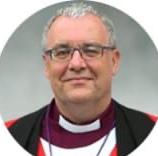 I preach every week, often more than once, and it takes me over 18 months to get to every one of my 82 parishes. Preaching is a highlight of my week, something that energises me and challenges me. I try hard to fit the expectation of length of sermon (between 12 and 35 minutes) and I have enjoyed the challenge of preaching shorter than I used to. I now use a stopwatch when I preach as it helps me keep to time better.
Maybe 60% of my parishes use the lectionary readings, which I fit into, preaching just one of the readings rather than something on them all. The remaining parishes are roughly split between asking me to fit into a sermon series or I have free choice.
My aim has been to write twelve new sermons a year, a low bar but the extreme busyness of the role, plus the ability to reuse older sermons, means I do not always succeed even to achieve this goal. In reusing older sermons, apart from adjusting the length of the sermon, I am trying to reshape the introduction and application to be more relevant to this particular congregation.
WHAT I MISS FROM BEING A VICAR
I have been an itinerant preacher for almost fourteen years, the last 6.5 as a bishop. I still miss two key things. Preaching to people I know. I always want to preach with love, and that was easier with people I pastored week by week. In addition, preaching to people I knew meant I could be more accurate and deeper in application.
I also miss preaching a series, building week by week through a portion of scripture. Each sermon now for me is very much standalone, and to a different congregation week by week. I miss the personal growth from working through some consecutive portions of scripture. I miss the more frequent opportunities to preach from the Old Testament. I have tried to create a few opportunities for additional preaching, with Lenten series on Sunday or midweek nights, a winter midweek Old Testament series, and the occasional camp or conference.
BEING ITINERANT
Being itinerant has advantages but also challenges. I am more explicit about Christ, especially in Old Testament passages. When I was a Vicar preaching a series, I could hint and suggest, I could anticipate the next week and build up to a series climax. Now, in standalone sermons, I have to be more explicit and make sure people see where the passage fits and leads to.
Being itinerant means that when preaching on a passage that has developed from earlier passages, I often have to do more unpacking of those earlier passages as I cannot always assume people see the passage in its literary context.
The other challenge is not knowing my people well. At least as bishop I return after a couple of years and get to the know the parishes gradually. However inevitably the application is broader and perhaps weaker. I rest comfortably with that, because I see other priorities in my preaching, which I come to below.
UPHOLDING TRUTH
When I was consecrated, I pledged to ‘maintain the Church’s witness to the resurrection of Christ from the dead, to protect the purity of the gospel, and to proclaim Jesus as Lord’. I take this seriously. My priority in preaching whichever passage in whatever church is to do exactly this.
I want people to have confidence in the gospel and an enduring commitment to Jesus. Many in our churches are uncertain in faith, inarticulate in theology and wearied in discipleship. In a societal environment increasingly hostile to Christianity, and in a global church environment that is conflicted on doctrine, I want above all to affirm Jesus, his sufficiency for salvation and his cosmic Lordship. By and large I do not seek to do that combatively or adversarially. Lifting up the glorious gospel of grace, highlighting the splendour of Jesus, in as compelling and attractive way as I can, is confidence-building, comforting and, I hope, convincing. It is what our church needs.
I stick to one Bible passage. Indeed I always have done. When I have taught preaching, I have argued that using other biblical references should only be for adding clarity or conviction. But I also stick to one text because I believe that people need confidence to read the Bible.
Cross-references, including floating through three or four lectionary readings, can erode confidence, as most people feel inadequate jumping round scripture. But as people see one passage opened up, being shown what is simply there, then my prayer is that they begin to see that the Bible is comprehensible.
I do not use my Sunday preaching in parishes to be about pragmatic issues or ministry, compliance, governance, mission action plans or diocesan priorities. They are primarily for preaching scripture, bearing witness to the risen Jesus that people may be drawn to him in faith, love, discipleship and witness, for his glory.
Bishop Paul Barker
Assistant Bishop, Diocese of Melbourne.
Preaching as a Team
- Details
- Written by: John Forsyth
 Preach the word; be ready in season and out of season; reprove, rebuke, and exhort, with complete patience and teaching 2 Timothy 4:2
PREACHING GOD’S WORD
One of the great joys and responsibilities of being an ordained minister is the preaching of God’s word to God’s people each week. The significance of this ministry is not just reflected in the amount of time we give to sermons in our Sunday services, but also the substantial and appropriate time spent in preparation. In many churches, this responsibility falls to the single vicar, rector or senior pastor. Many of my dear colleagues and friends in ministry face the challenge of faithfully preaching week in and week out without much of a break.
ST JUDE’S CONTEXT
In my parish of St Jude’s, we face a different context and a different challenge. St Jude’s is a multi-site and multi-staff church with 6 Sunday services across 3 sites, some occurring at the same time. Thus we need a number of different preachers each week to cover all our services. Additionally, we have 7 members of staff who are regular preachers, 3 who are occasional preachers, not to mention our ministry trainees and student ministers and we are even blessed with a vicar emeritus who is known to preach now and then. I am very thankful that we are very blessed with a large number of preachers.
HOW WE WORK OUT WHAT TO PREACH
St Jude’s is committed to expository preaching. This means that as we go through a book of the Bible, the main point of the biblical text being considered becomes the main point of the sermon being preached. The vast majority of our preaching is spent working through a book of the bible week by week.
Although we have six congregations, we have a combined preaching program for the whole church. I bring a draft program to the senior staff team and together we shape the preaching program for the coming year. Over a year we aim to cover a breadth of scripture. This usually means preaching through, a gospel, a New Testament letter, and a book from the Old Testament. Additionally, we preach through the Psalms over January. We tend to break series up to cover 6-10 weeks, with longer books being broken up into parts (eg. we recently preached through all of Romans over 4 years). We also write Bible studies for each series to enable our small groups to follow the preaching program.
There is also space for congregational ministers to choose their own preaching series for a set number of weeks These may be more topical or theologically shaped (eg. a series on “work” or the Apostles Creed etc).
HOW DO WE WORK OUT WHO WILL PREACH
Preaching is one of the fundamental ways of pastoring people entrusted to our care as shepherds. This means that our key pastoral leaders do most of the preaching. In our case this includes me as the vicar and the senior staff who lead campuses and congregations. The need for at least 2-3 different preachers each week ensures that most senior staff are preaching regularly and that congregations hear a variety of voices from the pulpit. We also create space for other staff, trainees and student ministers to preach 2-3 times per year. Having a team of preachers also allows our staff to serve by preaching at other churches from time to time.
OVERSEEING A TEAM OF PREACHERS
One of the challenges of being a multi-site church is that I am not able to see and hear all sermons preached on a Sunday. To address this challenge, we have two key strategies. Firstly, we have a weekly “Hour of Power” meeting for all the preachers who are preaching in 2 weeks time. This hour is spent exegeting the passage and discussing any initial thoughts and reflections. This gives preachers the ability to work together and allows more experienced preachers to guide those with less experience (iron sharpening iron). Secondly, junior staff are given feedback on their preaching and assistance if needed by the senior staff they report to.
While I know that not all pastors have the opportunity, I consider it a great joy to lead the team of preachers at St Jude’s. Not only am I blessed with hearing the scriptures expounded so carefully by my colleagues, it has also helped me improve my own preaching as we seek to powerfully bring the word of God to bear on people’s lives.
John Forsyth is Vicar of St Judes Carlton