
Evangelism
Book Review: 5 Thresholds Framework of Evangelism Training
- Details
- Written by: Mark Simon
The 5 Thresholds Framework of Evangelism Training
library.intervarsity.org/library/coaching-five-thresholds
Reviewed by Mark Simon
Evangelical churches regularly run program evangelism courses like Alpha, Christianity Explored or Taste and See. And so we should! Ministers regularly preach evangelistic sermons. And so we should. And we often train our members in evangelistic methods like sharing one’s own testimony or explaining the gospel with a model like Two Ways to Live. But in some churches this evangelism ecosystem doesn’t seem to be yielding many commitments of non-Christians to faith. Is it that our invitations to courses are not landing? Is it that people don’t want to hear our testimony? Is it that our gospel explanations are not connecting? What’s going on with the diminishing returns our program and personal evangelism strategies seem to be yielding?
One possibility is that we are misjudging the spiritual readiness of invitees to attend an evangelistic course, hear about our faith or believe the gospel as we present it to them. We may be offering an invitation to people who aren’t ready yet to hear it because we lack the relational capital with them necessary for them to respond positively.
This is where 5 Thresholds comes in. The 5 Thresholds is a ministry framework that describes the five steps that non-Christians commonly go through on their journey toward faith. The framework is based on research conducted by Don Everts and Doug Schaupp with 2000 individuals who had come to faith in Jesus from a prior position of scepticism. 5 Thresholds helps plot the necessary stages (or thresholds) a postmodern person typically moves through prior to repentance and following Christ. (Everts and Schaupp’s book I Once Was Lost: What Postmodern Skeptics Taught Us About Their Path to Jesus gave rise to the 5 Thresholds training model).
The training material is freely available on Intervarsity’s web pages: https://library.intervarsity.org/library/coaching-five-thresholds
There is an e-learning course (with video and text content), a training powerpoint, and an evangelistic Bible study resource structured around the 5 thresholds. Our church brought in a trainer from a local schools ministry with experience in using the model to train our growth group leaders. Those leaders are now training the members of their growth groups with the videos (https://library.intervarsity.org/library/five-thresholds) and powerpoint. Individuals can just use the e-learning course by signing up for a free Intervarsity Ministry Playbook account.
The training course aims to help us identify where people are in their spiritual journey, so that we can offer them a personally-appropriate step that will help them to move toward Jesus.
Threshold 1 is the move from skepticism into a relationship of trust with a Christian friend. Threshold 2 is from disinterest to curiosity about our faith. Threshold 3 is becoming open to personal change. Threshold 4 is from openness to change to actually seeking after Jesus. Threshold 5 is the wonderful moment when someone puts their trust in Jesus for the first time.
The things that help at each threshold are distinct – from spending time together in the early stages, using appropriate questions, showing vulnerability and building towards steps like offering to pray for a concern our friend may have.
I found this framework had a great deal of explanatory power for why my own efforts to raise faith issues with neighbours and contacts didn’t seem to be getting anywhere. I was assuming they were further along in the journey than they actually were. I believe the thresholds will help us do better friendship evangelism. They demystify the relational steps that some Christians intuitively take, but which are not self-evident to others. The course is also well-grounded in the gospels, with pertinent parables and encounters with Jesus used to illustrate the principles. I am looking forward to the members in our church feeling empowered by this framework to be better spiritual friends to those around them, and so help many to take a next step towards Jesus.
Rev. Dr. Mark Simon is Senior Minister, St Alfred’s Blackburn North.
Training People for Everyday Evangelism
- Details
- Written by: Julie-anne Laird
Training People for Everyday Evangelism: Blockages & Breakthroughs
It was great to come together around Australia and have a particular focus on Hope in 2025. I love how Churches were thinking about evangelism and that there was some fruit from our efforts. I personally ran some training across Australia and was amazed at how many people came along. It was so encouraging.
However, evangelism is a bit like the accelerator on a car, if you take your foot off, momentum can slowly grind to a halt. And that is the danger of doing a focussed year on evangelism. After it’s finished, we feel like we’ve done evangelism. In fact, when I was a Staff worker at Melbourne Uni for Christian Union, after we’d just finished a busy Mission Week, I heard a student say, ‘Phew, I’m glad evangelism is over for the year!’
So what do we do now that we’ve had a particular focus on evangelism in 2025? Well, there are plenty of options. The question for those in ministry and who are leading a Church is, what do their people need to help them feel confident in sharing their faith in everyday situations?
I find there are 4 things that stop people from sharing the hope that they have. (These observations will be developed in more depth in a chapter of a forthcoming book by City to City)
1. Fear - mostly of rejection. People don’t want to lose friendships over a seemingly controversial topic, nor do they want their friends or family to feel like they’re projects.
2. Unskilled - People often tell me that they are fairly ill equipped to talk about how their faith matters in their everyday life. They don’t know how to transition from regular topics to a conversation where God enters in.
3. The Culture - it’s an external pressure that makes it unpleasant to talk about our faith and just seems culturally inappropriate. We can’t do much about the culture and it will change over time. And some people are definitely more warm to Christianity than they’ve been for a long time.
4. Forget - it’s interesting but some people say, I just forget! They don’t remember to talk about their faith in their everyday lives. Now, partly that’s understandable if you’re a worker and you need to put your mind towards work, or if you’re studying and your thoughts are elsewhere.
So, if this is how most people feel, what can we do as a Church?
1. Regularly talk about conversations people are having in the service or other groups, or share encouraging stories of people becoming Christians.
2. Have yearly training to address certain topics, or to help people feel equipped. I’d get someone from outside the Church to do it as most ministers say, ‘I’ve said this before but somehow when someone else comes in, it lands for people!’ Why wouldn’t all Christians want to feel good about being able to share their faith with their friends and family. Let’s help people be able to do that.
Here are some courses to help Christians better engage with everyday conversation about faith; but also these courses help people pray more regularly for their family and friends who don’t know Jesus yet.
- Evangelism in Australia - Tina Waldron
- Ripple Effect - Julie-anne Laird/Helen Bell
- MyFriends - Power to Change
- Everyday Evangelism - Stephen Abbott
- Graphic Faith - Karen Morris
3. Run courses regularly or have avenues for unbelievers to be introduced to Jesus. One pattern is to encourage people to try reading the Bible with their friends.
There’s actually heaps of different courses and each one brings different elements. Right Now Media is currently pulling a lot of resources together in one place if you want to explore further.
Plus here are some courses you can run
- Christianity Explained
- Christianity Explored
- Alpha
- Taste & See
Julie-anne Laird is Director of Missional Engagement at City to City Australia.
Can You Imagine God? Apologetics in an Age of Authenticity
- Details
- Written by: David Williams
 What is the essence of a human being? This is an important question, not least because our answer will shape our approach to evangelism and discipleship. The Enlightenment project conceptualised us as thinking beings. Our rationality and thought processes were the core of who we are, hence Rene Descartes’ famous dictum “I think, therefore I am.” James K.A. Smith has challenged this rationalist assumption and suggests that humans are driven more by our desires than our thoughts – “I am what I love”[i]. He argues that we are embodied people whose lives are focused towards an ultimate end, taking us on a journey guided by what we love. At the same time, we are also people who believe – who have hopes and dreams, who have faith.
The reality, of course, is that my thinking, believing and loving are bound together in one body, a person made in the image of God. Rather than try to separate these themes out, (a very Enlightenment project to classify and put things in boxes), we should hold them together. This article addresses ways in which we might engage in apologetics to reflect this nature of our humanity. We will begin with a definition of apologetics and explore alternative approaches. But first …
A STORY
James has been praying for his friend for years, but opportunities to talk about the Lord Jesus have been hard to find. One day, quite out of the blue, James’s friend asks, “Why do you believe in God?” James is about to launch into a logical argument for the existence of God, based on creation and revelation. But something makes him pause. Instead, he says “Why do you ask?” His friend replies: “You seem a nice person, but the Church is such a dreadful institution with its endless abuse scandals.”
James’s friend might equally well have replied: “You seem so content, your family is great, I can’t imagine why you have this need for God.” Or “you seem quite intelligent, but belief in God makes no rational sense to me.” The answer that James needs to give to his friend will depend on the question behind the question and reflect different approaches to apologetics.
APOLOGETICS
Apologetics has been defined as “the branch of Christian theology which seeks to provide a rational justification for the truth claims of the Christian faith”[ii]. It is “an apologia for the Christian faith – a presentation and defence of its claims to truth and relevance in the great market-place of ideas”[iii].
Using these definitions, it is easy to see that apologetics fits well into a world that preferences rationality and is concerned that we get our thinking straight. This approach to apologetics fits into the culture of modernity, a culture that sought to establish and understand the truth.
My own early discipleship, in the 1980’s, included a great deal of useful and practical training in apologetics. We were equipped using resources like Paul Little’s Know Why You Believe[iv], which was voted one of the 50 most influential books in the evangelical world in 2006. We thought carefully about shaping answers to questions that our friends were asking. It was wonderfully useful, because our friends were asking exactly these questions. One of the principle evangelistic tools of the early [v]1980’s was dialogue evangelism supper parties. We invited our friends over for a meal and then gave them an opportunity to ask questions of a guest speaker. Friends came and duly asked their questions. Some became Christians. In many ways, apologetics was our bread and butter. For many EFAC readers, apologetics has been a key part of our journey as we follow the Lord Jesus Christ.
LATE MODERNITY
In 2026, however, we live in late modernity. This is a very different culture to my world of the 1980’s. We live in the age of authenticity where people are pursuing their own sense of flourishing and self-fulfilment without reference to God. For many people, this sense of flourishing comes from finding and expressing our own unique sense of individuality. We are in the age of authenticity not because we are trying to be true to an external standard, but because we are being true to ourselves. I am true to myself by expressing the special and unique person that I am – the world of expressive individualism.
In 2016, late modernity gave birth to post-truth politics, where it does not matter if politicians make claims that are untrue so long as those claims resonate with how I feel the world is for me.
People in a post-truth world are more interested in personal freedom than objective truth. They tend to be sceptical about big institutions, such as the church, but optimistic about an individual’s ability to know what is best for themselves. Rather than conforming to external standards such as society or traditional family values or religious traditions, authenticity values my feelings, my creativity and my unique way of living my own life. What does apologetics look like in late modernity?
APOLOGETICS AND THE IMAGINATION
Justin Ariel Bailey suggests two other ways that we can think about apologetics in our late modern world, in addition to the historic approach[vi]. The first of these is what Bailey calls church-oriented apologetics, where “the church’s communal witness and proclamation of the gospel” defends and promotes Christian faith to a watching world[vii]. If the historic approach to apologetics is challenging the unbeliever to ‘think it through’, church oriented apologetics invites the unbeliever to ‘come and see’. This approach echoes Leslie Newbigin’s argument that the local church is the hermeneutic of the gospel[viii], and is rooted in the words of the Lord Jesus: “By this everyone will know that you are my disciples, if you love one another” (John 13:35).
The practical demonstration of self-sacrificing love became a compelling witness for the early church, exemplified by the Roman Emperor Julian’s exasperation at the way Christians cared for the poor.[ix] The sacrificial love demonstrated by God’s people to a wider world remains compelling in 2026. However, we face challenges in this area. In many Western cultures, churches are considered a force for harm in society, so that our witness is easily misconstrued. And sadly, our witness is terribly mixed: it seems that despite many everyday acts of love by ordinary Christians, there are regular abuse scandals from Christian leaders that discredit the gospel.
The second approach to apologetics that Bailey focuses on is “the apologetics of authenticity: an apologetic that begins by exploring our intuitive and imaginative sense of our place in the world, locating the appeal of faith in the aesthetic dimension”[x]. Rather than ‘think it through’ or ‘come and see’ this approach asks the unbeliever ‘can you imagine?’ Bailey’s approach is based on a conviction that in the late modern world, the challenge we face is not just loss of belief, but a fundamental change in the way belief is conceived. As we’ve already seen, we have moved from a world where ‘if something is true you should believe it’ to world where ‘if something is untrue, you can still believe it if it feels right’. Bailey shows that in late modernity the conditions under which belief is even considered possible have changed. Faith must first be imaginable before it can be arguable. This in turn relates to Smith’s argument that we are what we love. If people are formed more by what they love than by what they argue, then apologetics must also address the visions of the good life that are being offered by our culture’s rival liturgies. For Smith, going to the shopping mall is a cultural liturgy that shapes and forms us to imagine that consumption will satisfy us. Can we imagine something different?
Bailey suggests that just as our minds are God-given, impacted by sin, but capable with God’s help of understanding God’s truth; so, our imaginations are God-given, impacted by sin, but capable with God’s help of imagining God’s beauty. This approach to apologetics seeks to enable people to imagine the world as belonging to God. Or as C.S. Lewis put it, to allow our eyes to travel up the sunbeam to see the sun[xi]. The imagination does not replace revelation; it is the faculty by which, with God’s help, it becomes possible to engage with revelation.
The apologetics of authenticity engages with human beings as people who love, people who desire a better future. It aims to show that believing in God is beautiful and opens hopes and dreams that are worth living for. It wants to help people imagine a world where faith in Jesus makes sense of life. One way to engage people’s imaginations is to share Bible stories with them, to invite them into narratives that shows the majesty and beauty of the Lord Jesus. Storytelling is a useful tool, but the apologetics of authenticity is about more than this. It aims to help people imagine a world in which grace, forgiveness, transcendence and hope are even possible.
This is not simply preparing the ground for later rational argument, but a way in which the truth of the gospel is encountered as good and real.
CONCLUSION
When James’s friend asks him, “Why do you believe in God?”, James is wise to pause and establish the question behind the question. Perhaps his friend thinks that faith is irrational and lacks an evidential base, in which case traditional apologetics will help James a great deal. But if the question is generated by a sense that the church has been a force for harm in society, then James might do better to invite his friend to come and visit his local church’s social outreach. And if the question is a bemused wondering about why on earth anyone could possibly believe anything in 2026, then the apologetics of authenticity might be the way to go. James might reply to the question “Why do you believe in God?” by saying “Can I tell you a story…” In each case, whether through rational argument, modelling love, or engaging the imagination, it is the Holy Spirit who opens blind eyes, not merely better techniques.
David Williams is Director of Training and Development at St Andrew’s Hall.
[i] Smith, James K.A. 2009. Desiring the Kingdom: Worship, Worldview, and Cultural Formation (Baker Academic: Grand Rapids, MI).
[ii] Craig, William Lane. 2008. Reasonable Faith: Christian Truth and Apologetics (Crossway: Wheaton, IL) p15
[iii] McGrath, Alister. 1992. Bridge Building: Communicating Christianity Effectively (InterVarsity Press: Downers Grove IL).
[iv] Little, Paul E. 2008. Know Why You Believe (InterVarsity Press: Downers Grove IL).
[v] Taylor, Charles. 2007. A Secular Age (Belknap Press: Cambridge, MA)
[vi] Bailey, Justin Ariel. 2020. Reimagining Apologetics: The Beauty of Faith in a Secular Age (InterVarsity Press: Downers Grove IL).
[vii] Bailey, p58.
[viii] Newbigin, Lesslie. 1989. The Gospel in a pluralist society (Eerdmans: Grand Rapids, MI). Chapter 18.
[ix] See for example: Amid Plague, their “Deeds Were on Everyone’s Lips”: How Christianity Conquered Rome - BibleMesh
[x] Bailey, p58
[xi] Lewis, Clive Staples. 1964. Letters to Malcolm: Chiefly on Prayer (Geoffrey Bles: London).
Seeking the Welfare of the City
- Details
- Written by: Herbert Um
Seeking the Welfare of the City: Religious Literacy, Love of Neighbour and Social Cohesion
“Seek the welfare of the city where I have sent you… for in its welfare you will find your welfare.” (Jeremiah 29:7)
For generations, evangelicals have wrestled with what it means to be faithful in societies that do not share their convictions. Jeremiah’s instruction to Israel in exile remains instructive. God’s people are not called to withdraw from the life of the city, nor to dominate it, but to seek its shalom - its peace, wholeness and flourishing. What might that look like in contemporary Australia?
In the months following the tragedy at Bondi, religion has once again returned to the centre of public conversation. Questions about extremism, belief and social cohesion have resurfaced with urgency. While investigations continue and public debate unfolds, one thing has become clear: Australians are grappling with how religion fits within our shared civic life.
In moments like these, immediate responses are necessary. Remediation, reassurance and action to quell fear and insecurity are essential in the present. Yet we must also ask a deeper question. Beyond today’s response, what longer term strategy are we investing in to shape the next generation of Australian school students to be better equipped in intercultural and interfaith understanding?
Moments of crisis often expose deeper currents. Beyond the headlines lies a quieter and more enduring challenge. Australia has become more religiously diverse and less religiously literate at the same time. We live in one of the most multicultural societies in the world. In our suburbs and classrooms, students encounter Christianity, Islam, Hinduism, Judaism, Buddhism, Sikhism, secular humanism and many other belief systems as part of ordinary daily life. Yet many lack even a basic understanding of what these traditions actually teach, how they shape identity, and why they matter so deeply to those who hold them.
In the absence of informed engagement, stereotypes and misunderstandings tend to fill the void. Religion is often encountered through headlines or moments of crisis rather than through careful explanation. As a result, rich and complex traditions that shape millions of lives are quickly reduced to simplistic narratives, and unfamiliar beliefs seem threatening rather than merely unfamiliar. This challenge is intensified by the role of social and mainstream media. Research into Australian media representation shows that religion is frequently framed through narrow institutional lenses and often associated with controversy or moral conflict.[i] Media processes do not merely report religion; they construct and sustain public perceptions of it. As religious literacy within journalism declines, complex faith traditions are easily reduced to simplified narratives. In an age of rapid communication, stereotypes can travel further than careful explanation.
As someone born in Australia to South Korean immigrants, I have long been aware of the complexity of belonging. Growing up between cultures sharpened my sensitivity to questions of identity, meaning and purpose, questions that many young Australians are now navigating in their own way. These challenges are not theoretical; they are lived daily in families, communities and classrooms.
Schools and classrooms are where this reality is most visible. Teachers recognise that religions and worldviews shape the lives of many of their students, yet many feel under-equipped to address these topics with confidence. With increasing curriculum demands, administrative pressures and complex behavioural challenges, engaging thoughtfully with religion can feel daunting. This is not limited to government schools. Across the education sector (Government, Independent and Catholic), leaders and educators are asking how best to prepare young Australians to live well in a religiously diverse society.
In this environment, the classroom becomes one of the few shared spaces where young people can engage religion critically, carefully and constructively, building bridges of intercultural and interfaith understanding.
How we address these challenges will have a lasting impact on how our young people and future leaders understand their place in the world and, just as importantly, how they engage with others for the common good.
These questions are not only external. Within Christianity in Australia, 24% of churchgoers speak a language other than English at home and 37% were born overseas, which highlights the rich cultural and linguistic diversity among Christians here.[ii] Our own diversity of language and culture prompts us to ask how well we have bridged differences within our own communities.
ILLITERACY, TRUST AND THE FRAGILITY OF FREEDOM
One such challenge for our educators and students is coming to terms with the reality that ‘nobody stands nowhere’.[iii] There is no neutral vantage point from which to observe religion as well as other non-religious worldviews. When religious literacy is absent, neutrality does not emerge. What emerges is stereotypes and misrepresentations of the ‘other’. This can leave our young people without the opportunity to critically examine the various worldviews that shape Australian society. It also can leave them without a framework to better understand their own personal worldviews as well as the worldviews of those around them.
Yet there is reason for encouragement.
Research into the religious literacy of Australia’s Generation Z suggests that many young people are not hostile to religion, but curious. They express openness to learning about diverse beliefs and recognise that such education can strengthen diversity and social inclusion.[iv] They are growing up in plural environments and are generally comfortable with difference.
Yet curiosity alone does not guarantee understanding. Openness creates the opportunity. Formation is what shapes the outcome.
The same national study found that students who had received General Religious Education (GRE) demonstrated significantly more positive views toward Australia’s religious minorities. By contrast, students who had received no GRE were approximately twice as likely to hold neutral or negative perceptions, even when controlling for age, gender, school type, socio-economic background and religious identity.[v] The findings suggest that structured engagement with religion in the classroom is associated with greater social inclusion and reduced prejudice.
If young Australians are to live well in a religiously diverse society, they must be formed not merely in tolerance, but in understanding. Generation Z’s openness suggests that such formation would not be imposed upon them, but welcomed.
Research into student wellbeing reinforces this. A strong sense of belonging is closely linked to academic success and mental health.[vi] When students feel seen and
respected, they flourish. Religious literacy, delivered with care and rigour, can contribute to that belonging by equipping students to navigate difference with confidence rather than fear. In other words, understanding appears to shape attitudes.
This matters because in a plural democracy, misunderstanding does more than create discomfort; it erodes trust. Trust is the fabric of social cohesion. It binds citizens to shared institutions and public norms. When trust weakens, suspicion hardens and division deepens.
In his 2025 Lowy Lecture, ASIO Director-General Mike Burgess warned: “You cannot spy your way to greater cohesion or arrest your way to fewer grievances. It requires a whole of community, whole of society response… Every one of us has a role to play protecting our social cohesion. In an age with unprecedented avenues for communication, I fear we are losing our ability to converse — or at least losing the ability to converse with civility, debate with respect, disagree with restraint. To have an exchange of ideas rather than an exchange of diatribes or slogans or rhetorical blows. To be right without being righteous. To compromise.”[vii]
His warning is instructive. Social cohesion cannot be enforced. It must be cultivated through our interactions with one another, across tribal lines and throughout our institutions.
Religious freedom, in this context, is sustained not only by law but by understanding. Where understanding is thin, freedom becomes fragile.
LOVING GOD, LOVING NEIGHBOUR AND SEEKING SHALOM
For Christians, this moment is an opportunity for faithful engagement underpinned with theological clarity.
When Jesus was asked about the greatest commandment, he replied: “Love the Lord your God with all your heart and with all your soul and with all your mind… and love your neighbour as yourself ” (Matthew 22:37–39). These twin commands shape not only private devotion, but public engagement.
To love God is to honour truth. To love our neighbour is to seek their good. In a diverse society, that includes pursuing understanding rather than stereotyping, and building trust rather than suspicion.
Jeremiah’s call to seek the shalom of the city reminds us that God’s people flourish when the society around them flourishes. Shalom is more than the absence of conflict; it is the presence of right relationships with God and with one another.
The apostle Paul offers a compelling example in Acts 17. In Athens, surrounded by unfamiliar beliefs and practices, Paul did not retreat in fear nor respond with hostility. He observed carefully. He reasoned thoughtfully. He quoted local poets. He began from shared understanding before proclaiming truth. His engagement was informed, attentive and confident. Careful study of other beliefs was not a compromise of faith; it was an expression of love and clarity.
Our confidence in such engagement rests in the Lordship of Christ. As Abraham Kuyper famously declared, “There is not a square inch in the whole domain of our human existence over which Christ, who is Sovereign over all, does not cry: ‘Mine!’” Yet Christ’s Lordship is not a mandate for control, but a call to faithful service. If he is Lord over every sphere of life including education and public discourse, then our presence in those spheres should be marked not by domination, but by humility, integrity and love.
Every person bears the image of God (Genesis 1:27). To diminish another through stereotype or hostility is to forget that dignity. The virtues that sustain a healthy democracy such as humility, patience, courage and self restraint are not accidental social conventions. They are rooted in the Christian vision of shalom and are embodied in the life of Christ himself.
If misunderstanding erodes trust, and trust undergirds social cohesion, then investing in understanding is one practical way Christians can love their neighbour and seek the peace of the city.
A COLLABORATIVE RESPONSE: FAITH VALUES AND RWE
Faith Values is a Melbourne-based Christian not-for-profit organisation working with multifaith communities to help educators engage their students with diverse worldviews, beliefs and religions – strengthening community connections and social cohesion through informed, respectful dialogue. Our vision is to see every student in Australia provided quality curriculum-aligned Religions and Worldviews Education to contribute towards flourishing cohesive multicultural and multifaith society. For the past five years, Faith Values has served as the secretariat for the Multi-Faith Education Collaboration (MFEC), convening leaders from Christian, Jewish, Muslim, Hindu, Sikh and other faith communities, alongside multicultural organisations. Auspiced by the Faith Communities Council of Victoria, Victoria’s peak multifaith body, this collaboration reflects a shared commitment to strengthening social cohesion through education.
Through sustained dialogue and trust-building, MFEC has worked to move beyond reactive debates about religion in schools toward constructive solutions grounded in educational best practice.
Out of this collaboration emerged the Religions and Worldviews Education (RWE) initiative.
RWE draws on a worldviews approach that recognises every individual, whether religious or not, interprets life through a framework of beliefs, values and assumptions. Rather than reducing religions to static doctrines, it invites students to explore the “big questions” of human existence: How do we see the world? What is life all about? What is right and what’s wrong? How do I right my wrongs? What responsibilities do I have? What do people believe about a spiritual world?
The pilot unit is aligned with the Australian and Victorian Curriculum, particularly Civics and Citizenship and the General Capabilities. At its heart is a pressing civic question: How do we get along well living in a diverse society?
Students are not merely asked to learn about religions. They are equipped to disagree well. to articulate convictions clearly, listen respectfully and engage difference without hostility. And the impact is already visible.
One teacher recently shared that after a lesson, a student from a Sikh background approached her quietly and said, “I saw myself for the first time in the classroom.” For that student, learning about worldviews was not abstract theory, it was recognition. It was belonging. Other students have said:
- “It made me think more critically about how media influences our beliefs.”
- “It made me think about how everyone sees things differently depending on their background or position.”
- “It helped me understand that our views are often shaped by where we come from.”
Teachers have responded similarly:
- “These resources are long overdue.”
- “I appreciated how each lesson was framed around a big question.”
- “The academic background underpinning the worldviews approach gives confidence.”
When education leads to belonging, something of shalom is glimpsed; not uniformity, but mutual recognition.
The RWE pilot is delivered in partnership with the University of Melbourne’s Faculty of Education supporting independent evaluation. Support from Templeton World Charity Foundation, Collier Charitable Foundation and others has enabled pilot curriculum resource development, professional learning and structured research. Schools across sectors are now being invited to participate in the pilot phase.
This is not an attempt to privilege religion or blur theological distinctives. It is a response to a literacy gap. It recognises that students are already navigating complex questions of belief. The classroom can either leave those questions unexplored and silenced, or engage them with intellectual rigour and care.
A HOPEFUL INVITATION
Shalom does not emerge automatically. It must be pursued. If we desire an Australia where freedom is resilient, where disagreement does not devolve into division, and where communities flourish together, then investing in religious literacy is one way we obey Christ’s command to love God and love our neighbour.
So, I invite you pray for our schools. Pray for students navigating identity in a complex age. Pray for our educators as they navigate complex classrooms and carry the responsibility of shaping young minds. Pray for wisdom for those engaged in the work of RWE. Pray for openness and favour as Faith Values seeks to serve in this space.
To learn more about Faith Values and the Religions and Worldviews Education initiative, visit our websites and explore the pilot program underway. In seeking the welfare of the city, we trust that even small, faithful acts including investing in understanding will contribute to God’s larger work of shalom in our society.
Herbert Um is the CEO of Faith Values (faithvalues. org.au), a Melbourne-based Christian not-for-profit organisation committed to strengthening quality Religions and Worldviews Education in Australian schools. He is the Project Director of Religions and Worldviews Education (reworldviews.org.au) and serves as secretariat to the Multi-Faith Education Collaboration. He is currently undertaking a Master of Theological Studies at Ridley College.
[i] Enqi Weng, Media Perceptions of Religious Changes in Australia: Of Dominance and Diversity, 1st ed. (Abingdon: Routledge, 2019).
[ii] NCLS Research, Australian Church Attendance Report (Sydney: NCLS Research, 2021).
[iii] Theos Think Tank, “Nobody Stands Nowhere,” YouTube video, https://www.youtube.com/watch?v=AFRxKF-Jdos.
[iv] Andrew Singleton et al., The Religious Literacy of Australia’s Gen Z Teens: Diversity and Social Inclusion (Melbourne: Monash University, 2020).
[v] Andrew Singleton et al., The Religious Literacy of Australia’s Gen Z Teens: Diversity and Social Inclusion (Melbourne: Monash University, 2020).
[vi] University of Technology Sydney, “Sense of Belonging Helps Students Thrive at School,” https://www.uts.edu.au/for-industry/ how-to-partner-with-uts/giving/impact-of-giving/sense-ofbelonging-helps-students-thrive-at-school.
[vii] Mike Burgess, “Lowy Lecture,” Lowy Institute, 2025. https://www.lowyinstitute.org/2025-lowy-lecture-delivered-directorgeneral-security-mike-burgess-am
The Expectation of Lausanne
- Details
- Written by: Tim Collison
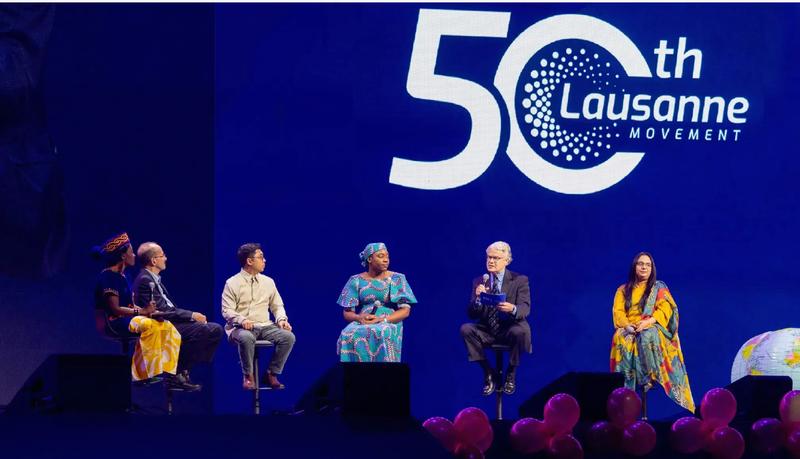
 Advent is the only church season which looks forward: to the return of our Lord Jesus Christ. It is somewhat difficult to quote Karl Barth these days, but he is right when he says “What other time or season can or will the Church ever have but that of Advent?[i] Advent is our perpetual season. We know Jesus has come, we know he will come again. It’s an appropriate season to reflect on my trip to the fourth Lausanne Congress (L4) in September 2024. The Lausanne Movement, beginning with the first congress in Lausanne in 1974 is around “uniting the global church around the unfinished task of the Great Commission.”[ii] Prior to L4 the Congress released the “State of the Great Commission” report, an in depth look at how the church is going on fulfilling the Great Commission. In the introduction it says “when the Great Commission is carried out with biblical faithfulness, it will lead to the worship of the King from all the nations of the world.”[iii] And is this not at the heart of living in Advent? We long both for the return of our King, and for all the world to rejoice when he comes again in power.
I attended the Congress with the two fold goal of learning as much as I could, and having a chance to reflect on how the church I am at can continue to be missional, locally, globally and regionally. The rejoicing of the 5,000 brothers and sisters from all the world together was a reminder of the joy we have in the Holy Spirit together. That God has gone to all the nations, and that there are people who worship Him “from the very ends of the earth” (Acts 1:8). L4 was also a reminder that we all have much to trust in the Holy Spirit for. The report notes that “only three percent of international missionaries go to the unreached (who compose 40 percent of the global population). Thus, 97 percent of missionaries are sent to people who already have gospel access.”[iv] In Australia we are all aware of the declining number of people in most churches, and that much church growth is transfer growth.
The congress sought to recognise this and speak to this, with three key themes standing out to me:
- The need for the “whole gospel”.
- The need for repentance.
- An increased prayerful reliance on the Holy Spirit.
1. The need for the “whole gospel”.
The tagline for the entire Lausanne movement is “The Whole Church taking the Whole Gospel to the Whole World.” The theme for L4 was “Let the Church declare and display Christ together.” The Lausanne Covenant which came out of the first Congress, and largely produced by John Stott separated out “Evangelism” and “Christian Social Responsibility”.[v] Even including point 5 was controversial, and continues to be controversial to some people. David Claydon writes in the Autumn/ Winter 2021 edition of Essentials this paragraph was not in the original draft, and only inserted with John Stott’s full support, after Rene Padilla and Samuel Escobar raised concerns about this, and David Claydon along with others put that wording together.
For many people this has continued this understanding has been challenging. For some it is challenging because this goes too far towards a social gospel. For others, it does not go far enough, and to say that mission consists of two things is “saying that it is possible to have evangelism without a social dimension and Christian social involvement without an evangelistic dimension.”[vi]
I note this history (hopefully briefly!) to say that at L4 most speakers leaned heavily into the idea that the Gospel & mission intertwine evangelism and social involvement. From the CEO of Lausanne, Michael Oh’s, initial address, to nearly every plenary speaker, there was an emphasis on the “Whole Gospel”. That the Gospel needs to be declared and displayed.[vii]
2. The need for repentance
This came through strongly to me in two sessions: Sarah Breul, the Brazilian Executive Director of Revive Europe’s plenary, and a presentation of the history of the Korean Church on the penultimate night.[viii] Sarah Breul spoke to the truth that only God makes revival happen, but that we can “posture ourselves for it” and pray for it in these six ways:
- Travailing prayer: Gal 4:19
- Intercession through wordless groans: Romans 8:26
- Hebrews groaned in slavery: Exodus 2:23
- Hannah weeping: 1 Sam 1:12
- Jesus in Gethsemane
- We can ask Jesus to pour out this travailing prayer in our communities
And that this removes impediments with personal and corporate repentance. She explicitly mentioned that the narrative that the missionary movement just enabled colonialism is crippling western movements. She said we need them at the table. That the Global North might be tempted to have control. And that Global South might be tempted to do things independently, but that God is building one church. We are his bride and we have been grieving him. We need to repent from corruption, from abuse and from a lack of unity.
The presentation on the history of the Korean church struck me that twice in the history of the Korean church, once before WWI and once post WWII Korean church leaders came together and repented. For various things, but especially for a lack of unity in working together for the Gospel. I know the Australian church has worked together, but have leaders ever come together to repent for our attitudes towards each other? And where our disunity has turned people away from the good news of Jesus Christ?
3. An increased prayerful reliance on the Holy Spirit
This stood out in many of the talks and sessions, but especially in the Rev Dr Femi B Adeleye, the Director of Langham Preaching Africa’s plenary. Acts was the book the morning plenary speakers spoke from, so it was an appropriate theme. As Dr Adeleye reminded us that Acts is not just about the doings of the Apostles, but about the Holy Spirit. That revivals began with prayer, and waitingon the Holy Spirit. He listed a number of Biblical and historical revival examples. He especially challenged “Those of us who believe in the work of the Holy Spirit but tend to sideline him by a mindset that depends primarily on modern management techniques, abundant finances, sufficient HR, statistics as measure of growth and impact, and the like, need to repent and depend on the Holy Spirit.”[ix]
There is much that I could write on, that I do not have space for. That there continue to be challenges for the global church in working together missionally, especially amongst evangelicals, and Pentecostals, was also clear at the Congress. Many were upset that the Statement for this Conference was released completed, with no opportunity for feedback.
In the Korean protestors outside who felt that the Lausanne movement is too inclusive of different churches, and that its perspective on homosexuality too liberal, demonstrating that even amongst Christians who are orthodox on the issue of marriage (as Lausanne is) find doctrinal issues that make it hard to work together. In the public apology the Congress sent out for Ruth Padilla DeBorst’s talk where she (very mildly) critiqued dispensationalist theology and expressed support for those suffering in Gaza, and then subsequent sending out of an open letter from her.[x]
The ecumenical attitude of the bishops at Lambeth in 1968 expresses the hope many evangelicals have: “that whatever can be done together should be done together.”[xi]
L4 demonstrated that we are still struggling, even where there is much doctrinal and cultural alignment, to work out what we can actually do together. It is not that insightful to observe that this will continue to be a significant challenge, even in Australia.
I found attending the L4 congress a blessing. I’m thankful for the invitation, and those who supported me financially to attend. I do feel that those three themes are significant and worth reflecting on for us here in Australia.
Tim Collison is the Assistant Minister at St Mark’s Camberwell, and the Secretary of EFAC Australia. He's passionate about people understanding how God is already working in their lives. In his spare time he enjoys reading and digesting trivial facts.
[i] Dogmatics (IV/3.1).
[ii] Lausanne.org/our-history, accessed 23/10/2024
[iii] State of the Great Commission, p.6. The Introduction also notes, rightly, that it is only the last 150 years or so that the Great Commission has been considered missional, rather than ecclesiological.
[iv] State of the Great Commission, p.15
[v] Points 4 & 5 respectively of the covenant. , accessed 23/10/2024
[vi] Bosch, Transforming Mission, p.405. This comes from a specific critique in the book of the Lausanne Covenant.
[vii] For obvious reasons (Dr Porter gave me a word limit), I cannot mention every speaker who said this. But you can watch many of the plenary sessions by going to Lausanne.org/accelerate or if reading is more your speed you can access all 20,000~ words of my notes at https://bruderreden.substack.com/p/lausanne-congress-day-7. No need to subscribe to my substack, just scroll to the bottom of my post and you’ll see a link to download my full notes.
[viii] The presentation “The Twelve Stones of the Korean Church” can be watched here: https://www.youtube.com/watch?v=U5yzpFbWgeI
[ix] From my notes. Cf footnote vii
[x] Gordon Preece has a more comprehensive article on this at ethos. http://www.ethos.org.au/online-resources/Engage-Mail/israel-palestine-and-lausanne-iv
[xi] Hocking, A Handbook of Parish Work, p.127
How to prepare for an outreach event
- Details
- Written by: Sarah Seabrook
 Event evangelism. Has it had its day? Not if you look at what is still happening in our churches in the School Holidays, at Easter and around Christmas. We still like to invite friends, family, neighbours, and colleagues to a gathering that isn’t church but where the hope is they might hear something of the gospel or even perhaps a very clear gospel presentation and a call to respond. Getting it right for everyone is pretty tricky. How do we make it outsider friendly? When will the talk be and for how long? What ought to happen around the talk time?
We often put a lot of effort into the event we are holding and possibly not as much effort and time into preparing ourselves beforehand. So, if you do go to an event as a believer, what should your attitude and actions be?
There are 3 things that need to inform our attitude.
1. Be convinced that God will work because Christ came to save sinners and God desires that all people be saved and come to the knowledge of the truth (1 Tim 2:4). He will work through the message of the gospel in power and the Holy Spirit (1 Thess. 5:1, 2:13) and in you ‘to fulfil every resolve for good and every work of faith by his power’ (2 Thess. 1:11-12).
2. Be assured that the message is relevant because the gospel is the means of salvation for every single person and ‘God commands all people everywhere to repent’ (Acts 17:30-31).
3. Be aware that you have a role to play because the message is always delivered in a context. The relationship between the people who are listening is significant. In a very encouraging article about how sceptics have come to Christ, the number one influence was having a close relationship with a Christian who was patient and open with them (J. Harmon, worldviewbulletin.substack.com/p/what-ilearned- from-100-atheists) The New Testament exhorts Christians to live a life/walk in a manner worthy of the gospel (eg: 1 Thess. 2:11, Titus 2:11- 14, Eph. 4:1) speaking and walking in love (Eph. 4:15, 5:2), being wise (Eph. 5:10), pleasing to God and bearing fruit (Col. 1:10). Our friends and family see how we live, and they will have questions for us. It is up to us to be ready to answer them.
As for our actions, there are 6 ‘P’ things to do – two before the event and four at the event.
Before:
1. Pray. We know it is a spiritual act to be reconciled to God, to no longer be alienated and hostile to Him (Col 1: 21-22), and to be brought out from the power of the evil one (1 John 5:19-20). Not many come to Christ in one hearing of the gospel. God often draws people to himself over a long time. This event may be one of many things God is using to awaken people. We need to remember it is the work of the Holy Spirit to convict of sin (John 16:8) and that God will open hearts for people to pay attention and believe (as happened to Lydia in Acts 16) so we ask God to do just that.
2. Practice gospel speech. At the event the speaker is going to assume that believers will continue talking about the gospel issues, but often our church people are not ready or keen to do that! A bit of forethought and training does not go astray. A church which has learnt to love and speak gospel truths to one another is going to find it a lot easier to include the outsider in that sort of conversation. We have found it particularly effective at our church to model and expect that parishioners will talk about the sermon after the service and enquire after each other’s spiritual well-being. We also have open mic times of praise for answered prayer. Peter tells us to be prepared to give an answer for the hope that we have (1Peter 3:14-15) so we need to practice. To that end, running a course or including role playing (maybe during Bible Study) where the congregants are engaged in turning conversations to Jesus is very effective. There are a variety of courses around and you can visit the Evangelism and New Churches website to find out more. (encministries.org.au)
At the event:
1. Pay attention to what is said. For a lot of us we can tune out when we listen to a talk at an event, or we tune in to the illustration and miss the point. Try putting yourself in the shoes of the outsider. Listen so that you are internally asking questions of what is said and make a mental note of something that would be a good springboard for conversation.
2. Politely engage in conversation. We are not there to verbally pound people into submission. We want to be respectful and loving, having our conversation full of grace, seasoned with salt so that we can discern how to answer people when they have questions (Col 4: 5-6).
3. Prompt conversation by asking good questions! If you look at how Jesus engaged with people, he spent a lot of time asking them questions. Questions show that you are interested in others. They also allow people to gather their thoughts and provide the space to deal with spiritual things. After all, those invited guests know they’ve come to a Christian event. They know these kinds of topics are on the table. If you apply the above you can ask: ‘I thought it was interesting how the speaker said that the world’s complexity points to God, what were your thoughts on that?’
4. And lastly, prove that what was said out the front is true in your experience. Your ‘story’ is powerful. You are living proof that what the speaker said is true. Find ways to declare God’s excellencies to those around you (1 Peter 2:9-12) so that they know the gospel is transformational knowledge. I find that people gifted in evangelism have no trouble with this part (or any of the others actually!). They delight in telling others about how God has worked in their life. However, for your ‘average’ (especially Anglo) Christian speaking up about the goodness of God to them in salvation does not come as easily. This is where ‘God talk’ is good to model and teach (see point 2 Practice Gospel Speech) so that we are ready to be engaged in it with outsiders.
Sarah Seabrook is a Trainer and Evangelist at Evangelism and New Churches (ENC) in Sydney.