
Essentials
Book Review: Religious Freedom in a Secular Age
- Details
- Written by: Michael Stead
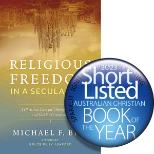 Religious Freedom in a Secular Age
Rev Dr Michael F, Bird
Zondervan, 2022
Reviewed by Bp Michael Stead
Religious Freedom has become a lightning rod of controversy in many Western societies, over whether and how religious freedom needs to be limited in order to protect the rights and freedoms of others, especially the LGBTQI+ community. Bird’s book Religious Freedom in a Secular Age was written largely between 2016 and 2020, at a time when both Australia and the wider world were increasingly embroiled in political conflicts about this, arising from the intersections of religion, government, the public square and personal belief. Bird proposes a way forward that challenges those on the political left who are antagonistic to religion freedom, and those on the political right who seek to weaponise it.
Chapters one and two seek to give a positive argument for secularism, and to distinguish this from militant secularism. Bird argues that secularism is a “post- Christendom political settlement concerned with negotiating space for religious beliefs, diverse beliefs and unbelief in a society no longer dominated by a single homogeneous religious worldview.” (15). Secularism arose out of both the Reformation and the Enlightenment, emerging as the best way to ensure religious freedom in nation states made up of diverse religious adherents living in proximity to each other, set within the framework of fresh philosophies of political rights and freedoms. Bird argues that “secularism with the separation of church and state is a genuinely noble way to carry Christianity forward in a free, democratic and pluralistic environment” (54). Bird contrasts this to militant secularism, which seeks to both to remove religion from the public square and to subject religions to regulation by the state. Secularism is based on state neutrality to religion; militant secularism seeks to neutralise religion
Chapters three, four and five collectively make a positive case for religious freedom. Bird argues that Christians should not pursue a civil religion (such as Christian Nationalism) nor should they accept the imposition of a civic totalism driven by progressive authoritarianism, but instead pursue a confident pluralism. Confident pluralism is Bird’s articulation of classic liberal pluralism, in which individuals and groups have liberty to live and act in according with their own values, and the state should only limit this liberty where necessary to protect the freedoms and rights of others. Freedom of religion is critical in this, because it is the litmus test of overall freedom in society and overall human rights. Bird argues that “the society that ensures the free exercise of religion is more likely to uphold the rights of those who are vulnerable, marginalised, and despised for being ‘other’” (114).
Chapter six and seven propose a strategy for maintaining a Christian witness in a post-Christian society. Bird briefly canvasses other possible responses (political theocracy, living as “Christians in exile”, the “Benedict Option” and “faithful presence”), before articulating his own proposal, “the Thessalonian Strategy”. Bird argues that, like the church in Thessalonica described in Acts 17, we need to turn the world upside down by a counter-cultural living out of the gospel, while holding out a more compelling worldview that Jesus, not Caesar, is Lord. As applied to our modern secular context, “the Thessalonian strategy is a two-pronged approach. First, positively, we must champion confident pluralism as a sociopolitical philosophy, demonstrate community in action, love our neighbours, and live in such a way that those who hate us cannot give a reason for their hatred. Second, negatively, we must challenge the new legal structures being erected around us, expose the hypocrisies and prejudices of those who claim to be committed to tolerance, confront incursions into religious liberty, and disrupt the secular narrative that religion is bad for social fabric.” (131) We should work together in the public square with Christians across the denominational spectrum, and with other faith groups as well. We need to be apologists who defend not only our own beliefs but also the freedom of all faiths by articulating the case for a confident pluralism and advocating for a fair secularism.
This book is a very helpful and eminently readable account of the basis of, and argument for, religious freedom in secular liberal democracies. It is not, and does not seek to be, a work of political theology. Bird’s articulation of the “Thessalonian Strategy” is not the only possible way that Christians could seek to apply biblical principles to respond in the modern secular age, but in my view Bird’s proposal is a good option for our current context. I commend it warmly.
Bishop Dr Michael Stead is the Anglican Bishop of South Sydney and Chair of Freedom for Faith.
Theological Education: Facing the Unknown
- Details
- Written by: Sydney Tooth
 One day in class a student asked me a question. While that’s standard in any class, this time I wrestled internally with how to reply. I didn’t know the answer, but should I admit that? I’m the lecturer after all. I should know these things. And I’m a woman in an overwhelmingly male profession with overwhelmingly male students. If I admit I don’t know, would that undercut my credibility? Would that justify those who think I shouldn’t be doing this? Should I try and just make something up, see if anyone calls my bluff? After a deep breath, quelling the internal monologue, I simply replied, “I’m sorry. I don’t know, but I’ll see what I can find and come back to you.” I didn’t think much of this exchange (other than fighting my own imposter syndrome) until later a student approached me to thank me for being so honest. This student then shared that thought they shouldn’t ever say “I don’t know” as someone training for ministry as they had never seen someone in church leadership do so. They said seeing someone in my position admit a lack of knowledge was surprising and freeing for them. That experience shocked and saddened me at the time, but I’ve now seen this play out repeatedly among my students. Another time, a student told me they were afraid to test out new ideas or initiatives because there was “the way” things “should” be done and because they weren’t given any permission to try and fail; it had to be a success if they were going to try anything new.
These two interactions highlight what I think are some fundamental problems that theological educators should be pushing back against. One problem I see in the current landscape is a desire to look impressive or to come across as competent and effective in ministry. This plays out in multiple ways, such as popular Christian figures claiming academic credentials they do not actually have or a desire to recruit and influence “the best and brightest.” At the same time, in many of these circles there has been an alarmingly consistent unwillingness to admit when a mistake has been made or to clearly name harm that has been done. We also see this occur where leaders neglect the perspective of those under their care, assuming that they have the “correct understanding” of things. I think those of us involved in Christian ministry and education are often afraid to admit our limitations and weaknesses. One of the most helpful books I’ve read lately is Kelly Kapic’s You’re Only Human. Kapic focuses on the very human quality of finitude and how our nature as limited beings is not a curse or something to be overcome but is instead a gift from God, the only one who is infinite and unlimited. Living out our finitude requires humility—an understanding that we cannot possibly do it all, for we were not designed to do so. It also requires patience and discipline to regard our limits as blessings rather than hindrances and to not be afraid of revealing those limitations to others.
There are challenges here for theological educators and for church leaders alike. Too often theological education can serve to puff up rather than humble. We’ve all encountered the fresh student who overfills their sermon with quotes from Calvin or appeals to “the original language” while communicating little of real pastoral value. One possible antidote to this problem could be encouraging a culture of theological educators who regularly admit their own shortcomings and limitations, thus forming the same practices in their students. I would love to see a greater emphasis across the theological education sector of training students to try new things, with wisdom, and to not be ashamed of failure. I would also love to see more church leaders give themselves and those under their care permission to show weakness.
To enact this vision, we need to ask: What’s the goal of theological education? Perhaps the obvious answer is to be equipped for ministry. There is something utilitarian in this answer, though, as if the only benefit of education is to walk away with a set of strategies and specialist knowledge that can be directly applied. At times, however, theological education does not look particularly useful.
“How will this help me practically in my ministry?” is a fair enough question, but it reveals that we have failed in communicating the real goal of education. Ask most theological educators what they want for their students and I guarantee you’ll hear something along the lines of wanting students to be personally transformed through their time at theological college. Truly valuable theological education grows students’ characters even more than their knowledge. While there are of course skills and information that are important for one’s ministry training, what is most important is letting that knowledge form one’s habits, thoughts, responses, and interactions.
Theological education can be particularly suited to exposing limitations as students grapple with deep and complex theology, battle with the new grammar of ancient languages, and are stretched by pressured deadlines and demanding assessments. The formative impact of intentionally helping students to seriously consider and value their finitude would be significant. It would force one to grow in patience, recognising that learning is a lifelong process and that it’s impossible to have all the answers or to always do the right thing. It would encourage leaders to actively seek out other perspectives and to listen well to those under their care. And, hopefully, it would open the door to a greater willingness to acknowledge our mistakes. The simple sentence, “I was wrong” can make a significant difference in the culture of a church or institution. A setting where mistakes are accepted, real apologies are quickly and sincerely offered, and clear repentance and change is at work is a place that models the power of the gospel.
For myself, I hope among everything important and helpful my students learn they learn how to say, “I don’t know.” I hope they are bold enough to acknowledge, even value, their limits and to model that for their congregants. I hope they are endlessly curious about God and about people, wanting to grow in knowledge in order to love better. I hope when they get something wrong they are clear and honest in their apologies and take active steps to right the wrong. I hope they can bear cheerfully with others’ limits and not expect more of people than is reasonable. Like what is said of Abraham in Hebrews 11:8, I hope they might be courageous enough to obey and go, even when they don’t know exactly where they’re going or how things will turn out.
Sydney Tooth (PhD, University of Edinburgh) is Lecturer in New Testament and Greek at Oak Hill College in London, UK. Her research interests lie in the Pauline Epistles, especially Thessalonians, and Christian eschatology. She is a co-host on the Two Cities Podcast.
The Symphony of Theological Education
- Details
- Written by: DR Madison Pierce
 Surely there is a sense in which nothing stands outside the concept of “theological education.” As a child, I learned the gift of love and security reflected in the actions of my parents. This taught me about God. As I grew and learned about the natural world—the rocks and seas and animals—I learned about the intricacies of creation. This taught me about God too. And I could, of course, go on forever.
The idea that we learn about God through a near limitless number of avenues is a beautiful reflection of the expansiveness of God and his reach. Nothing is beyond his grasp, and thus every moment is a moment with him
and a part of our theological education. And yet I am a professional theological educator, and I do not believe that nature walks alone equip us sufficiently for ministry.
So what is the difference? Why in a created world that reveals God should someone pursue formal theological education? And why in an era where information is so readily available? What value is added by spending countless hours sitting in a classroom, studying, reading, and writing?
These are the questions of so many today. Seminary and other forms of theological education are supposedly the ways of the past. The future is learning through being in the world and through curating one’s own educational experience online.
So, again, what makes formal theological education different? Three things come to mind.
Theological education provides access to mentors.
When a student walks into a classroom, they have an experience designed by someone with expertise. The readings and lectures—when planned thoughtfully—flow together like a perfectly crafted playlist. The architect of this experience, the professor, raises problems and solutions that shift the tone and weight of the conversation like the move between ballad and bop.
But the professor is present for the experience of this oscillation. They gently guide the student through experiences of dissonance with what they previously held to be true, and when the student has that moment of connection with the material that represents growth and understanding, the professor can affirm the progress. Other students watch and participate in this process by asking their own questions and bearing witness
Nevertheless, some professors do not curate these kinds of experiences, and they do not deserve to be called “mentor.” They understand their primary role to be one of content delivery, and a student would learn just as much from that professor if they found their content in a video on the internet. Mentoring takes time and demands love in the classroom and beyond.
Theological education provides access to peers.
Although I myself am a professor (and hopefully a mentor), I firmly believe that the most important people in my students’ education are their peers. In the illustration I provided above, I shared a relatively vertical picture of education—a professor teaches a student—and although I named the presence of others, I gave the impression that they were bystanders.
But the best “lectures” that I have ever delivered were not me at a lectern and students voicing their assent to my brilliant ideas; they hardly qualify as lectures at all. On those days the students internalised the material. They engaged together—each from their own perspectives— and they participated in a dialogue. On those days, I simply facilitated a conversation, offering clarifications and raising questions when necessary. At the risk of belabouring my musical metaphors, on those days, I sang the melody, and my students joined me in rich harmonies. Their voices add fullness and diversity.
Even so, some educational environments do not always celebrate and facilitate the diversity of their students. They value assimilation—catechesis is both cultural and doctrinal. These environments do not welcome students to share who they are within the classroom and thus allow meaningful peer to peer learning. In those environments, peers reinforce the professor’s position because it is the only one that is valid.
Theological education provides access to formational experiences.
No matter how rich one’s classroom experience may be, theological education demands other opportunities for learning and spiritual formation. Many of these experiences draw upon the presence of good mentors and peers, but they centre spiritual growth rather than intellectual growth.
For the new information that students receive to sink deep within their bones, they must see it in action. In chapel, they hear preaching that reflects the goodness of God in a particular text in Scripture. This brings together their homiletics, biblical studies, and systematic theology lectures, and more importantly, it nourishes their souls. In their dining hall, they eat with students from other backgrounds; they break bread and pray for one another. They model charity, and they build relationships that will hold them together during in-class disagreements. Similarly, in the hallways, students hear professors laughing with colleagues and other students, and they see them with their children and spouses. In some environments, faculty, staff, and students are neighbours. Together they serve in local government and provide for the marginalised. Through this, they attest to God’s redemptive work in the world. These experiences also bear witness to the gifts God has bestowed to those in our midst. Hearing a peer singing or preaching or praying allows us to give thanks for how they have been equipped by God. Likewise, standing alongside those gifted in hospitality and exhortation presses us to develop those gifts in ourselves. But some theological programs have little to offer students outside the classroom. Students grow in knowledge and understanding of a certain kind, but their education is not embodied. The ties between the classroom and the church remain invisible.
When these benefits—good encounters with mentors and peers as well as other shared experiences—are not present, the difference between formal and informal theological education is diminished because they press us beyond our natural associations. In other words, they give us access to new things.
The breadth of this may vary depending on where our theological education takes place, but even in small denominational training schools, you should expect to encounter those whom you would not meet otherwise— people with knowledge of other theological traditions, regions, cultural backgrounds, and life experiences. But the limitations in certain styles and venues of theological education require students to choose their environments carefully. Practical considerations, such as degree length and cost, cannot—and should not—be eliminated. But formal theological education is a once-ina- lifetime opportunity that will lay the foundation for decades of ministry. In some cases, waiting a year or two (or five) might provide additional financial stability or an opportunity to relocate for residential education. These investments truly are not possible for everyone, but they should be considered by all desiring to pursue ministry.
At its best, formal theological education provides additional categories and language for our informal theological education. Our mentors and friends help us to put language to what we have observed in the world. And we worship together.
Madison N. Pierce (PhD, Durham University) is Associate Professor of New Testament at Western Theological Seminary (Holland, MI, USA). She also is New Testament Editor at Reviews of Biblical and Early Christian Studies and a co-host of The Two Cities podcast. Her research interests are the Epistle to the Hebrews and early Christian interpretation.
Essentials - Summer 2023
- Details
- Written by: Gavin Perkins
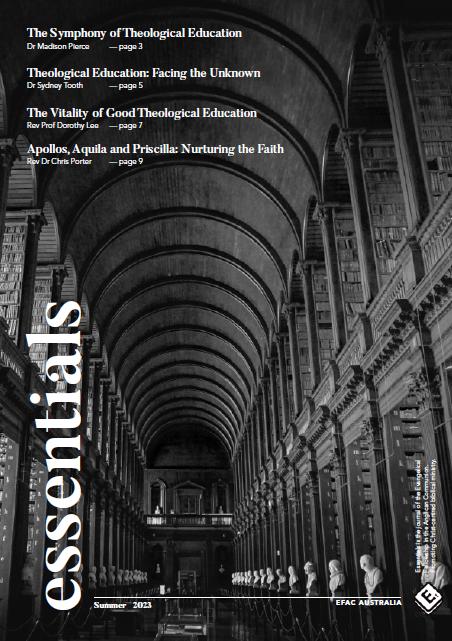
Essentials Summer 2023 pdf (2MB)
Essentials Spring 2023 pdf (2MB)
Essentials Winter 2023 pdf (2MB)
Essentials Autumn 2023 pdf (2MB)
Essentials Summer 2022 pdf (8MB)
Essentials Spring 2022 pdf (4MB)
Essentials Winter 2022 pdf (4MB)
Essentials Autumn 2022 pdf (1MB)
Essentials Summer2021 pdf (3MB)
Essentials Spring 2021 pdf (3MB)
Essentials Winter 2021 pdf (3MB)
Essentials Summer 2020 pdf (3MB)
Essentials Spring 2020 pdf (1MB)
Essentials Winter 2020 pdf (1MB)
Essentials Autumn 2020 pdf (4MB)
Essentials Summer 2019 pdf (8MB)
Essentials Spring 2019 pdf (5MB)
Essentials Winter 2019 pdf (5MB)
Essentials Autumn 2019 pdf (5MB)
Essentials Summer 2018 pdf (5MB)
Essentials Spring 2018 pdf (5MB)
Essentials Winter 2018 pdf (5MB)
Essentials Autumn 2018 pdf (5MB)
Training in Evangelism Today
- Details
- Written by: Gavin Perkins
 How do we best train people in personal evangelism today?
In a recent survey of our church it emerged that the vast majority saw personal evangelism as their individual responsibility (83%). It seems that very few had bought the line that evangelism was only for the specialists or the especially gifted. The average parishioner knew it was at least partly their job. Yet, in the same survey it also emerged that at least half that number had virtually no spiritual conversations with non-Christians in the previous year. Not unexpectedly such a situation leads to an ongoing and constant low-level sense of failure and frustration: “I want to share Christ, I know I ought to share Christ, and yet I rarely do it”. In the same survey most (84%) felt comfortable to clearly explain the gospel, and whether we agree with this assessment matters little in regards to a conclusion that a sense of inability to share the gospel does not represent a primary barrier to speaking.
Editorial Summer 2023
- Details
- Written by: Gavin Perkins
Training and equipping Christian ministers, workers, and the church is the endeavour of the whole of the church working together. From ministers to expound scriptures and pastorally care for their congregations, mentors to come alongside and together with sisters and brothers in all stages of life, and those extra-congregational and para- church groups and organisations who support the building up of local churches and mission.
However, in this ecosystem the work of theological colleges is often shrouded in mystery, either seen as some hallowed ivory tower or a strange realm far removed from the realities of the local church. Indeed, at times there has been significant distrust of theological colleges for these very reasons.
Yet the work of theological colleges is important on two fronts, and neither are of the chalk and talk variety. First, the work of theological education helps our churches to see the breadth of God’s mission for His world, across the scope of human history and through the various means He engages through the church. Second, as a third space outside of the local church it draws together members of local churches to gather around a shared goal of understanding God better. Both of these —amongst many more—aim to keep us from myopia and also from the challenges of hubris.
This edition of Essentials aims to peel back the curtain somewhat, to reveal the great scope of theological education around our world.
Unfortunately—and ironically—the length of this issue is slightly shorter than normal, owing to an eleventh hour withdrawal of one article, due to a very sad situation in a theological college which only reinforces the distrust of these institutions.
Nevertheless, those articles that remain serve to lift our eyes to the scope of God’s work in theological education.
Rev Dr Christopher Porter, Melbourne Editor
Editorial Spring 2023
- Details
- Written by: Gavin Perkins
The theme of this edition of Essentials is evangelism.
The consensus in our context, as observed by Julie-anne Laird, is that when it comes to evangelism things are not going well. It is into that space that we seek to provide some encouragement, inspiration, and hopefully several ways forward.
There are many tasks and projects with which we can keep ourselves busy that are far easier than evangelism, and in the contested space of the post-Christendom West it is an ever-present temptation to focus on those easier things. However, to do so would be to lose sight of the glorious commission given us by Christ.
In this edition Peter Jensen’s article on GAFCON does far more than rehearse the story of a movement, it is a call and a challenge to all evangelical Anglicans to keep gospel mission at the heart of what we do.