
Essentials
Essentials 2024
- Details
- Written by: Chris Appleby
To look through the collection, see the article list on the left.
Publishing of Essentials is made possible by a paid membership so if you're not currently a paid-up member/subscriber we encourage you to become one so we can continue to fund this very worthwhile journal. Our Membership form is here.
Book Review: Raising Tech-Healthy Humans
- Details
- Written by: Mark Simon
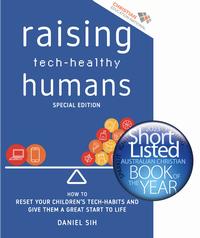 Raising Tech-Healthy Humans
DANIEL SIH
Publish Central, 2023
REVIEWED BY MARK SIMON
Daniel Sih’s book for parents on shaping the technology habits of their children is just what it claims to be – helpful guidance for parents grappling with technology usage in the modern world. Every parent I know grapples with this area. Countless studies and articles highlight the potential dangers of excessive technology use by children (and adults), and Sih includes brief highlights of some potential harms. So the need for guidance in this area is clear, and Sih serves up a range of practical strategies underpinned by a foundational principle: parenting is about raising adults, not children. Therefore, “the role of a parent is to love, mentor and equip their children with the physical, emotional and psychological experiences they need to become adults.” (p.7) The strategies, perspectives and reflection questions he presents all contribute to a parent’s ability to raise tech-healthy adults, not just to minimise arguments about screen time.
A brief chapter on brain development and function highlights the reasons children so easily get addicted to technology (it engages the ‘downstairs brain’ – impulsive, emotional, fight/flight responses), and introduces a distinction between passive and interactive media. Passive media (such as TV and movies) has been around for decades, but more recently the proliferation of interactive media (such as video gaming and social media) encourages users to ‘lean-forward’ to engage with it, and overstimulates the downstairs brain, making it the more problematic form of technology for healthy brain development.
The core of the book is a framework based on the acronym ‘Starter’. Start with self; Take it slowly; Age appropriateness; Regular talk; Tech-healthy rhythms; Encourage adventures; Rely on others. For each of these principles, Sih combines research and insights with practical suggestions. The book is a short and easy read – perfect for time-poor, technology-saturated parents. It includes an appendix ‘100 Fun Non-Screen Activities to do with Kids’ – which reminds us all that the best things in life are free (teddy bear picnics, dress-ups, board games, exercising together, music, water fights…)
One interesting feature of the book as a short-listed finalist in the Australian Christian Book of the Year Awards is that it doesn’t present any explicitly Christian perspectives on technology usage in the family. There are plenty of implicit priorities that Christian families would affirm (such as mentoring, and mutual accountability), but the book got me wondering whether parenting in a Christian context adds any distinctive dynamics or goals into the mix.
The book is also best suited to parents of younger children and pre-teens, since it acknowledges the capacity to impact or radically change course with teenagers who have already become set in unhealthy habits requires a different approach. Despite these minor quibbles, there is much benefit to be gained by readers of Sih’s book (not just parents, but anyone who uses technology).
Rev Dr Mark Simon is Lecturer in New Testament and Research Associate at Ridley College, and minister of St Luke’s Vermont.
Book Review: How to Find Yourself: Why looking inwards is not the answer
- Details
- Written by: Karen Hale
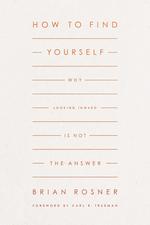 How to Find Yourself: Why looking inwards is not the answer
REV DR BRIAN S. ROSNER
Crossway, 2022
REVIEWED BY KAREN HALE
In his previous book Known by God A biblical theology of personal identity (2017) Brian Rosner (Principal, Ridley College) outlines a compelling argument for our identity being directly linked to being known by God. This latest book is a more accessible account exploring our identity and the question ‘Who am I? In the west the answer to this question is solved by looking inward. Rosner critiques this way of working out our identity and explores the many short comings of this view. He then seeks to provide an alternative of seeing our identity not primarily from within but by looking upwards to God. This view of looking inward is called expressive individualism. It stresses that if you want to know yourself and be happy then you need to look inward. Personal freedom is prized above all else and we should celebrate everyone’s quest for self-expression. The positives of this view are briefly outlined by Rosner before addressing a thoughtful critique.
The question of identity is not new but the markers that we use to express our identity have changed significantly over the last 50 years. Today we use fewer identity markers to describe who we are. Rosner challenges us to ask 5 important questions of expressive individualism. Does it help us deal with suffering, our pride, the poor and weak, injustice and our happiness. Rosner argues that this way of finding our identity is both fragile and faulty.
By looking at some ancient Biblical texts Brian Rosner explores how we have seen the fragility and faults of humans in seeking to look within to define their identity. In the story of Adam and Eve we find humans thinking they can work out their own path and that they know best. This has terrible consequences, and it is only in looking at Jesus that we finally see a human who is tempted to trust themselves and yet trusts God. Even though today we are told to look inward, Rosner rightly identifies that this is not the full view. We have never been more obsessed with looking around us. Through social media, in particular, we compare and contrast ourselves to everyone else. Rosner suggests that the missing piece we are yearning for is looking upwards. True identity is beyond us. He suggests that we are a social story telling beings that want to worship. From when we are babies to the end of life we live in society and are shaped by all the relationships that we have. To know yourself you need to be known. Known by others but more importantly known by God.
Rosner contends that today the narrative that we inhabit is secular materialism. Historically this has come from the enlightenment, a story of progress, freedom from the dark past. We then had the sexual revolution, a story of freedom for pleasure. Now we see the story of consumerism, we are what we buy. This seems to tap into financial security and enjoyment. All these stories have failed us, as they do not take seriously the impact of personal freedoms nor the capacity of humans to do harm. There has been some acknowledgement of these pitfalls and so another story has emerged that highlights social justice. This is a strong voice at present. It is a very black and white view of social justice and fails to take into account the complexity of many issues.
In contrast to secular materialism Brian Rosner offers a positive way forward. We are part of a bigger story, God’s story, which is particularly seen in Jesus’ story. He then asks the same questions of this view. Can this help us with suffering, our pride, the poor and weak, injustice and happiness. We don’t just believe God’s story we inhabit this story.
The final part of the book looks at how to live within this story. It is a paradox that you are told to lose yourself to be able to find yourself. We don’t look in, but to Christ to truly find ourselves. We are encouraged to trust in Jesus and to immerse ourselves in his story, a story with love at the centre.
I highly commend this book as it seeks to help us engage with the complex issue of our identity. In a world that currently has fewer identity markers and yet espouses greater freedom that does not seem to deliver. Identity crisis seems to be occurring at every age today from children to the elderly. The story we have been sold of expressive individualism doesn’t seem to be delivering on the freedoms it seems to promise. Instead, people are more confused than ever. Brian Rosner provides a compelling case for seeing our identity within God’s story. The story of the good news of Jesus. It is a bigger story beyond ourselves but one in which we get to live. We are part of this narrative, and it is a story that is rooted in love. To be truly known and loved by God gives us an identity that is able to withstand the complexities of life.
Karen Hale is Teacher of Religious Education and Science at Ivanhoe Girls’ Grammar School.
Apollos, Aquila and Priscilla: Nurturing the Faith through Teaching
- Details
- Written by: Chris Porter
 In the vibrant narrative of early Christian communities found in the book of Acts, Luke introduces us to Apollos in Acts 18:24-26, an evidently eloquent and fervent disciple whose story gives us some insight into education and mentoring in the early church. Apollos, hailing from Alexandria, enters Ephesus, equipped with a fervent spirit and a thorough knowledge of the Scriptures. However, Luke draws out a crucial revelation for us: “he knew only the baptism of John." Despite his evident zeal and scriptural competence, Apollos stands at the threshold of deeper understanding, highlighting the significance of ongoing theological education and the community of faith.
This is particularly shown in the teaching intervention orchestrated by Aquila and Priscilla, a couple known for tent making ministry and association with the Apostle Paul. Recognising what was lacking in Apollos' knowledge, they take him aside and "explain to him the way of God more accurately." Aquila and Priscilla here exemplify the vital role of teaching, and spiritual mentoring, within the Christian community. Their act of taking Apollos aside signifies a deliberate and personal investment in his theological education underscoring that knowledge—even substantial knowledge—can benefit from the guidance of seasoned mentors.
We can also see here the communal nature of theological education. The act of taking Apollos aside implies an intimate, one-on-one setting where the complexities of faith are unpacked through dialogue, explanation, and patient instruction, emphasising the importance of personal engagement in the process of nurturing theological understanding. But from our knowledge of ancient education the home environment is also strongly communal, and if we have any doubt we see in verse 27 that the “brothers and sisters encouraged [Apollos] and wrote to the disciples [in Achaia]” to commend him.
Indeed, Apollos goes on to Corinth where Paul describes him as nurturing (watering) the faith of the church (1 Cor 3:6).
This relationship of learner and teacher deepens the understanding of the church, and challenges the common perception that teaching is a one-sided endeavour of “chalk and talk.”
In reflecting on this early Christian community, we should be prompted to evaluate our own roles in the teaching and learning dynamics within our churches and communities. Do we actively seek opportunities to teach and be taught? Are we fostering an environment where theological study and instruction is approached with humility and a desire for mutual growth?
The narrative of Apollos' encounter with Aquila and Priscilla in Acts still serves as a pattern for believers today—a call to engage in intentional, personal teaching that nurtures the growth of theological understanding and relationship. Luke encourages us to view teaching as a collaborative and transformative act, fostering a community where knowledge is shared, humility is cultivated, and the journey of faith is enriched through intentional, personalised instruction.
Chris Porter (PhD, Ridley College) is the Post-Doctoral Research Fellow at Trinity College Theological School (Melbourne). His research interests are in the social-identities of the early church, the sociology of schism, the Gospel of John, and is currently writing a commentary on Acts. He serves on several Christian for-purpose boards, and is a regular co-host on the Two Cities Podcast.
The Vitality of Good Theological Education
- Details
- Written by: Dorothy Lee
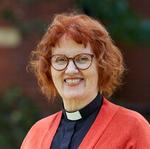 A strong and solid theological education for clergy is vital for the life of the church.
There are those, I know, who would disagree, arguing that skills in preaching, leading liturgy, administering the sacraments and engaging in pastoral care is all that’s required, without adding all that “irrelevant academic stuff.” These skills can be gained in all kinds of ways, surely, that don’t require the cost and sacrifice of three plus years of academic study.
There is more than one response to this argument. In the first place, the training of minds — the academic side — is not an optional extra. Jesus calls us to love God with our whole being, including our minds (Mk 12:29). Our minds need to be trained, focussed, shaped. Anti-intellectualism is dangerous and leads to people who don’t think issues through but who are led by emotions, emotions they don’t necessarily understand. Theological education is not attempting to turn students into formal academics. Instead, it’s opening up worlds that will engage, shape and broaden the mind — and also, therefore, the heart.
Secondly, the purpose of theological education is not primarily to teach skills. Its aim is the formation, and even transformation, of those who believe they have a vocation to holy orders, and other ministries. This formation has a number of crucial elements. It means being formed into a kind of leadership that is profoundly theological and spiritual which begins with the study of the Scriptures. Understanding the Bible is not simply a question of my response to individual passages and how they connect to my life. It’s far bigger than that.
The study of Scripture involves learning at least one biblical language — in most cases, this will be Greek but Hebrew is also encouraged — so that the sacred text can be read in the original languages, with awareness that every translation has its own bias. It means studying the social and religious contexts out of which the texts arise and which enable us to discern meaning for our very different contexts. It involves exploring the different genres of literature that the Bible contains (on a wide spectrum) and the literary ways in which the story or the discourse or the poetry is told, to tell the Bible story in our own diverse environments. It includes developing an awareness of the diversity of Scripture within its overarching unity, enabling it to speak to many different settings and situations today.
Equally important is knowing the development of theology in the historical life and experience of the church. Understanding the ecumenical creeds, for example, enables us to grasp the centrality of affirming God as holy Trinity — Father, Son, and Holy Spirit — and also Christ as both divine and human. Learning the history of these debates in those crucial early centuries, when the church was so often under persecution, is critical for our grasp of the theology. Learning about the Reformations of the sixteenth century helps us to grasp the centrality of grace within the life.
One of the things church history teaches us is how different contexts, cultures and genders bring their own insights to bear on studying Scripture. Our Western context has often ignored the Eastern church which is every bit as old and revered as ours. We’ve also tended to assume whiteness as the norm, when in fact Christians across Africa and Asia vastly outnumber us. We’ve assumed maleness to be another norm, setting aside the insights that women bring to theology and spirituality. Theological education expands our horizons beyond the narrow bounds of Western white male structures and symbolism.
On a somewhat more practical level, theological education gives insight into spirituality, sociology, psychology, missiology and pastoral care. Students need to learn how society functions and how the human mind and emotions work. Theological education unveils the rich veins of Christian spirituality down through the ages. It teaches how mission works — how it has sometimes failed in the past by being associated with colonialism, and how it needs to become contextualised and focussed not only on individual conversion but also on social transformation and care for our endangered environment. It teaches the elements of pastoral care and the theology which should undergird it.
Yes, there are indeed skills to be learned in the process of theological education. But these skills are the outward manifestation of a profound sense of theology, an awareness of where the evangelical centre of our faith lies. That centre is a broad place that incorporates not just the individual but also the community and indeed the whole creation.
In one sense, such learning is a life-long process and not just for the formal years of theological education. Our clergy and ministers need to be aware of the need to continue their own education beyond graduation and ordination. They need to be learners all their lives. The word ‘disciple’ means a student and we never move beyond that role as followers of Jesus Christ. We need always to be open to learn, to discover new ways of understanding the faith, new insights from the Scriptures, new abilities to comprehend the world we live in. The model of Mary of Bethany sitting at the feet of Jesus to learn from him, above all other duties, is a wonderful picture of where the centre lies in discipleship and ministry (Lk 10:38-42).
It's true that life is much more complex now and the old model of ordinands living together for three or four years while they study and pray is no longer viable. The church can’t afford it and ordinands are often married with children and don’t have the same freedoms. We need to think in new and imaginative ways about how that formation can happen, without forsaking academic and theological rigour, and without abandoning the focus on learning together in community.
However we do it, in what shape or form for the future, theological education will remain essential for the vigour and well-being of the church in its God-given tasks of worship and mission.
Dorothy Lee is Stewart Research Professor of New Testament at Trinity College Theological School (Melbourne) with a particular interest in the narrative and structure of the Gospels—especially the Gospel of John—and women’s ministry in the New Testament.
Book Review: The Future is Bivocational
- Details
- Written by: Angus Monro
The Future is Bivocational
Andrew Hamilton
Arkhouse Press 2022
Reviewed by Rev Angus Monro
Andrew Hamilton wants to goad, encourage and guide pastors and church-planters to broaden their horizons beyond the standard “professional minister” model, and is convinced that bivocationality needs to become normal. So, this book – shortlisted for SparkLit’s 2023 Christian Book of the Year - is designed for you if you are:
- considering a future in pastoral ministry or church- planting
- struggling to connect meaningfully with your flock’s everyday experiences
- wanting to radically deepen your community engagement
- looking for a way to circumvent that inevitable conversation-stopper (“I’m a minister”)
- desiring your members to take more ministry
- operating bivocationally already but struggling to make it work
- or in a financially struggling parish.
Book Review Behind the Tears
- Details
- Written by: Michelle Monro
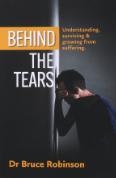 Behind the Tears: Understanding, Surviving and Growing from Suffering
Dr Bruce Robinson
Macsis Publishing, 2023
Reviewed by Michelle Monro
“Behind the Tears” is a book for those who are suffering, have suffered and are caring for those who suffer… in other words, for all of us.
If the reader is looking for a rich theological exploration of theodicy; or a radically transformative and perfectly argued perspective on godly suffering, this book should not be your first port of call. Dr Bruce Robinson is a medical doctor, not a theologian, and he readily admits that there is a wealth of other resources that address the question of suffering from an academic viewpoint.
Yet this is where the book’s value is to be found. Not only has the author spent many years journeying professionally beside those who suffer, Dr Robinson has personally experienced pain and loss on many different levels. The breadth and depth of his experience enable Dr Robinson to write on the topic of suffering with compassionate clarity.