
Parish Ministry
Hate Speech laws threaten Religious Freedom
- Details
- Written by: Michael Stead
 Laws that outlaw speech are the biggest threat to religious freedom in Australia at the moment.
There has been a recent explosion of laws that restrict speech. In the 34 years from 1989-2023, there were 19 Bills that imposed restrictions on speech. The same number of Bills have been passed in the last 26 months.
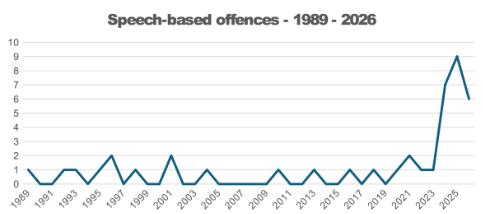
These new laws prohibit or regulate hate speech, vilification, right wing ideology, conversion practices and harmful online content.
The particular concern for religious freedom arises from moves to suppress speech merely on the basis that is hateful or offensive. Compounding this, in some jurisdictions this is assessed subjectively or from the perspective of a member of the target group. This means that hate speech becomes ‘speech that I find hateful’ and offensive speech is ‘speech that offends me’.
In the UK, it is a criminal offence to use an ‘electronic communications network’ (e.g., Facebook or WhatsApp) to send a message that is ‘grossly offensive’ or which is ‘for the purpose of causing annoyance, inconvenience or needless anxiety’.[i] In April 2025, the Times reported that the UK police were making 30 arrests a day for offensive online messages.[ii] Furthermore, under Section 4A of the Public Order Act 1986 it is a crime to use ‘threatening, abusive or insulting words’ ‘with intent to cause a person harassment, alarm or distress’. There were 11,876 prosecutions under this section in 2024/25.[iii] There have been a wave of cases of Christian street-preachers who have been arrested under this provision, including for making biblical statements about homosexuality,[iv] alleged ‘misgendering’[v] and for preaching criticising the Quran that caused distress to Muslims.[vi] The fact that in many cases the charges were eventually dropped does not undo the gross imposition on religious free speech at the point of arrest.
Criminalising so called ‘hate-speech’ is wrong, because it undercuts the principles of tolerance that underpin our western liberal democracy. It blurs the distinction between speech that is awful and speech that is unlawful. Our laws impose two types of appropriate limits on speech.
The criminal law is the mechanism used by the state to protect people against attacks on themselves or their property. In the same way that attempting to commit a crime or conspiracy to commit a crime is subject to the same maximum penalty as the crime itself, speech that incites others to commit a crime is itself a crime, and speech that threatens a criminal act is itself a crime. But if the underlying action or position is not a crime, then speech advocating for that action or position should not be a crime either.
The civil law provides a mechanism to provide redress where the actions of one party have caused harm to another. This includes speech - what I say might have consequences in defamation law, intellectual property law and anti-discrimination law. Civil law doesn’t criminalise these kinds of speech. Rather, it holds people accountable for the consequences of their speech – for slanderous comments that cause reputational harm, for example.
But if speech is not criminal because it threatens a crime or incites a crime, and there isn’t a personal or economic harm caused by that speech that warrants civil redress, then the state does not have a role to play in regulating speech.
Instead, we must tolerate speech that is merely awful, but not unlawful. Toleration is a core tenet of a liberal democracy. It is the decision not to prohibit or repress the words or actions of others that I find incorrect, undesirable or objectionable. It is captured aptly by the most famous thing Voltaire never said ‘I disapprove of what you say, but I will defend to the death your right to say it’. Historically, this Enlightenment principle arose from a religious war in the 17th century. After 30 brutal years of Protestants and Catholics killing each other over religious beliefs, people realised that the imposition of faith by force cannot work, and that religious toleration of different beliefs was essential for society. Out of this religious toleration develops the modern idea that freedom of thought, conscience and belief is intrinsic to what it is to be human.
The framework above highlights two key problems in recent legislative attempts to regulate speech.
PROBLEM 1: CRIMINALISING SPEECH WHICH SHOULD NOT BE A CRIME.
As noted above, Inciting violence is (and should be) a crime because violence is a crime. Inciting hatred should not be a crime, because it is not a crime to hate someone. Instead, inciting hatred – otherwise known as vilification – is (and should be) a civil offence (see further below). However, there have been recent moves to introduce criminal vilification provisions. In response to rising antisemitism, the NSW Government added s.93ZAA to the Crimes Act. Section 93ZAA makes it an offence, punishable by up to 2 years in prison, to intentionally incite hatred on the ground of race causing a reasonable member of the target group to ‘fear harassment, intimidation or violence’ or ‘fear for [their] safety.’
A criminal provision for hate crimes should not be determined by the fear of a reasonable member of the target group. It is unclear whether the breadth of ‘harassment, intimidation or violence’ include subjective psychological states or feelings – e.g., ‘I felt intimidated’ or ‘I felt harassed’. If so, then preachers beware! Suppose a preacher proclaims ‘Jesus is the only way to salvation. Being a Muslim won’t save you. Being Jewish won’t save you’. Would a reasonable Jew be ‘fearful’ about their eternal salvation, or feel intimidated by this? If so, then the preacher has committed a criminal offence. Section 93ZAA criminalises the exclusive claims to eternal salvation of different religions.
This concern is compounded if the protected attributes are expanded beyond race to include sexual orientation and gender identity. Traditional Biblical teaching on sexual ethics might be viewed by a member of the LGBTQI+ community as ‘intimidating’ or ‘harassing’, but this does not therefore make it appropriate to restrict free speech or the ability of a Christian church, school or parents from teaching or preaching in accordance with their doctrines, tenets and beliefs.
In January 2026, the Federal government also sought to introduce a criminal vilification provision as part of the Combatting Antisemitism Hate Extremism Bill 2026. Section 80.2BF made it an offence, punishable by up to 5 years imprisonment, to publicly promote or incite racial hatred, where ‘conduct would, in all the circumstances, cause a reasonable person who is the target, or a member of the target group, to be intimidated, to fear harassment or violence, or to fear for their safety.’ It is extraordinary that a sentence of imprisonment of up to 5 years could arise from speech that a person merely regards as ‘intimidating’ or ‘harassing’. Like section 93ZAA, this clause was directed at racial vilification, but government ministers signalled a willingness for this to be expanded to other protected attributes.
This caused provoked widespread opposition from faith leaders and free-speech advocates, and this part of the Bill was withdrawn by the government.
PROBLEM 2: ‘LOW BAR’ CIVIL OFFENCES FOR SPEECH OFFENCES.
Traditionally, civil vilification laws had a ‘high bar’. Legislation defines vilification to mean inciting hatred, serious contempt or severe ridicule. The high threshold established by this test is consistent with the role of the civil law – to provide redress where someone’s actions cause direct and material harm to another person. The law does not – and should not – exist to protect us against hurt feelings or being offended.
But there are unfortunate examples where legislators have got this wrong and made it an offence to offend or insult. In 1995, s.18C was added to the Racial Discrimination Act. Section 18C of the Racial Discrimination Act makes it unlawful for someone to do an act that is reasonably likely to ‘offend, insult, humiliate or intimidate’ someone because of their race or ethnicity.
Section 17 of the Tasmanian Anti-Discrimination Act 1998 prohibits ‘conduct which offends, humiliates, intimidates, insults or ridicules another person’ where a ‘reasonable person… would have anticipated that the other person would be offended, humiliated, intimidated, insulted or ridiculed.’ In 2014, the range of protected attributes in the Act was expanded to include, for example, gender identity. This enabled Martine Delaney, a transgender activist and Greens candidate to lodge a complaint with the Tasmanian Anti-Discrimination Commission in late 2015 against Tasmanian Catholic Archbishop Julian Porteous. The complaint was in relation to the distribution by Porteous of a leaflet entitled Don’t Mess with Marriage to the families of those attending Catholic school in Tasmania, to inform them of the church’s position on the meaning of marriage. The complaints process limited Archbishop Porteous’ ability to participate in advocating for the Catholic doctrine of marriage in the public square in the lead up to the postal vote about same-sex marriage. The complaints process dragged on for 9 months, until it was withdrawn by the complainant.[vii]
‘Insult’ and ‘offend’ provisions such as these are used by activists to silence Christians in the public square. They encourage confected outrage so as to claim victim status, which then engages the machinery of the complaints process against an opponent. Even if the complaint is ultimately unsuccessful, the process is the punishment. As Christians, what should we do in response to laws like this that threaten religious freedom?
We should strenuously oppose laws that inappropriately restrict speech. Neither criminal nor civil law should be used to impose a particular vision of the social good. We have to preserve the space for legitimate disagreement and dissent. Laws restricting speech should not be used to impose a uniformity of ideology regarding the world.
The right response to the awful speech is not to make it unlawful, and not to suppress it by deplatforming people or ‘take down’ orders for online content, but to counter it with good speech. A commitment to free speech entails a commitment to robust public debate with civility that is prepared to call out awful speech. A commitment to tolerance doesn’t mean that we applaud bad speech or stand passively on the sidelines.
The antidote to bad speech is not to suppress it but to challenge it in the free market of ideas through robust public debate, so that the truth may prevail.
The Right Reverend Dr Michael Stead is Bishop of South Sydney
[i]Section 127 of the Communications Act 2003; non-digital communication is similarly coverer by s.1 of the Malicious Communications Act 1988.
[ii] https://lordslibrary.parliament.uk/select-communicationsoffences-and-concerns-over-free-speech/
[iii] https://www.parallelparliament.co.uk/question/HL10453/public-order-offences-arrests-and-convictions
[iv] https://www.christian.org.uk/case/john-craven/
[v] https://christianconcern.com/news/win-for-street-preacher-asmisgendering-conviction-overturned/
[vi] https://persecution.org/2025/03/14/british-preacher-whopublicly-criticized-quran-found-not-guilty-of-hate-crime/
[vii] Section 127 of the Communications Act 2003; non-digital communication is similarly coverer by s.1 of the Malicious Communications Act 1988.
In God's Image – A Confession About Human Nature
- Details
- Written by: Michael F. Bird
 I’ve long argued that theological anthropology is the # 1 issue that Christians must wrestle with today. Whether we are talking about sexuality, gender identity, transgenderism, transhumanism, artificial intelligence, disability, or even the soul, it is all comes down to “what is a human being?” What follows below is my Beta-Test of some ideas on theological anthropology.
Now, this is spectacularly hard and I might be spectacularly wrong, because some of these issues are very complex, they defy simplistic analyses or resolution, and they involve a combination of biology, psychology, and sociology. Or else, many theologians within the Christian tradition might legitimately dispute the validity or cogency of the various assertions I make below. But these are the issues that we simply must address today in the second quarter of the twenty-first century.
I’m using a format of we confess, we affirm, we deny, and we commit. I hope it reads well - but remember, it is only a first draft!
THE IMAGE OF GOD
We confess that all human beings are created in the image of God, bearing inherent dignity, worth, and value that cannot be diminished or destroyed (Genesis 1:27-28).
We affirm that by God's grace, this image is present in every person from conception to death.
How the Churches are missing out on their mission to the aged
- Details
- Written by: Mike Flynn
 Doug had been a decorated, high-ranking military leader, an experienced and inventive engineer, and a determined Christian from Presbyterian roots. It was he who first explained to me that when ministers sought to close traditional worship in the name of relevance and outreach, the message they conveyed to the people who depended on that worship was the Christian truths they had been taught in their youth were no longer considered true.
Doug described the harm he had seen this produce, as people left their churches of many years, their faith in Christ damaged at a time in life when maintaining confidence in the world to come was vitally important. I have met many of these traditional refugees, angry and wounded. Most could not articulate as well as Doug what has hurt them but changing and devaluing their worship traditions and personal history had damaged their faith as effectively as teaching them heresy. Their confidence in what they were first taught had been lost.
However, as pastors, we also know other ways of diagnosing the faith struggles of older church members. Sometimes there are older traditionalists who are unable to adapt. Some act as gatekeepers against gospel mission because their congregations lost their gospel heart to the optimistic naivety of old-school liberal teaching decades ago. The result was these churches eventually became about themselves. Their history and community mattered more than the mission, truth and glory of God’s gospel.
Pastors who want to see these churches grow feel compelled not only to stop liberal teaching but the traditions it became associated with. These pastors will then swim against a strong tide to update the style of worship in the name of mission and growth. In my denomination these efforts are often not welcomed and will mostly be costly for both the pastor and the congregation, too often ending in mutual frustration.
But, there is evidence we can do better and that it is possible to turn our ministry to older people and declining congregations into fruitful gospel opportunity. After all, if we are students of the Bible we know we are taught to treat our elders with respect[i], and respond to our opponents with gentleness,[ii] even love.[iii] I have seen this approach create an invitation that is more likely to help some turn towards God during a critical and confronting time of life. However, grace and graciousness will also confirm the hardness of others. Nevertheless, to be fruitful in any mission to older people, I suggest we begin our diagnosis of their faith by first describing, valuing, and nurturing them according to Paul’s advice in Romans 14 rather than rebuking or dismissing them by drawing parallels with Romans 2.
ROMANS 14
In Romans 14, Paul continues the application of the gospel (Romans 1:16,17) he began in chapter 12. By chapter 14 he addresses how to worship God (12.1,2) by acting in love within the cultural and religious diversity of the first-century church. The question is, how does a congregation live out the gospel expounded in Romans 1 to 11 given the diverse spiritual traditions that were being drawn together by this powerful gospel? If we consider the many strands of Jewish devotional practice and the multiple sensibilities burnt into the souls of Gentiles escaping their pagan pasts, it looks like an unworkable diversity to manage.
In Romans 14 there are religious clashes over traditions of meat eating, alcohol consumption, fasting, and the observance of holy days (14:2,5,21). Paul’s solution is to ask the church in Rome to protect and build up the faith of those whose religious identity is linked strongly to their traditions. He wants the strong in faith (whose beliefs free them, to some extent, from the traditions they inherited[iv]) not to cause the weak in faith (those who link their traditions more firmly to the truth of their beliefs) to act against their conscience because, for them, it would be a sin (14:23).
This is not pastoral relativism; this is Paul addressing a pastoral problem that remains common in our churches. That if we act against our conscience on non-essential traditions, that nevertheless was the packaging in which truth was delivered to us, then we risk becoming disoriented and could act against our conscience on essential gospel truths and behaviour.
The application of this for us as pastors today is, rather than seeing our elders as roadblocks of our ministries, it is wiser to spend our energy working out how to encourage their Christian discipleship using the traditions that helped form their trust in Christ. We also need to consider our wider mission field. Our ageing population relates more readily to traditional forms of Christian worship and many young, disillusioned post-modernists, are fascinated and moved by the traditional forms of Christianity they see are still ‘standing at their post’.[v] Meanwhile, contemporary forms of worship are viewed with increasing suspicion[vi].
I have seen how, in my denomination and others that, if sincerely done, traditional forms of worship combined with biblical, creedal beliefs, result in changed lives and therefore God’s heart for mission is revived. It is then possible for those congregations to grow in even the most unpromising parts of our city. The issue is less with the forms of worship and more with the openness of our hearts towards God and his words affecting our lives.
OUR TRADITIONS, OUR OPPORTUNITIES
All of us carry traditions which, at their best, have formed us to believe and live gospel truths and we are wise to be careful about our traditions because they are useful servants but deadly masters[vii]. But if we are formed by what now passes as contemporary worship, we need to accept it will be outmoded and set aside by the new leaders who are coming. The worship and church styles that once nurtured us will be challenged. As we age and we too struggle to hold onto energy, focus and habits that prompt our memories, we too will find the form (our traditions), has become a strong vehicle for the substance (the gospel).
So, dear pastor, please do not risk harming the faith and conscience of others or miss out on the missional opportunity older traditions offer to move many to Christ Jesus and deeper into him. Try to honour our elders and, in gentleness, test if they are in any way open to the words of God, even if that means honouring them as your weaker brothers and sisters.
Mike Flynn has worked in ordained Anglican ministry for over 30 years as a local church minister, university and aged care chaplain. He currently serves as Vicar of St. John’s Brunswick West in Victoria and as Archdeacon for Essendon in the Diocese of Melbourne.
_________________
[i] For example: Exodus 20:12; Leviticus 19:32; 1 Timothy 5:1.
[ii] For example: Ephesians 4:2; 1 Timothy 6:11; 2 Timothy 2:25; Galatians 6:1, James 3:17-18, 5:19,20; Jude 20-22.
[iii] Matthew 5:43-48
[iv] See 1 Corinthians 8 for a longer explanation
[v] James Marriott, Full Fat Faith, the young people filling our churches (The Times, 28th of August 2025)
[vi] For example: https://www.abc.net.au/news/2023-06-11/afterthe-demise-of-hillsong-is-there-a-place-for-the-church-in-/102465418/
[vii] For example: Mark 7:7-13
When Memory Fades Memory Remains
- Details
- Written by: Sarah Bull
 Imagine, for a moment, what it might feel like if your mind began to slip into confusion and forgetfulness. Imagine the disorientation of not being able to attend Sunday services week by week, to no longer participate in the ministries that once filled your heart with joy, or to miss the regular fellowship of believers who have long been your church family.
Now imagine knowing that others think you are “faithful and solid” in your faith—someone who has walked steadfastly with Christ for decades. They assume you are fine, confident you will endure to the end. But quietly, you begin to doubt. Bible passages you once recalled feel lost. You find it difficult to bring the right words together in prayer. You long for the closeness of God’s Word and His people but feel your capacity slipping away.
This is the reality for many older saints among us. And this is where the beauty and necessity of seniors’ ministry comes into sharp focus.
Rich Pickings
- Details
- Written by: Ben Underwood
 Each Sunday I write a short column for the Sunday order of service. I write different kinds of columns, including seasonal topics, introductions to sermon series, tangential titbits that did not make it into the sermon, mission partners’ news etc. But recently I have found what seems to be rich pickings in stories of the faith of prominent or remarkable people which have made it into the public eye. Here are five of the profiles I have included over the last 13 months. Two are Australians, two testify to the sustaining power of faith in terrible conditions, three are of conversions in mid or late life. All I found inspiring and an encouragement that God is at work in his world and our lives. I hope you might too.
Ayaan Hirsi Ali – Muslim, Atheist, Christian
26 November 2023
“The more time I spent with … people such as Christopher Hitchens and Richard Dawkins … the more confident I felt that I had made the right choice. For the atheists were clever. They were also a great deal of fun. So, what changed? Why do I call myself a Christian now?”
These are the recent words of Ayaan Hirsi Ali, whose life has been full of twists and turns. As a girl in Somalia she absorbed the vigorous Islam of the Muslim Brotherhood. In 1992 she found political asylum in the Netherlands, escaping a forced marriage. Following the September 11 attacks she renounced Islam and joined the circles of the leading New Atheists. She became a strong critic of Islam, especially in its treatment of women, and a member of the Dutch parliament. She has been controversial, acclaimed by some, accused by others, threatened by a few.
She moved to the US in 2006. Her latest change of direction has been to embrace Christianity, explaining herself in an online essay (unherd. com/2023/11/why-i-am-now-a-christian). She gives two reasons for doing this. First, she feels that Western civilisation is under threat, both externally and internally, and that secularism cannot provide the source of unity that is required to meet those threats. Nor is secularism the source of the values, ideas and institutions that have safeguarded human life, dignity and freedom in the West. Rather, these have their source and unity in Christianity and are its legacy. Only by owning Christianity can the West find itself and the resources to meet the hour. But there’s a second reason: She says, “I would not be truthful if I attributed my embrace of Christianity solely to the realisation that atheism is too weak and divisive a doctrine to fortify us against our menacing foes. I have also turned to Christianity because I ultimately found life without any spiritual solace unendurable — indeed very nearly self-destructive.” At first atheism was a release from fear of Allah’s hellfire. But Ali found atheism incapable of providing either meaning or consolation. She’s been going to church. Pray that she might indeed find the spiritual home she seeks in Christ and as one of his people. And pray that others who feel the same need might find the same home themselves.
Bill Hayden – Home Late
3 December 2023
“I do believe Jesus was such a magnificent man, he suffered for our shortcomings.”
These are the words of the late Bill Hayden, one time Labour leader who died on October 2, 2023. But for much of his life he was outwardly stridently opposed to Christian faith. His father was, he told the ABC, "a very bitter anti-religionist. I think that got to me." As a young man the riches of the Vatican offended his sense of the just sharing of wealth. In 1966 his 5-year-old daughter Michaela was hit and killed by a car. “Don't think I was an atheist just by chance. I thought a lot about it.” he said after his baptism in 2018 at age 85. He was the first governor-general to make an affirmation, and not to swear an oath on the Bible.
However, his mother was Catholic, part of his schooling was Catholic and he had a long friendship with Sister Angela Mary Doyle, longtime administrator of Mater hospitals in Brisbane. She was a great campaigner for universal health insurance, which Hayden was championing as a government minister. Troy Bramston wrote that it was “seeing so many selfless acts of compassion by Christians over his lifetime, and deep contemplation while recovering from a stroke, that prompted his decision [to be baptised].” He owned that, “There’s been a gnawing pain in my heart and soul about what is the meaning of life. What’s my role in it?”
During this time of recovery and contemplation Hayden and his wife Dallas visited Sister Angela in hospital and, he said, “The next morning I woke with the strong sense that I had been in the presence of a holy woman.” Reading a book on Shia Islam, it dawned on him that Christianity was love, forgiveness and compassion, not law. All this tipped him over into Christianity. “I can no longer accept that human existence is self-sufficient and isolated”, he came to say. “I do believe Jesus was such a magnificent man, he suffered for our shortcomings.” “I’m going to vouch for God”. He experienced his baptism as a homecoming, a recognition of where he belonged. He said, “I thought, 'I've always been here, I shouldn't have wandered off ’.”
https://www.abc.net.au/news/2018-10-01/bill-haydenexplains-why-he-decided-to-be-baptised/10316846
https://www.abc.net.au/news/2018-09-19/bill-haydenturns-to-god-at-85-baptism-brisbane/10280724
Alexei Navalny – Hungering For Righteousness
25 February 2024
Alexei Navalny has been one of Vladimir Putin’s most well-known opponents. He founded the Anti-Corruption Foundation (FBK) to investigate and expose Russian government corruption. He organised political rallies and ran for office in opposition to the ruling party. He survived a couple of attempts to poison him. He was imprisoned on various charges carrying long sentences. On 16 February, he died in a notorious Arctic Russian prison.
Part of what sustained and guided Navalny was a Christian faith. In a 2012 interview he said, “Up to the age of 25 or so, when I became a father, I was such a rabid atheist that I was ready to grab any priest by the beard.” But by 2012 he said, “I’m ashamed to say that I’m a typical post-Soviet believer—I observe the fasts, I cross myself when I pass a church, but I don’t actually go to church very often.” When atheist friends mocked his piety and shallow knowledge of his faith, he admitted, “It’s true, I don’t know as much about my religion as I would like to, but I’m working on it.” At his 2021 trial, he said, “The fact is that I am a Christian, which usually sets me up for constant ridicule in the Anti-Corruption Foundation, because mostly our people are atheists. […] But now I am a believer, and that helps me a lot in my activities, because everything becomes much, much easier.” Easier because he sought to live by the Bible, and so had a path to follow. But he also acknowledged, “It’s not always easy to follow this book”, he said, “but I am actually trying”. Navalny took Jesus’ words, “Blessed are those who hunger and thirst for righteousness, for they will be satisfied” as a commandment to fulfil. Reflecting on his decision to return to Russia and face arrest and imprisonment, he said, “while not enjoying the place where I am, I have no regrets about coming back, or about what I’m doing. […] On the contrary, I feel a real kind of satisfaction. Because at some difficult moment I […] did not betray the commandment.” Truth and righteousness were worth more to him than his life, and Jesus was the Lord who named them as the goal to pursue.
Ken Elliot – He Was Always There
8 September 2024
Dr Ken Elliot and his wife Jocelyn are Christians from Perth. Seeking to serve God’s purpose for them, they founded a hospital in Djibo, Burkina Faso. From 1972 to 2016, Ken operated on people from all over West Africa, charging little or nothing, and praying for what they needed rather than fundraising. “It was just amazing how we got what we needed when we needed it”, said Ken. Militant Islam is pushing south through Africa, and nations such as Burkina Faso, Mali and Niger are suffering its violence. The kidnapping of westerners, held for ransom, is part of the Islamist business model. In 2016, Ken and Jocelyn became victims of this tactic. The town of Djibo was their home for over 40 years, and the people there were outraged at their kidnapping, for the Elliot’s had done nothing but good for the people there, whatever their creed. Jocelyn was released after three weeks, but octogenarian Ken endured over 7 years of captivity in the Saharan desert, with gruelling weather, scorpions, poor diet, scurvy, boredom and uncertainty. He was released in 2023 and returned to Perth. He and Jocelyn have given their only interviews to Jonathan Holmes on the ABC’s Foreign Correspondent. The episode aired on August 29, 2024 and I found it compelling viewing.
For someone who has endured such injustice and hardship as Ken has, he came across as wonderfully sane, at peace, undamaged by his ordeal, and his Christian faith seemed lodged right in his bones. The reporter, Jonathan Holmes, asked him about attempts by his captors to convert him. Ken said, “The Lord has been good to me. There's no way I was going to dishonour him by converting to Islam. Or even pretending to convert.” Holmes challenged Elliot: “Some might say that the Lord hadn't been doing you any favours for this period of your life. Didn't you ever feel that God had abandoned you?” Ken’s reply: “Never. No. He was always there.” If you can, read Holmes report ‘Scorpions, sandstorms and scurvy’ on the ABC news website, or watch the episode on iView.
Niall Ferguson – We Can’t Be Spiritually Naked
19 Jan 2025
Respected historian Niall Ferguson has joined his wife Ayaan Hirsi Ali in coming out publicly about his recent adoption of Christian faith. Born in Glasgow in 1964, Ferguson was brought up by atheist parents whose outlook was shaped by the Scottish Enlightenment. And atheism did him nicely for much of his life. But in recent years he has changed his mind. Greg Sheridan wrote about Ferguson’s journey to Christian faith in The Weekend Australian recently (21-22 Dec, 2024).
Ferguson describes his loss of faith in atheism in two stages. First, he said, “as a historian, I realised that no society had been successfully organised on the basis of atheism. All attempts to do this had been catastrophic.” But further, he came to believe “that no individual can in fact be fully formed or ethically secure without religious belief.” This conviction was, he says, “born of our experience as a family”.
Ferguson was not hostile to religion. In fact his conservative convictions made him respect it. But he has crossed over from respecting the church to wrestling personally with Jesus whom the church proclaims, praying and going to church in a spirit of faith and learning. He is struck by Jesus, “whose power to transform the world has never been equalled”, he now thinks it is cruel to deny the human impulse to pray, and he prays and finds prayer real. “We can’t be spiritually naked, we can’t be spiritually void, it’s too miserable”, he says. Were your child to go missing, “if you don’t pray in those moments, you are not flesh and blood”, he says.
He laments that we have largely given up on religious observance in the West. “This is a mistake—the empty churches on Sundays, people not saying grace at dinner … we’ve lost something very powerful and very healing”. And in a passage to warm the heart of pastors everywhere he says, “What strikes me … is how much one learns every Sunday morning. Every hymn contains some new clue as to the relationship between us and God. … All of this matters hugely, and as a society we’ve turned away from it.” Ferguson suspects that our mental health crisis exists because, “we’ve thrown away those wonderful support mechanisms”. Sanity is sustained by relating not only to other people, but, finally, by relating to God through Christ.
I have found writing a weekly column a good discipline. I enjoy writing and the chance to give the people in the congregations a side dish, to complement and add to what they get from me in the sermon feels like a worthwhile use of my time. Enough people say regularly enough that they value it for me to keep going. It makes me look out for things to share and perspectives on situations both current and perennial. This little set of testimonies is an example of how the columns can develop their own threads and themes. The testimonies of prominent people can cut both ways, but I hope I’ve been measured enough to avoid claiming too much for the journeys of faith these people have been on.
Ben is Rector of St Edmund’s Wembley in Perth Diocese.
Old Hymns Augmented or Updated
- Details
- Written by: Allan Chappel
 While walking home from church after we’d sung Horatius Bonar’s hymn ‘I heard the voice of Jesus say’, I was thinking what a shame it was that he hadn’t written more than three verses. The obvious next thought was, ‘Stop complaining and have a go!’ It turned out to be much harder than I realised, and I doubt the end result is all that good. But it might prompt a better versifier to have a go.
Four extra verses for ‘I Heard the Voice of Jesus Say’
Tune: Kingsfold
Based on John 6:35-40; 10:2-4, 11, 27-29; 11:25-26; and 14:2-6
4. I heard the voice of Jesus say, “I am the living bread,
I’ve come to bring the world new life; its cost is my blood shed.
I give it free to all who come, and drive no one away.”
My endless hunger’s ended now: I feast on him each day.
5. I heard the voice of Jesus say, “Your shepherd I will be.
Because I give my life for you, you’ll live eternally.”
He searched and found me, called my name; I’m safe inside his pen.
He knows me, leads me, holds me fast: I won’t be lost again.
6. I heard the voice of Jesus say, “I have new life to give.
My resurrection conquers death, and guarantees you’ll live;
My rising means a bright new world, where death no more holds sway.”
He’s now my life, my hope; the dawn of everlasting day.
7. I heard the voice of Jesus say, “I’ll make a place for you
inside my Father’s spacious house, where life is always new.
When this life’s done, I’ll come for you, and take you home with me.”
I want no other guide or home; no better place to be.
And here is my second and only other attempt, which resulted from walking home after singing ‘Abide with me’ at church. I thought, ‘But nobody “abides” these days!’
‘Abide with me’ updated
Tune: Eventide
1. Stay with me, Lord, when daylight fades away
And death’s dark night arrives to end the day.
All other helpers fail, too weak like me;
Help of the helpless, Lord, remain with me.
2. Like grass that withers, earthly life is brief;
Its joys soon gone, with death a cruel thief.
Change and decay mark all that I can see—
But I’ll stand firm if you remain with me.
3. Through all my days I need you at my side,
as my protector and my constant guide.
Because my sin brings harm and misery,
Transform me, Lord, as you remain with me.
4. You hold me fast to bring me through my fears;
Your tender touch will heal my wounds and tears.
Death comes defeated, deprived of victory;
Life cannot end while you remain with me.
5. Hold up your cross before my dying eyes:
Pledge of eternal glory when I rise.
In life and death, my true security,
My lasting joy, that you remain with me.
Allan was raised and converted in WA, and has served as a pastor, AFES worker, and theological teacher in WA, the UK, Malaysia, and back in Perth. * The lyrics in this article are © 2025 Allan Chapple.
If you would like to use them, please contact him using
Having a go at writing hymns
- Details
- Written by: Ben Underwood
Evangelicals have been great hymn writers, and our hymn books are full of treasures, and often there is a hymn for whatever occasion arises. But sometimes you can’t find one, or you have an itch to write one yourself. I’m no musician, so I can’t compose a tune, but I can take a hymn tune I like and write a new hymn to fit the tune and to fit the occasion. I began by writing hymns for our Maundy Thursday service, since a) there did not seem to be many good existing hymns in the hymn books I have for this annual focus on the Last Supper, and b) the service tends to be a smaller one and so I’m not inflicting my amateur efforts on too many people. Using a well-known tune makes it simple to just place the hymn in the service and let everyone have a go at it.
When I preached through Romans 8 I had the urge to write a hymn that reflected that wonderful chapter of Scripture. I wrote one that expanded to 5 verses, but the beauty was that you could sing a shortened version with whichever middle verse(s) were most appropriate to the sermon text that Sunday (vv 1, 2 and 5 week one; vv 1,3 and 5 week 2 etc). I got in the groove and wrote another whole hymn for Romans 8:18-27.
This time I shyly inflicted the new hymns on the Sunday congregation. Some people noticed my name attached to the lyrics and said encouraging things about the hymn to me, how they enjoyed the words and the way they resounded the scripture text and the sermon themes.
Anyway, now I’m mentioning these efforts here, in case a) you find these hymn words useful yourself, and b) in case it is time for more new evangelical hymn writing to bubble up. None of this is to deprecate the many excellent modern church songs we so enjoy, but there’s lots to love about the hymn tunes we know well (or would be well served to learn).
That said, there’s an awful danger of producing bad hymns. Bad grammar, bad rhymes, a bad fit between the stresses in the language of the lyrics and the rhythm of the tune, bad theology, bad poetry: why torture your poor church? If you wish to have a go, don’t imagine that a few polite compliments after the service are an endorsement of real talent. Take your time and write and re-write.
Reflect on, shape, craft, tweak and polish your hymns, and ideally, take thoughtful criticism as a needful part of the process if you are going to do this more than once or twice. I gave what I thought were my better efforts to the Essentials editors, and here follow lyrics they think are at least fit to print here as grist for your mill. All the defects of these hymns remain mine!
A hymn for Maundy Thursday
Tune: Hanover (O Worship the King, All Glorious Above)
1. Our Lord took the bread
and broke it in two.
He gave us his word:
‘My body, for you.’
This sign of the life he gave up on the tree
I eat in remembrance that he died for me.
2. Then taking the cup,
he spoke of his blood:
the new covenant
between us and God:
our faults cast away and remembered no more;
his mercy to sinners condemned by his law.
3. Together we share
the loaf that is one;
together we drink
the cup of the Son.
Till he comes in glory, his death we proclaim:
O Lord, how you’ve loved us, all praise to your Name!
Hymn for Romans 8
Tune: Morning Light (Stand Up Stand Up for Jesus)
1. Set free from sin and death by
your risen Son our king,
with joy we lift our hearts up
as with glad tongues we sing
of weakness given strength through
the Spirit’s living breath,
and progress in the warfare
with darkness, sin and death.
2. Let hard hearts now be softened;
recall our stray desire;
make real your reign of goodness,
our righteousness inspire!
According to the Spirit
direct our lifelong way
in what is true and holy
as day succeeds to day.
3. O God, who raised Christ Jesus,
we would your children be!
Grant us your Holy Spirit;
receive us tenderly.
In all our present sufferings,
our bondage to decay,
light hope for unseen glories;
our inward groans allay.
4. For all you call, who love you,
you work in all for good;
how gracious is your purpose,
Christ’s gift of brotherhood!
Our Jesus shall be first of
a glorious family;
the end of a salvation
ordained eternally.
5. The Son through whom we conquer
now speaks for us above;
nor trouble, sword, nor danger
can keep from us his love.
Nor height, nor depth, nor powers
unsay his blood-bought word;
we stand inseparate from
God’s love in Christ our Lord!
Hymn for Romans 8:18-27
Tune: Woodlands (Tell Out My Soul)
1. ‘Let there be light!’ rang out God’s first command
Then day and night were named and by God’s hand
Sky, land and seas were filled with what he made
His glory in life’s teeming kinds displayed.
2. But now she groans in bondage to decay
The ground is cursed; and for our sin must stay
In labour pains, her state bound up with ours
Until God’s final purpose fully flowers.
3. O haste the day, when creatures are redeemed
Freed by the grace that through one man has streamed
which overflows from every child of God
To make life whole and break death’s cruel rod.
4. When Jesus Christ shall bring his liberty
To winged bird, to graceful, ancient tree
Then life shall live, and beauty overwhelm
All shall be new in God’s created realm.
5. Until that time, O Spirit, when we pray,
Cry out for us who walk this earthly way
Direct our hearts into the hope we share
With eager, longing creatures everywhere.
A Hymn for St Edmund’s Day
Tune: St Denio (Immortal, invisible God only wise)
I became rector of a church that observed its patronal festival, with certain hymns sung on the day. I wanted to write a better option. St Edmund was a royal martyr, whose death is rich in legend and scant in history. This hymn involves martyrs and royalty, and thus seeks to have a figure like St Edmund in the background, although unnamed.
1. Brute powers be warned that you must bow the knee:
One king is exalted by heaven’s decree!
The Son’s rule shall reach the horizon’s far rim
and blessed are those who take refuge in him.
2. All we who in Jesus taste God’s truth and grace
are called to bear witness, in trials to keep faith.
Both poor folk and kings have loved Christ more than life
and known him to stand by their side through their strife.
3. All struggle and clash will give way to Christ’s peace
when he keeps his word to the great and the least
and vindicates those who stake all on his love
and gifts them the white robes of Zion above.
4. Should those who surround us press us to deny;
Lord, fill us with courage their cause to defy,
that in resurrection our place may be found
with those royal martyrs whom Jesus will crown.
A Hymn for Exodus 20
Tune: Moscow/Italian Hymn (Lord, your almighty word) Compare Exodus 19-20, Psalm 15, Hebrews 12
1. Once the great God of might
came down on Sinai’s height
and spoke ten words:
holy commandments for
Israel to know his law,
led by his thunderous roar,
‘I am the Lord’
2. Who on God’s mount can dwell?
Those who do all things well,
fearing the Lord:
who take the faithful part,
dead to the tempter’s art,
who with the pure of heart
draw near to God.
3. What hope for us who fall,
who do not heed God’s call
and dread his voice?
Praise Christ whose sprinkled blood
reconciles us to God;
we hear that better word,
‘Welcome, beloved.’
4. As we, amidst the throng,
soar on angelic song
to Zion’s hill,
give us Christ’s holiness,
which is our needful dress
in the rejoicing press
‘round you, O Lord.
A Hymn for Trinity Sunday
Tune: Ebenezer.
1. ‘Holy, holy, holy, Lord of hosts!’
cry the seraphim on high.
Burning in bright exultation
they the Father magnify.
Uncreated, unbegotten,
depthless fount of deity,
seated on your throne in heaven,
in your love remember me.
2. ‘Worthy, worthy, worthy is the Lamb!’
flights of angels ever sing,
‘to have power, wisdom, honour.’
Let his praises ever ring!
Word and image of the Father,
Son from all eternity;
slain that we might have salvation,
in your grace remember me.
3. Glory, glory, glory, glory be;
glory be to God above.
By his Spirit he has set us free—
poured into our lives his love!
From the Father’s heart proceeding;
gift of Christ the Risen Son;
seal and sign of our adoption,
dwell in us and make us one!
4. Hail eternal, living Trinity,
Father, Son and Holy Ghost;
consubstantial mutuality,
hymned by all the heavenly host!
Shine your light into our darkness,
from the depths your people raise,
so that, rid of mortal weakness,
we may ever sing your praise.
Ben Underwood is Rector of St Edmund’s Wembley, WA
* The lyrics in this article are © 2025 Ben Underwood. If you would like to use them, please contact him using