
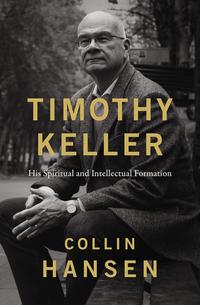
 Timothy Keller: His spiritual and intellectual formation
Colin Hansen
Zondervan Reflective, Feb 2023
Reviewed by Andrew Katay
One of the things that Tim Keller used to say was that, in order to be evangelistically fruitful, Christians needed at the same time to be reassuringly familiar and intriguingly different.
I wonder whether biographies might have the same applied to them.
There’s little point in writing a biography of someone who is wholly and completely different, a full and genuine singularity, to whom it is impossible to relate. And at the same time, there’s equally little point in writing a biography of someone who is simply the same as you, wholly recognisable as the person you might have been. What we need in biographies is someone who is reassuringly familiar - sufficiently familiar that I can see myself in them, or perhaps a better version of myself; and at the same time, someone who is different in intriguing, even challenging ways, ways that call me to be better or deeper or fuller than I currently am.
Colin Hansen’s Timothy Keller: His spiritual and intellectual formation is that sort of biography, although at the outset, Hansen is at pains to make sure that his readers understand this is no ordinary biography. Working from Tim Keller’s own self-effacing convictions as his starting point, Hansen says in the preface that “The story of Tim Keller is the story of his spiritual and intellectual influences”, and so this is a biography of those influences.
Structured in four parts, of between 4 and 6 chapters each, the book is a well-researched, lively narrative of the forces that shaped the remarkable ministry of Tim Keller. Keller was, of course, mostly unknown on a broad scale prior to planting Redeemer Presbyterian Church in New York City in 1989, and even then, it was only his leadership in the aftermath of the Twin Towers terror event in 2001, and even more, the publishing of The Reason for God in 2008, that brought Keller to a wider audience. It is perhaps for this reason that I found the earlier, less well-known parts of Tim’s journey among the most absorbing - his childhood and teenage days, his time at Bucknell college and involvement with the InterVarsity group there, and the profound influence that Kathy Kristy - who would become Kathy Keller - had on him.
As someone myself whose life course was deeply impacted by my university years and the ministry of InterVarsity (called the Evangelical Union at Sydney University), I found these sections particularly relatable. I was reminded of the enormous changes that uni students are going through, and the wonderful opportunity for mission and discipleship that campus ministry represents. Hansen concludes:
“Even when Keller left InterVarsity for the local church, he brought InterVarsity’s instincts with him. He learned that Christians must never compromise on their core values, which he identified as the infallibility of the Bible, the substitutionary death of Jesus on the cross, the necessity of the new birth, and the full deity of Jesus ... At the same time InterVarsity taught him to value what Christians hold in common over the doctrines that divide them. That doesn’t mean that what separates Presbyterians from Baptists or Pentecostals is unimportant. “But the core is the core,” he said. “You ought to be collegial and open-minded to other Christians who differ on the secondary issues. I learned that from InterVarsity.”
Of course, for anyone who knows of Keller’s ministry, these values sound very familiar. Helpfully, Hansen is clear that the influences on Keller’s ministry were not merely intellectual. The description of Tim’s engagement with RC Sproul and the Ligonier Center (sic) gives insight into Keller’s deeply experiential focus, right alongside his intellectual rigour. Hansen writes: “When Keller looks back on Ligonier Valley Study Center, however, he doesn’t primarily recall ideas or debates. Rather, he remembers most fondly many dinners shared with the Sprouls in their Stahlstown home.”
Similarly, the depiction of Tim’s time in small-town USA - Hopewell Virginia to be precise - was moving, summarising them in Tim’s words as “the most formative ministry years” of his life.
The second half of the book moved into more familiar territory, for those who have listened to or read much Keller material.
The time at Westminster, and in particular the influence of Ed Clowney (in relation to Biblical Theology) and Harvey Conn (in relation to contextualisation) is recounted well - and the description of some intra-faculty tensions at Westminster adds colour to the story. Similarly, the impact of Jack Miller on Keller is also described, specifically in relation to the way that Tim embedded what we would later call ‘grace renewal dynamics’ at every level of church life, especially preaching. And then the story of Redeemer, reluctantly planted by Tim, and yet which was the bringing together of all of Tim’s experience in both pastoral ministry and seminary. Of course it grew, and fairly quickly gave birth to a worldwide ‘extension arm’ called City to City (I often say that I praise God it was not called ‘Tim Keller International Ministries’, which of course he would never do). And yet, in this section, it is the account of the deathbed conversion of Tim’s younger brother Billy that is the most moving.
I think there are two ways that this spiritual and intellectual biography could be improved. First, and the smaller of the two points, Hansen doesn’t really address what was one of the most powerfully animating themes for Tim, which is the idea of a movement of the gospel. After all, as Tim said repeatedly, it takes a movement to reach a city, and part of the deep structure of Tim’s motivation was not just to build a great church, but to see a gospel movement emerge that would build a great city.
Second, it seems to me that Hansen hasn’t been able to present an integrated vision of how these many influences on Tim worked together to produce what Tim called a ‘theological vision’. It may be that Hansen regarded this as beyond the remit of his project; however, I would suggest that providing this synthesis would have made for a more compelling biography. Indeed, Hansen concludes his survey by noting that “Keller’s originality comes in his synthesis, how he pulls the sources together for unexpected insights. Having one hero would be derivative; having one hundred heroes means you’ve drunk deeply by scouring the world for the purest wells”.
This is a great insight, and explains much of Tim’s appeal to so many.
Rev Dr Andrew Katay is Senior Minister at Christ Church Inner West.