
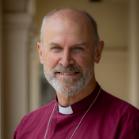
 Interviewed by Breeana Mills
DO YOU WANT TO START BY INTRODUCING YOURSELF AND SHARING SOMETHING OF YOUR LEADERSHIP JOURNEY?
I'm Ric Thorpe, Archbishop of Melbourne. I’ve been in the role for a few months now. My spiritual journey really began in childhood. My parents took me to church, and I had a lot of head knowledge about faith, but I wasn't following Jesus. I also attended a boarding school with compulsory chapel, so I had plenty of information about Christianity, but it didn’t really affect my life.
At university, someone invited me to church. She turned out to be the leader of the Christian Union and was very evangelistic. I went along to a service aimed at new students. I must have heard the gospel many times before, but that day I truly saw it and understood it. From there, I threw myself into university Christian life.
All the things I had heard in church and chapel as a child fell into place. I grew quickly as a Christian. After university I spent a year working with the evangelist J. John. In February 1988 we came to Australia running school and university missions for about eight weeks across Sydney, Wollongong, Perth and Bunbury. It was my first time here, and something of Australia lodged in my heart.
After that I went into marketing with Unilever for a few years. During that time, I attended Holy Trinity Brompton (HTB) in London and was part of Nicky and Pippa Gumbel’s home group. He encouraged me to start a new group, so church planting ideas began very early for me. We started multiplying mid-sized groups of about 30 people.
One of the most influential parts of that season was meeting weekly with my vicar, Sandy Miller. We met for an hour each week for 13 years. That investment shaped me enormously and I remain deeply grateful.
Eventually I went to theological college at Wycliffe Hall, Oxford and married Louie early on in our time there. After three years we returned to HTB, with a very clear sense that God was leading us back there. I served a curacy there that lasted nine years. My main role became running the church while Nicky and Sandy travelled leading Alpha conferences.
In 2005 we were invited to lead a church plant in the East End of London with a planting team from HTB. We kept the traditional service going and started a new contemporary service. Both began to grow. Then we added an evening service. After that we helped revitalise struggling churches in East London, sending teams of 10, 20, and eventually 30 people.
Later the Bishop of London appointed me as the Bishop of Islington, with responsibility for church planting across London. About 70% of my time was spent nationally, helping bishops recruit, train, and deploy church planters. Early on, we founded the Gregory Centre for Church Multiplication, which supports leaders and bishops starting new congregations.
I was also involved in church planting learning communities and was invited to help with one here in Australia. One of the teams was from the Diocese of Melbourne. It’s interesting how God lays foundations over time.
Eventually the opportunity to be considered for Archbishop of Melbourne came up. It wasn’t initially our first option, but over time other doors closed. As we prayed and discerned, it became clear that this was where God was calling us.
And now we’re here.
NOW THAT YOU ARE HERE, WHAT DO YOU SENSE GOD IS CALLING THE ANGLICAN DIOCESE OF MELBOURNE INTO IN THE NEXT SEASON?
I’d answer that in two ways.
First, we’re beginning a listening process across the diocese called “Listening in Lent.” We're asking churches, church members, and even people outside the church a series of questions about the next season. The hope is that this will produce a grassroots sense of calling across the diocese.
Alongside that, I sense God calling us to focus on several priorities in this first season. These emerged both from my own convictions and from conversations during the discernment process. There are five priorities.
1. Prayer
There is already a lot of prayer happening, but how can we catalyse even more across the diocese?
2. Healthy churches on mission
We want churches to flourish and fulfil their calling in God’s mission.
3. Church planting
Melbourne is a rapidly growing city likely to double in size over the next 25 years. We need to plant new churches to reach new communities. The same principles can also help revitalise struggling congregations.
4. Developing leaders
We will need many new leaders, not only for churches but for the wider city. At the end of our services we send people out ‘to love and serve the Lord’. We should be equipping them to lead well in every sphere of life.
5. Anglican schools
Anglican schools play an important role in shaping young people and contributing to the life and culture of a city. I would love to see us strengthen those connections and the Christian foundations that have shaped them.
My hope is that over the next year these two tracks, the listening process and these priorities, will converge into a clear vision and strategic framework.
ACROSS YOUR YEARS OF MINISTRY, WHAT HAVE YOU LEARNED FROM CONTEXTS WHERE CHURCHES HAVE GROWN OR BEEN RENEWED THAT YOU WANT TO BRING INTO MELBOURNE?
One key lesson is confidence in the gospel.
I’ve had the privilege of serving in contexts where churches were growing. While growth isn’t universal across the global church, it does happen. Often those churches share a few characteristics.
First, they take evangelism and the mission of God seriously.
Second, they have a deep commitment to intercessory prayer. We pray in our liturgies, but in other traditions, Pentecostal, African and Latin American churches, you often see an extraordinary passion for prayer. I believe we have much to learn from them.
Third, they pay attention to welcome and hospitality.
Visitors are not treated as temporary guests but as potential future members. That simple mindset changes how churches welcome people.
Fourth, they ask good questions about growth and barriers. The Church Growth Movement raised helpful questions about why churches plateau and what prevents them from moving beyond certain stages. It’s not that bigger is always better. But if a church stops growing, it’s worth asking why. Are there barriers preventing the mission from expanding or multiplying?
Renewal often begins with honest questions like that.
IN TERMS OF YOUR HOPES ACROSS AUSTRALIA— AND EVEN ACROSS DENOMINATIONS—HOW DO YOU ENVISION FOSTERING UNITY AND COLLABORATION BOTH WITHIN THE ANGLICAN CHURCH OF AUSTRALIA AND WITH OTHER DENOMINATIONS?
That’s an important question. The approach is slightly different depending on the context, because even within the Anglican Church there is a wide breadth of views, and sometimes we find it difficult to identify common ground.
If you look at what Christians actually believe, a great deal is shared. The challenge is that when we focus on our differences, they become very prominent. But when we focus on the mission of God and on Jesus, we often discover greater opportunities for unity, even while recognising that some differences remain.
Rather than beginning by asking, “Why won’t this work?”, we might instead ask, “How could this be helpful?” If we start from that posture, I think it opens more possibilities for unity.
Unity matters because it mattered to Jesus. In John 17, Jesus prayed for the unity of his followers. These are foundational truths that Christians across traditions affirm.
That doesn’t mean things aren’t complicated, they are, but those are good places to start.
Within our own denomination, I would love to see a posture that says: despite disagreements, we are on mission together. Each of us may pursue that mission in slightly different ways, but if we are proclaiming Christ, his Lordship, and his Salvation, then we are heading in the same direction.
The second thing is recognising that we don’t all need to do things the same way. In fact, diversity in practice often means we can reach more people. Difference is not necessarily a bad thing.
A third posture is asking, rather than criticising others, “How can we be the best we can be?” What does faithfulness and fruitfulness look like in our own context?
I often think of Richard Foster’s book Streams of Living Water, which describes the different streams within the Christian tradition and the gifts each brings. For example:
- The evangelical stream brings a deep love for Scripture and a commitment to proclaiming the gospel and making disciples.
- The charismatic stream emphasises the work of the Holy Spirit and the living presence of Jesus.
- The contemplative tradition offers depth in prayer and reflection—something many younger people today are increasingly drawn to.
- The sacramental tradition speaks powerfully through mystery and the outward signs of inward grace. Many younger people are rediscovering a hunger for that.
- The social justice and transformation streams, often strong in the Catholic tradition, remind us of the church’s calling to serve and transform society.
Each of these traditions has something important to offer the wider church. Rather than competing, we should be learning from one another.
If within our denomination we can keep pointing toward Jesus, remain focused on prayer, and invite one another into the mission of God, that would be a wonderful thing.
I would love to see every part of the church playing its role in that mission.
When it comes to other denominations, we often end up collaborating mainly with people who are most like us. That’s a good start, but I think we can go further.
One thing I would personally love to see is greater shared prayer across denominations for our state and for our city. That’s something I hope to participate in and encourage. We don’t have to start with complicated structures or programs. We can start by loving one another, encouraging one another, and praying together for the city.
And from that place, it may be that new opportunities emerge, ways we can serve and reach our city together for Jesus.
WHAT DO YOU HOPE PEOPLE WILL MOST EXPERIENCE THROUGH YOUR LEADERSHIP OVER THE NEXT TEN YEARS OR SO?
That’s an interesting question. My answer would simply be: Jesus. It might sound like a simple answer, but it really is the most important one.
I don’t feel my role is to be remembered as someone particularly significant. Rather, I would hope to be someone who, often behind the scenes, helps enable good things to happen. I’d love to help catalyse health and growth within the diocese. It’s already a wonderful diocese, and I want to join in with what God is already doing and wanting to do.
If in ten years’ time the diocese is more confident in its mission, more rooted in discipleship, and more deeply connected to Jesus, that would be wonderful. The Diocese of Melbourne’s strapline speaks about making the Word of God fully known, and I would love to see that flourish even more.
And beyond the diocese, I would love to contribute positively to relationships with other dioceses and churches across Australia. There are some extraordinary people doing wonderful work. If I can simply be part of that wider movement and faithfully play my role, that would be a great privilege.
The Most Reverend Dr Ric Thorpe is the Archbishop of Melbourne, elected in May 2025 and installed at St Paul’s Cathedral later that year. A leading Anglican voice in church planting, he previously served as the Bishop of Islington in the Diocese of London, a national role focused on helping the Church of England develop new worshipping communities and revitalise existing churches. Ric founded and led the Gregory Centre for Church Multiplication (CCX) for a decade and continues as a trustee. He has a doctorate in church planting and has trained many leaders at St Mellitus College, London. Earlier in his ministry, he and his wife Louie led a church revitalisation from Holy Trinity Brompton into St Paul’s Shadwell, which went on to support several further plants in East London. Educated at Stowe School and the University of Birmingham, Ric first worked in marketing with Unilever before training for ministry at Wycliffe Hall, Oxford. He is married to Louie, with whom he has three children. He loves the sea, wide horizons, and sailing whenever he can. As Archbishop of Melbourne, he is committed to listening well, discerning God’s leading, and strengthening the shared life and mission of the Diocese.
Breeana Mills is Canon for Church Planting, Anglican Diocese of Melbourne.