
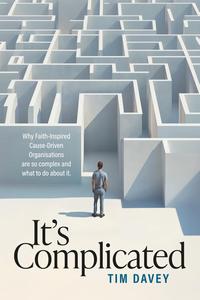
 “It’s Complicated”
Tim Davey
Green Hill Publishing, April 2025
Reviewed by Peter Stone
This work introduces us to a new acronym: FICDO. Faith-Inspired, Cause-Driven Organisation. Almost all of us are connected to one (or more) of these and some of us are deeply committed to its aims and their achievement. Many will probably be involved in some way with the organisation’s operations and governance. This book is especially focused on those folk.
The author helpfully maps the genetic makeup of these organisations:
- They are almost always complex. So few things are simple or straightforward.
- They have a social contract with supporters, stakeholders and paid staff related to faith and purpose. Often this is not clearly articulated or actively managed.
- They have a business model that is not widely understood. Assumptions are often based on limited knowledge or data. Measurement of impact is challenging at best.
- The interface with faith can be volatile and sometimes affects goal formation, strategy and management. Areas like risk management and the relationship with regulators can be challenging. It is this faith dimension that delineates FICDO’s from other not-for-profit organisations.
I have worked with the executive and boards of dozens of these organisations in the last twenty-five years and found myself nodding in agreement with Tim’s experience and observations as I read the book. These organisations are both wonderful and infuriating at the same time. Their purpose is almost always laudable but usually struggles to translate into operations, policy, strategy and culture. Sometimes this leads to catastrophic failure. Usually it results in constant low-level frustration and systemic conflict between (legitimate) stakeholders who bring expectations that are often irreconcilable.
One of the drivers of this syndrome is the challenge of finding, training and developing leaders in both management and governance who can rise to the task at hand. That task is evolving rapidly as ever more intrusive legislation and regulation demand attention and resources.
Child protection, risk management, financial probity, mandated reporting, privacy, data integrity, industrial relations (to name a few) have grown hungrier and grumpier over the last two decades. Then add social media and artificial intelligence to the mix. They demand more time, expertise and headspace than most of our inherited practices and policies envisaged or imagined. There are no easy or quick answers to this challenge.
However, there is wisdom gleaned from experience and reflection that can be helpful to guide thinking and practice. This book is a valuable contribution to that worthy goal.
It does this by confronting and wrestling with the overarching issue: complexity. Few people are comfortable with complexity and even fewer enjoy working with it. Most of us either want to run from engagement with it, deny its significance or seek simple answers to short-term manifestations. (Just reflect on how the media engages with complex issues for illustrations of these responses). The author Peter Senge helpfully observed that “there is no such place as away for problems to go to.” Henry Cloud defines integrity as “the courage to confront reality.” The beginning of wisdom is squaring up to the reality and impact of complexity. Tim Davey does that comprehensively in the first half of the book.
The second half looks at practical responses to the challenge.
It looks at the centrality of leadership as the foundation. This not just about knowledge or technique. Issues about character, accountability and calling are explored as well as more secular insights into effective leadership.
Importantly leadership is understood as the impact and influence of leaders at all levels, including governance.
He identities five unique capabilities requisite for leadership of FICDO’s.
- Light the way forward
- Hear and harness diverse voices
- Strive for excellence
- Eliminate fear
- Make space for wisdom
Each of these is explored with helpful guidance of how they play out in practice.
He then goes on to describe four unique attributes for FICDO leaders.
- A clear sense of personal identity
- Humility
- Courage
- Faithfulness
Again each is supplemented by practical suggestion and illustrations. Scripture is cited thoughtfully and helpfully.
The place of prayer is highlighted. The next major focus area is governance where Tim explores the specific role of the board in FICDO’s. He cites secular authorities and accepted standards. He goes on to thoughtfully explore how difficult it is to assemble, lead and make best use of a board amid this complexity. Staffing is then examined. Bringing in the right people, moving on the ones who don’t fit, enabling appropriate commitment managing performance and setting expectations are helpfully illustrated.
The outcome of all this will be an organisation’s culture. Tim ranges across how culture is formed, what a great
culture looks like, and specific traps that often ensnare
faith-based organisations. He then gives helpful clues on how to shape an effective culture.
The book closes with some helpful guidance:
- Do not lose sight of why you exist
- Recognise that you cannot eliminate risk
- Don’t mistake efficiency for effectiveness
- Strive to be faithful to the faith
- Be realistic about what can and should be achieved.
- Do not mistake ego for vision
- Accept that this may be messy
- Recognise that this is a different sector
- Support the people who work in the sector
- Do not give up
Amen to all that!
Peter Stone is a member of Merri Creek Anglican Church in Melbourne. He is a graduate of Regent College in Vancouver and has recently retired from twenty years as a consultant in strategy formation and implementation.