
 ADELAIDE IS A GREAT PLACE TO LIVE
When you think about Adelaide, what comes to mind? The City of Churches? The AFL Gather Round? Wineries? Pie floaters (an Adelaide cuisine involving a meat pie floating in pea soup and smothered in tomato sauce)? When I ask some of my friends this question, they say, ‘Not much!’. I’ve lived in Adelaide most of my life and love it.
But here is the thing you really need to know about Adelaide and South Australia – we are gospel poor. A tiny percentage of the population attends church regularly, and few of these are in evangelical churches. Like every other state in Australia over the last 60 years, mainline churches have experienced a huge drop in attendance and membership. Our city and state are full of people who are spiritually lost and in desperate need of the gospel.
TRINITY CHURCH ADELAIDE HAS A RICH HISTORY
Trinity Church Adelaide (TCA) was planted in 1836 as the pioneer church for the new colony of South Australia. It has a chequered past. It has always been evangelical in character, but at many moments in its history, its future seemed precarious.
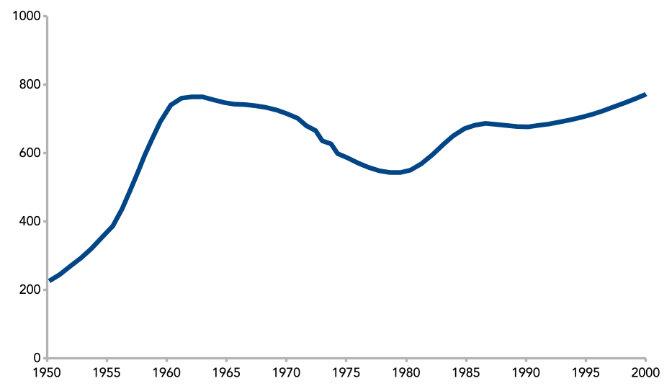
It wasn’t until the 1950s that TCA became a larger city church. As you can see from the attendance graph, the church plateaued in size from the 1960s until the late 1990s. Essentially, the church was ‘full’. The building had multiple services that were well-attended. There was much to be thankful for, but just no room to grow. We became increasingly convicted that a busy and full church facility was not a good reason to stop evangelising in a gospel-poor city.
REIMAGINING OUR FUTURE MINISTRY PATHWAY
We began to ask God to help us rethink how we might have a growing evangelistically healthy ministry for His glory and honour.
There seemed to be two main options: redeveloping our CBD site to enable more people to meet there or planting churches in the suburbs and regional South Australia. In the end, we felt we were likely to be more effective in reaching a greater number of people through church planting than through a complex city site redevelopment.
A DESIRE TO PLANT CHURCHES
From the mid-1990s, we began to pray, learn about, and plan to plant churches. We formulated some broad guiding principles to frame our church planting desires. They were:
- Keep the gospel of God’s grace and mercy to us in Christ at the centre of everything. One of the dangers with lofty dreams is that we could become preoccupied with our efforts and goals and take our eyes off the wonderful kindness of God in the gospel. We wanted to grow in our dependence on and love for the Lord. We wanted everything we did to be for the praise of His glory.
- Start planting on a 20-minute driving ring from the CBD. We were a larger church with members travelling for up to 30 minutes on a Sunday. If we could plant churches 20 minutes away from the CBD, we thought this would enable those churches to then plant further afield if God gave us a ‘second generation’ planting phase.
- Stay networked. There seemed to be a lot of value in staying connected as we planted churches. The history of church planting is littered with churches that started well but declined and ceased to exist after a short period of time. Our sense was that we could achieve more if we partnered together.
- Plant to evangelise . Our prayerful goal was that God would enable us to reach unbelievers through church planting. We had no interest in transfer growth from other faithful Bible-believing churches.
- Plant churches that plant churches. In a gospel-poor part of the world, we wanted to be part of a disciple-making movement. It seemed like a good idea to aim to plant churches that would have DNA that meant they themselves would, in due course, plant other churches.
But to be honest, when we started formulating the above in the late 1990s, it was ‘pie in the sky’ thinking. We had never planted a church and felt like we were making it up as we went along.
WHAT HAPPENED?
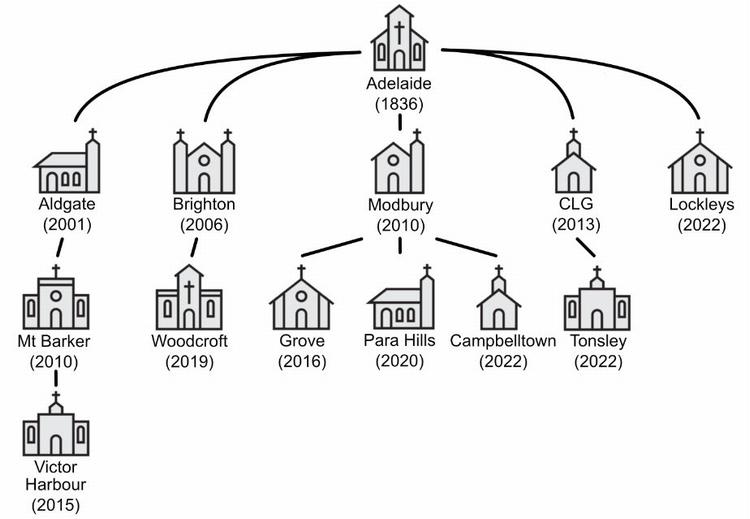
In 2001, the city congregation sent about 80 people (10 % of its members) to start a new church at Aldgate, about a 25-minute drive to the southeast of the city. I remember being at the launch day. It was a great celebration! We prayed that, in God’s kindness, He would give this new congregation the privilege of being able to send a group out to plant a new church in due course. We have prayed this same prayer on the launch day of each church plant. In 2006, the city church sent a group about 25 minutes to the southwest of the city to do the same thing. Then, in 2010, we were able to plant two churches in the same week – one from the city church 20 minutes to the northeast and another from the original plant, a further 15 minutes from the city at Mount Barker. God was answering our prayer to have church plants planting! Now, in 2025, we are a network of 14 churches across Adelaide and regional South Australia. One of the really encouraging things that has happened is that 8 of these churches have been planted by church plants. You can see the pattern for this church multiplication in the diagram below.
There is a lot to give thanks for. Since 2001, the number of people attending churches in the Network has increased threefold. But the thing is, each ‘number’ is a person loved by God. Each church plant has many stories to tell of how God has called people into His eternal family. I get to move around the Network of churches on a regular basis. At every church, I hear the stories of lives transformed by the gospel. New Christians are inviting their unbelieving friends to church and to courses to investigate the gospel. A few months back, one of our pastors let me know that there were over 20 people turning up each Sunday (around 15% of the congregation) who were investigating Christianity. We’ve seen more people raised up for vocational ministry. The city church has more space for newcomers, and the evangelistic temperature there has increased.
WHY A NETWORK? HOW DOES IT WORK?
I am often asked why we have chosen to stay together as a Network rather than plant and let each church operate independently. Often, questions relate not so much to our vision to plant churches but more to structure, governance, accountability and ministry resourcing. All these things are important. But at the end of the day, I think there is a network ministry culture piece that is increasingly important as we grow. All our churches, pastoral staff, board, leadership teams and members know they belong to a family of 14 churches located around Adelaide and South Australia that treasure God’s grace and mercy and serve together for His glory and honour. We are collaborating to reach the lost. And we are convinced that we do better by partnering together.
IN PRACTICAL TERMS, WHAT DOES OUR NETWORK LOOK LIKE?
We are deliberate in our partnership. Prayer points for all the churches and ministries in the Network are circulated once a month. Each of the churches prays for other churches in their weekly gatherings. Pastoral staff from across the Network meet regularly for training, prayer and encouragement. Some of our churches cooperate in ministries such as youth or evangelism. We are now finding that when we plant a new church, the core or starter group is often made up of people from multiple Trinity Network Churches. There is also the enormous benefit of learning from each other’s good ministry ideas – what has ‘worked’ in other churches. We aim to have a culture where we cheer each other on in gospel ministry, not compete with one another.
Being a Network is a real strength when there are challenges and tough times. During COVID, having a Network structure provided support and fellowship in the face of ‘unprecedented’ circumstances. At point, pastors have had extended periods of sick leave, and the wider Network has been able to pitch in to provide support and resources. A little while ago, one of our pastor’s wives (in a church facing some serious challenges) sent this text: ‘It has shown again what a blessing it is to exist in a Network with so many supports.’ Having a culture where we strive to support and encourage one another in gospel ministry has been a real strength.
All 14 churches share organisational, governance and administrative resources. We have a Board that oversees the Network and Leadership Teams in each church. If there is an administrative or organisational activity we can do centrally that will free up the local church to do ministry more effectively, then our approach is ‘let’s explore how we can do it’. This means we employ people to serve the whole Network in areas such as finances, safe ministry, communications, church planting, training, HR, governance, risk, policy and a range of other areas.
GOD HAS BLESSED THE MINISTRY…BUT YOU DON’T REACH A CITY WITH ONE NETWORK
Last year, at our annual Network Board planning day, we were thinking through the question of, under God, where we would love to be in 10 years’ time. We came away with a prayerful desire to see God double the number of churches and people in our Network over the next decade. We are totally dependent on God to see this happen. But it seems to us it would honour God to aim to take the gospel to more lost people in our part of the world.
But partnership is not just an internal Network thing. We are keen to continue partnering with other churches and ministries that share the same gospel and heart for reaching the lost. In Philippians 1:3-5 Paul the apostle speaks about his relationship with the Philippian church like this: “I thank my God every time I remember you. In all my prayers for all of you, I always pray with joy because of your partnership in the gospel from the first day until now…”. Paul and the Philippians are separated by geography but view themselves as labouring together in the same gospel-promoting task.
Over the last 20 years, God has graciously tripled the number of people who are part of the Trinity Network. But we are still only scratching the surface of the desperate gospel need in our part of the world. We are keen to ‘strive together’ (Philippians 1:27) with others for the sake of the gospel. That’s why we are so thankful for our partnership with Reach Australia, which has provided support, encouragement, and advice along the way. It would be great to see many more networks like the Trinity Network and stacks more churches planted. That’s why we are so thankful for the other churches and networks around Adelaide and South Australia who are working towards the same goal. There is still a desperate shortage of people being raised up for vocational gospel ministry. That’s why we are linked to MTS (Ministry Training Strategy). We know that for gospel work to flourish, there needs to be a terrific local gospel-centred theological college that trains vocational workers. That’s why we back the Bible College of South Australia. Lifting our vision to the gospel needs of our world is why we are keen for mission agencies like the Church Missionary Society to raise up cross-cultural workers. We want to cheer on the work of the Australian Fellowship of Evangelical Students on campuses across our city and the ministry of Bush Church Aid in regional and remote parts of Australia. We are keen to see the ministry to workers and high school students flourish.
A LOT TO BE THANKFUL FOR... BUT…
Here in the Trinity Network, we are so thankful to God for His kindness to us and for the privilege of serving Him in His gospel work in our city and state. We treasure our gospel friendships as we strive together. We are delighted that God has used us to take the gospel out. BUT there is so much work yet to be done. We would certainly appreciate your prayers that we keep the gospel at the centre of all we do and that God will use us for His glory and honour.
Paul Harrington is Rector and Senior Network Pastor of the Trinity Church Adelaide.