
Essentials
The Expectation of Lausanne
- Details
- Written by: Tim Collison
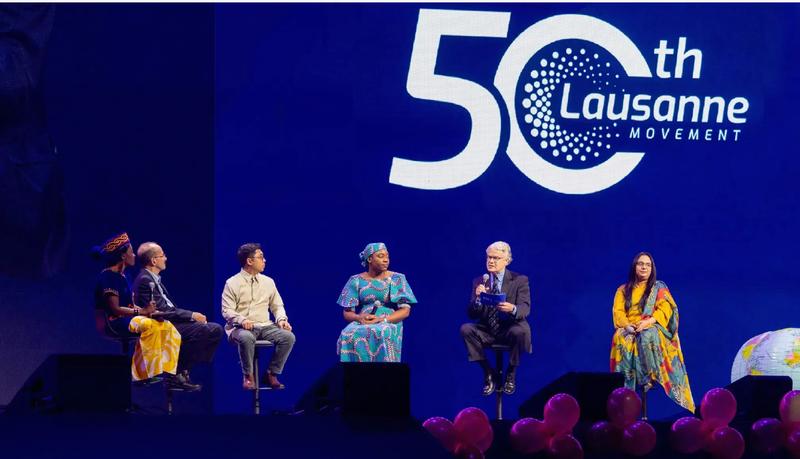
 Advent is the only church season which looks forward: to the return of our Lord Jesus Christ. It is somewhat difficult to quote Karl Barth these days, but he is right when he says “What other time or season can or will the Church ever have but that of Advent?[i] Advent is our perpetual season. We know Jesus has come, we know he will come again. It’s an appropriate season to reflect on my trip to the fourth Lausanne Congress (L4) in September 2024. The Lausanne Movement, beginning with the first congress in Lausanne in 1974 is around “uniting the global church around the unfinished task of the Great Commission.”[ii] Prior to L4 the Congress released the “State of the Great Commission” report, an in depth look at how the church is going on fulfilling the Great Commission. In the introduction it says “when the Great Commission is carried out with biblical faithfulness, it will lead to the worship of the King from all the nations of the world.”[iii] And is this not at the heart of living in Advent? We long both for the return of our King, and for all the world to rejoice when he comes again in power.
I attended the Congress with the two fold goal of learning as much as I could, and having a chance to reflect on how the church I am at can continue to be missional, locally, globally and regionally. The rejoicing of the 5,000 brothers and sisters from all the world together was a reminder of the joy we have in the Holy Spirit together. That God has gone to all the nations, and that there are people who worship Him “from the very ends of the earth” (Acts 1:8). L4 was also a reminder that we all have much to trust in the Holy Spirit for. The report notes that “only three percent of international missionaries go to the unreached (who compose 40 percent of the global population). Thus, 97 percent of missionaries are sent to people who already have gospel access.”[iv] In Australia we are all aware of the declining number of people in most churches, and that much church growth is transfer growth.
The congress sought to recognise this and speak to this, with three key themes standing out to me:
- The need for the “whole gospel”.
- The need for repentance.
- An increased prayerful reliance on the Holy Spirit.
1. The need for the “whole gospel”.
The tagline for the entire Lausanne movement is “The Whole Church taking the Whole Gospel to the Whole World.” The theme for L4 was “Let the Church declare and display Christ together.” The Lausanne Covenant which came out of the first Congress, and largely produced by John Stott separated out “Evangelism” and “Christian Social Responsibility”.[v] Even including point 5 was controversial, and continues to be controversial to some people. David Claydon writes in the Autumn/ Winter 2021 edition of Essentials this paragraph was not in the original draft, and only inserted with John Stott’s full support, after Rene Padilla and Samuel Escobar raised concerns about this, and David Claydon along with others put that wording together.
For many people this has continued this understanding has been challenging. For some it is challenging because this goes too far towards a social gospel. For others, it does not go far enough, and to say that mission consists of two things is “saying that it is possible to have evangelism without a social dimension and Christian social involvement without an evangelistic dimension.”[vi]
I note this history (hopefully briefly!) to say that at L4 most speakers leaned heavily into the idea that the Gospel & mission intertwine evangelism and social involvement. From the CEO of Lausanne, Michael Oh’s, initial address, to nearly every plenary speaker, there was an emphasis on the “Whole Gospel”. That the Gospel needs to be declared and displayed.[vii]
2. The need for repentance
This came through strongly to me in two sessions: Sarah Breul, the Brazilian Executive Director of Revive Europe’s plenary, and a presentation of the history of the Korean Church on the penultimate night.[viii] Sarah Breul spoke to the truth that only God makes revival happen, but that we can “posture ourselves for it” and pray for it in these six ways:
- Travailing prayer: Gal 4:19
- Intercession through wordless groans: Romans 8:26
- Hebrews groaned in slavery: Exodus 2:23
- Hannah weeping: 1 Sam 1:12
- Jesus in Gethsemane
- We can ask Jesus to pour out this travailing prayer in our communities
And that this removes impediments with personal and corporate repentance. She explicitly mentioned that the narrative that the missionary movement just enabled colonialism is crippling western movements. She said we need them at the table. That the Global North might be tempted to have control. And that Global South might be tempted to do things independently, but that God is building one church. We are his bride and we have been grieving him. We need to repent from corruption, from abuse and from a lack of unity.
The presentation on the history of the Korean church struck me that twice in the history of the Korean church, once before WWI and once post WWII Korean church leaders came together and repented. For various things, but especially for a lack of unity in working together for the Gospel. I know the Australian church has worked together, but have leaders ever come together to repent for our attitudes towards each other? And where our disunity has turned people away from the good news of Jesus Christ?
3. An increased prayerful reliance on the Holy Spirit
This stood out in many of the talks and sessions, but especially in the Rev Dr Femi B Adeleye, the Director of Langham Preaching Africa’s plenary. Acts was the book the morning plenary speakers spoke from, so it was an appropriate theme. As Dr Adeleye reminded us that Acts is not just about the doings of the Apostles, but about the Holy Spirit. That revivals began with prayer, and waitingon the Holy Spirit. He listed a number of Biblical and historical revival examples. He especially challenged “Those of us who believe in the work of the Holy Spirit but tend to sideline him by a mindset that depends primarily on modern management techniques, abundant finances, sufficient HR, statistics as measure of growth and impact, and the like, need to repent and depend on the Holy Spirit.”[ix]
There is much that I could write on, that I do not have space for. That there continue to be challenges for the global church in working together missionally, especially amongst evangelicals, and Pentecostals, was also clear at the Congress. Many were upset that the Statement for this Conference was released completed, with no opportunity for feedback.
In the Korean protestors outside who felt that the Lausanne movement is too inclusive of different churches, and that its perspective on homosexuality too liberal, demonstrating that even amongst Christians who are orthodox on the issue of marriage (as Lausanne is) find doctrinal issues that make it hard to work together. In the public apology the Congress sent out for Ruth Padilla DeBorst’s talk where she (very mildly) critiqued dispensationalist theology and expressed support for those suffering in Gaza, and then subsequent sending out of an open letter from her.[x]
The ecumenical attitude of the bishops at Lambeth in 1968 expresses the hope many evangelicals have: “that whatever can be done together should be done together.”[xi]
L4 demonstrated that we are still struggling, even where there is much doctrinal and cultural alignment, to work out what we can actually do together. It is not that insightful to observe that this will continue to be a significant challenge, even in Australia.
I found attending the L4 congress a blessing. I’m thankful for the invitation, and those who supported me financially to attend. I do feel that those three themes are significant and worth reflecting on for us here in Australia.
Tim Collison is the Assistant Minister at St Mark’s Camberwell, and the Secretary of EFAC Australia. He's passionate about people understanding how God is already working in their lives. In his spare time he enjoys reading and digesting trivial facts.
[i] Dogmatics (IV/3.1).
[ii] Lausanne.org/our-history, accessed 23/10/2024
[iii] State of the Great Commission, p.6. The Introduction also notes, rightly, that it is only the last 150 years or so that the Great Commission has been considered missional, rather than ecclesiological.
[iv] State of the Great Commission, p.15
[v] Points 4 & 5 respectively of the covenant. , accessed 23/10/2024
[vi] Bosch, Transforming Mission, p.405. This comes from a specific critique in the book of the Lausanne Covenant.
[vii] For obvious reasons (Dr Porter gave me a word limit), I cannot mention every speaker who said this. But you can watch many of the plenary sessions by going to Lausanne.org/accelerate or if reading is more your speed you can access all 20,000~ words of my notes at https://bruderreden.substack.com/p/lausanne-congress-day-7. No need to subscribe to my substack, just scroll to the bottom of my post and you’ll see a link to download my full notes.
[viii] The presentation “The Twelve Stones of the Korean Church” can be watched here: https://www.youtube.com/watch?v=U5yzpFbWgeI
[ix] From my notes. Cf footnote vii
[x] Gordon Preece has a more comprehensive article on this at ethos. http://www.ethos.org.au/online-resources/Engage-Mail/israel-palestine-and-lausanne-iv
[xi] Hocking, A Handbook of Parish Work, p.127
Advent and Aesthetics
- Details
- Written by: Miriam Dale
 I remember our little plastic Christmas tree, no taller than me as a child, looking increasingly scrawny as it lost another branch or two each year. The tinsel was never replaced either, and slowly the bushy sparkle turned tatty, as blu-tac pulled away the strands and the fishing wire showed through. We had a single honeycomb-tissue Santa, who was folded away with a paperclip each year until we extracted him, slightly embarrassed of himself, and expanded his red paper belly. In a reach for some unknown heritage, we also made clove-oranges, pressing the little spikes into the peel till my thumbs were sore, and tying them with a red ribbon. But Mum always insisted on a prominent Nativity scene, each year re-building a little cave out of brown paper or a cardboard box. In it she set the wooden figurines, carefully released from their bubble wrap, and topped it with two ceramic angels, the right one glued back together after it broke in a non-satanic fall.
Each Christmas Eve we put one of Dad’s socks (we wanted the biggest options) at the end of our beds for ‘Santa’ to fill, though I had known that myth’s true identity ever since my brother told me to ‘wait up and see, it’s just Dad!’. The gift giver was irrelevant to me, I craved that bulging bundle of little pencils and bubble blowers, insisting on ‘stockings!’ until at last, in my early teens, Dad grew tired of waiting for us to fall asleep. I woke to no stocking, and after frantically patting around in my bedding, tiptoed into my sleeping parents’ room to see them on their dresser. We let the charade go after that.
Alongside those memories are those of Christmas church services, late at night, with a single candle handed out to each congregant. The twist of paper or plastic cup around the candle base didn’t quite keep all the hot wax from landing on my fingers, and the pews felt uncomfortable and cold, but there was a sacred moment when the flame was passed from person to person, candle to candle, and then we stepped out into the cold winter air with a bright little blaze, reminding us to take our Hope home with us. These were memories we made at home or with our little faith community, but to our neighbours in this non- Christian country (and as yet untouched by secular Santa) it was just another day.
When I moved to Australia, I was determined to give myself over completely to the joy of a communal Christmas. For nearly a decade I insisted on buying a real Christmas tree – even after finding a dead redback in one of them! I still play Michael Bublé, put up store-bought stockings with my housemates, decorate the house with a vengeance and even make the Christmas cake I reviled as a child. From early December until early January (but no longer – my mother told me I could either put the tree up at the start of Advent or keep it up till the 12 days of Christmas were over, but not both), my home feels different.
Last year (having succumbed to the ease of a plastic tree again), I had friends over for one of my new traditions, a ‘tree-trimming’ party. Each friend is invited to bring a decoration, and we eat gingerbread and mince pies and drink mulled wine or hot chai at odds with the summer evening. One friend, a Turkish Muslim lass in Australia for study, asked about the Nativity, and I was excited for her chance to hear the Gospel. We told her the story; she listened with interest then pointed to one of the Santa decorations on the tree.
“What about Santa? Where does he come from?”
Confronted with such tendrils of secular syncretism, it can be tempting to strip Christmas back completely. Should I be throwing my plastic tree out the window, and resigning Michael Bublé to his fate in an op-shop CD shelf somewhere? Is this a cleanse-the-temple moment? Am I blocking the route to the Holy of Holies with pigeons for sale? Am I cluttering the path to Jesus with baubles and tinsel?
Sometimes, I fear the answer is ‘Yes’.
If the amorphous ‘spirit of Christmas’ could mean anything, then it means nothing. Cinnamon candles, ‘seasonal’ foods, chocolate Advent calendars, mistle-kisses and tinny carols and the ever-earlier sale of cheap décor in our supermarkets … I might find them great fun, but perhaps it is all just a capitalist scheme?
And yet… I don’t want to throw the Christ-infant out with the cinnamon-scented bathwater.
The so-called magic of Christmas, as glorified in each new round of delightfully pulpy Netflix Christmas movies, is appealing for a reason. It speaks to the wonder and mystery of childhood, and our urge to rediscover that excitement as adults. And that yearning, for innocence and wonder, curiosity and awe and excitement, is a God-given desire:
“Truly I tell you, unless you change and become like little children, you will never enter the kingdom of heaven.” - Matthew 18:4.
It is good and right to treat Christmas as special!
From the first moment that YHWH breathed life into the nostrils of Adam, He has invited mankind to join Him in His creative acts. To name animals, to tend a garden, to raise a family, all invite a creative awe and curiosity. Made in the image of God, the Holy Spirit creates and so do we: In Creation, we see the first act of a Creative God (Genesis 1:1), and it was Good – God delights in the act and product of creation (Genesis 1:31)! He invites Adam’s involvement with naming – this creativity is an act of co- creation with God (Genesis 2:19). Jacob weaves Joseph’s robe (Genesis 37:3), Moses sings (Exodus 15:1-18), Miriam dances and leads the women in music and dancing (Exodus 15:20-22). Later, Exodus: God specifically chooses Bezalel and gives Him creative gifts required to do God’s work (Exodus 31). David, the man after God’s own heart, a king who shamelessly danced and sang and wrote (1 Samuel 16:22, 2 Samuel 6:14, Psalm 3, 4, 6 and more). The Psalms were largely written for corporate worship, to imbue God’s people with a knowledge of His character and their identity. Then came Solomon, the king whose great wisdom also permitted him to build a place of worship for God (1 Kings 5-6). The book of Job, a different genre to its companion texts, is a poetic tale which explores the knowledge of God and man. In grief, the people of God returned to music with Lamentations; in love, they turned to Song of Songs. Isaiah the prophet uses oracles in a poetic style.
The New Testament includes many references to poems and Psalms, parables and poetic prose. In 1 Corinthians 14:26 Paul highlights hymns as gifts from God, and in Revelation, John uses creative apocalyptic writing to give hope to a weary church.
God also calls us to remember. In sacrifices and altars, in festivals and celebrations, God tells and reminds His people who and Whose they are. Noah builds an altar immediately after the Ark (Gen 8:20), Abraham sacrifices a ram to God in Genesis 22, and Jacob builds an altar after an angelic vision. God specifically directs His people to celebrate and remember Him in festivals through Genesis, Exodus and Leviticus. Esther calls her people to gather in prayer and then in celebration, to remember their God and who He is.
These festivals and practices, these cultural ‘forms’ of spiritual or religious exercises, also tell us where we come from and why we are here. We are called to practice curiosity and wonder. One of the most foundational and frequent reminders, of course, is Sabbath: a day every week to remember that we are made in the image of God, that we are defined not by what we do, or produce, or have, but by whose we are. And yet …
“One Sabbath Jesus was going through the grain fields, and as his disciples walked along, they began to pick some heads of grain.The Pharisees said to him, “Look, why are they doing what is unlawful on the Sabbath?”
He answered,“Have you never read what David did when he and his companions were hungry and in need?In the days of Abiathar the high priest,he entered the house of God and ate the consecrated bread, which is lawful only for priests to eat.And he also gave some to his companions.” Then he said to them,“The Sabbath was made for man,not man for the Sabbath.So the Son of Manis Lord even of the Sabbath.” Mark 2:27-27
There is an opportunity here, for Christians to reclaim the practices of Advent, as Jesus reclaimed the Sabbath. Because there is one key element that Christmas kitsch - as much as I might delight in it - is missing. Jesus, valuing humans more than practices, refused to allow the Sabbath to be a time of just papering over the brokenness in the world. While the bright celebration of Christmas has translated well into consumerism, it is the remembering, waiting, grieving, and yearning for transformation of Christmas that our world desperately needs. As Rachel weeps for her children and refuses to be comforted, we have permission, a framework, to weep for the brokenness of the world, and to dwell in the question to which the birth of Jesus is the sublime and mind-blowing answer.
Advent, the taking of time to reflect, remember, to taste of sorrow and joy, offers us space to remember who and whose we are, and why Christmas matters. So how do we practice the season of Advent? And where does the creativity and awe - implicit in the traditions God gave the Israelites - fit in? Some churches hold tightly to an annual Advent structure, others disregard it completely, continuing independent sermon series right up till Christmas Day. Some invite families or children to light Advent candles, others avoid the fire hazard of a small child waving a live flame around a wreath! Do we use a chocolate calendar? Light a candle? Set liturgical readings? Red-and-green ‘ugly’ jumpers?
In any situation, Advent offers us the same potential of celebration and risk that any spiritual form or practice does; will it draw us towards Christ or away from Him? Do we use it to remember, or to distract and condemn? Derek Brotherson, author of Contextualisation or Syncretism? The Use of Other-faith Worship Forms in the Bible and in Insider Movements, puts the question this way: does the worship form help or distract from true worship? He is of course examining the use of other-faith forms in a Christian context, but that same question could be applied to a secularised version of Christian tradition. I am not here to paint chocolate calendars, Michael Bublé, or Santa figurines as ungodly forms of Christian traditions. Culturally relevant celebrations – with food, dancing, and wine – were a part of Jesus’ context and could absolutely be a part of ours. As mentioned, I adore Christmas kitsch.
However, as I think back on my Muslim friend, I can see how some of my delight in the ‘Christmas spirit’ can distract or get in the way of her understanding of Jesus. And as I watch the latest ‘Christmas movies’, I can see how an idolisation of happiness can diminish that which brings us happiness in the first place. Even more, I can see they take away from the room Christ makes for grief, for lament, and for comfort and healing. As domestic violence and divorce rates peak at Christmas, it is that grief, lament, comfort and healing which is the most important part of the ‘Christmas Spirit’. But we are human – and the season before Christmas has become increasingly shrill! So, we forget truth, and we need help remembering who and Whose we are. This is where our practices, our religious forms, our aesthetics, come in. Seasonal food or clothes or music tell us there is something special about this time! The God who created creativity invites us to use it to know Him.
The practice of lighting a candle, when it creates pause for reflection and silence, an image of light in the darkness, can be a powerful form. The same can be said for music, art and poetry which helps us to sit in the stasis - the uncomfortable waiting and longing of Christmas. The Centre for Christianity, Culture and the Arts, out of Biola University, puts out a seasonal daily email for Advent and Lent, with a poem, an artwork, and a piece of music to tie into a daily devotion. I find these devotions ground me as a I travel or rush around in the lead up to Christmas.
Several years ago, my mother ordered a children’s book of ‘Jesse Tree’ colouring sheets. Each page had a passage and a symbol to represent a point in the Biblical narrative, one for each day of Advent. A rainbow for Noah, a sheath of wheat for Ruth, a sceptre for Esther… Mum asked me to colour them in, and as a 30-year-old, I loved it! Then we cut them out and laminated them and made them into decorations for our tree. Each day of Advent, we read the passage and hung the relevant ornament. The Christmas we count down towards is the culmination of a long gospel history. It is the longed-for coming (present-continuous) of Hope. And when we take the time to remember that longing and that resolution - in creative practices, in aesthetics, in awe and vulnerability – we teach ourselves and those around us what it means, each day and each year anew.
Miriam Dale is a poet and educator who has been playing with words, rhythm, and the big questions of life for over a decade. From growing up in the Middle East as an MK she now works with Interserve.
Advent, Art, and the Aesthetics of Surprise
- Details
- Written by: Laura Cerbus
 I have found my familiarity with Scripture to be a double edged sword. Not in the sense, as the saying goes, that familiarity breeds contempt, but in the sense that the poet Samuel Taylor Coleridge means when he speaks of the “film of familiarity.” A film, or thin veil, can cover my eyes and my ears so that I “have eyes, yet see not, ears that hear not, and [a heart] that neither feel[s] or understand[s].”
This film of familiarity makes it easy to read without really noticing—or, to read in a way that reinforces what I already believe or imagine or desire, rather than allowing the Scriptures to transform me. I look in the mirror of God’s word, but a quick glance, one that assumes I already know what I will find, causes me to miss what it was reflecting back to me. I have no expectations that what I will encounter in the text may be different than I expect.
One such text, I suspect for many, are the stories of Advent-tide. Part of our cultural as well as our religious traditions, these stories are easily obscured by our familiarity with them. When we are captive to this kind of familiarity, we need something to wipe away the film, to clear our eyes and ears so that we can encounter the text in new ways. The surprise encounter can do this work, jolting us out of inattention to awareness.
In the moment of surprise, we are confronted with a reality that is different from what we had believed or thought to be true. In response, we must choose whether to alter or revise our ways of thinking.
Art, particularly artistic representations of the stories of Scripture, can be a valuable means of aesthetic surprise.
Art can confront its audience with a way of imagining the text that challenges their assumptions or ideas. One example, for me, is the painting of Noah’s ark by sixteenth century artist Simon de Myle. My encounter with it gave me a jolt of surprise. And although not obviously a painting that represents the stories of Advent, it prompted reflection and shifted the way I imagine anticipation for the coming of Christ.
At first glance, the busy scene is familiar. The moment portrayed is one after the flood waters recede and the ark comes to rest on Mount Ararat. Birds swarm in the sky over the ark, animals make their way down the ramp, and more animals cover the dry land around the ark, no doubt stretching their legs and enjoying relief from their long confinement. Several human figures do the same. And then—as I take a closer look—I see several animals splayed out on the ground. They are not sleeping, but dead. And then, to my horror, I realise that one, a horse, is prey: the painting shows the moment that a lion bites into its stomach.
The surprise comes from the shocking difference between de Myle’s portrayal of this moment and the many other portrayals I have seen. Here, there is no idyllic harmony, no optimism for an earth cleansed after the flood. Immediately—some creatures are still embarking—one animal preys on another.
On further reflection I think that these dead animals are, likely, casualties of the flood. De Myle has confronted his observer’s imaginations not only with the company of animals spared on the ark, but also those left to destruction. It is a sobering surprise—a moment in which I realise how often these animals are absent from the retelling of this story, and how often we neglect the relationship between animal and human worlds, in which human sin, demonstrated clearly in Noah’s celebratory drunkenness, has consequences for the entire creation.
Through the skill and creativity of de Myle, I have been struck, surprised—and as a result, my imagination is challenged, and I see a familiar text in a new way. Particularly during this Advent season, as I imagine the world which “Long lay...in sin and error pining,” do I imagine the animals, too, longing for Christ’s coming? Do I imagine them to be also crying out, “Come, Lord Jesus,” as they wait for the final end to the curse that has bound them to humanity’s corruption?
Too easily we limit the scope of Christ’s redemptive work to ourselves, to humanity. However, as Paul insists, “the whole creation has been groaning as in the pains of childbirth” (Rom. 8:22). This includes the animals, as de Myle’s imagined scene communicates. They, too, suffer under the curse, and they, too, find redemption through Christ the ark (Rom. 8:21).
I think of the many nativity scenes that include field and stable animals. Cows, horses, goats, sheep, sometimes others, are present, although none of the Gospel narratives mention them. In those scenes, peace reigns, as “ox and ass before him bow.” It is easy to forget, though, that although Christ’s coming heralded this peace, it is not yet accomplished. We still wait, all creation still waits, for its consummation.
In one sense, the waiting of the Advent season precludes surprise: we remember Christ’s first coming, and we expect his second. But for the characters of the Advent and Christmas stories, surprise plays an important role.
Mary is amazed at the announcement that Gabriel brings her; the shepherds are astonished at the chorus of angels that illuminates their sleepy night watch. Herod, too, is caught off guard at the news of the Magi that a king has been born right under his nose. Jesus’s birth, particularly the means and circumstances, confronted these characters with incredible news that they had not expected.
Yet, surprise does not compel. The news of Jesus’s birth comes to each one with the weight of the unexpected, and their responses vary. For Herod, the surprise further entrenches him in his pride and spiritual blindness. Others, however, express an openness to what they had not anticipated.
Aesthetic surprise works in the same way. De Myle’s painting does not force the observer into one, predetermined or correct response. Nor can we manufacture surprise. It is a gift of grace that comes unbidden and undeserved. Yet we can, especially at Advent, prepare ourselves to receive such a gift.
Consider seeking out art for the Advent season as a way to reimagine the stories that may have become obscured by a “film of familiarity.” Jane Williams’ book The Art of Advent provides a painting and a reflection for each day from Advent to Epiphany. Biola University offers an Advent devotional resource that combines art, Scripture, and a written devotion.
Here, attentiveness is more important than novelty. It is the Spirit, after all, who enables us to encounter texts in new and fresh ways. In all of our reading, both of visual and of written texts, we should cultivate hearts that are humbly expectant, ready to yield to God and believe that who he is and what he is doing cannot be plumbed.
Laura Cerbus is a teacher, writer, and PhD candidate in Theology at Trinity College Theological School. During her time in Melbourne she has been involved in the Evangelical Women in Academia group. Her desire is to help students delight in texts of literature, Scripture, and theology, in order to develop wonder and awe at the beauty, goodness, and truth of God’s world and of God himself.
Adventus for the Rest of Us
- Details
- Written by: Christopher Porte
I must admit that I am somewhat of a fall tragic. Note I said fall, not autumn. That’s right I mean the northern hemisphere idea of autumn leaves falling as the days get shorter and shorter, and as gaudy Christmas lights get hoisted up street lamps, and in America at least pumpkin spice seems to be everywhere. Living in Australia each year we end up with a strange sort of dissonance, as so many of the cultural practices—and most of the cultural kitsch—that we have are derived from the Northern Hemisphere environment.
Perhaps it’s some sort of a tragic sentimentalism for something that I didn’t grow up with and yet somehow culturally is such a part of what we do at Christmas. Because a lot of the time it can be hard to differentiate the things that we do at Christmas which I found in the gospel in the Bible in our Christmas narratives from those which happen in and around Christmas. Indeed there are a whole bunch of secular Memes that come out at this time of year claiming regularly that all of the Christmas traditions are just adaptations of Saturnalia or some other form of Roman or pagan festival. So I thought perhaps as we consider that first Noel maybe it’s time for us to do a bit of myth busting.
In and amongst our Christmas celebrations it isn’t hard to find elements of the Advent narrative which have been adopted into our broader societal celebrations. Our practice of decorating houses with gaudy Christmas lights—and increasingly audio-visual extravaganzas—can remind us of the light coming into our world (John 1:9), and also the heavenly choir announcing this good news to shepherds outside Bethlehem (Luke 2:8-15). Similarly, each year we pop bon-bons to extract paper hats—of only the finest (read: thinnest) tissue paper—and wear them while telling terrible jokes and sharing in cheap toys or puzzles. Recently I was reminded that this tradition is apparently uniquely English, as an American friend struggled to understand its relationship to Christmas. However, even here we can see some vague resemblances to the biblical narrative: especially with intertextual engagement with kings bringing gifts, shepherds sharing in joy, and Mary treasuring these things in her heart (Luke 2:19).
Some things are a bit more head scratching, such as the oddities in our hymnody around this time. As the father of children I can guarantee that the idea of having a small child “Pah-rum-pah-rum-pum!”-ing to a newborn is not high on my list of ways to settle a baby. In a similar vein Away in a Manger pictures Jesus as a peaceful baby, without any crying at all. Indeed, a picture which would seem to remove much of Jesus’ humanity from the picture. If our picture of a baby Jesus never cries then one must wonder how much humanity that Jesus really shares (c.f. Heb2:14).
However, while some of these Christmas elements are more of head scratchers, some of them—as with Away in a Manger—can cause us to stop and ponder the reality of the Christmas story; and similarly some in a pernicious vein. If Away in a Manger questions the full humanity of Jesus, then we should consider other carols such as Mary Did You Know? Which—infamously—asks if Mary knew that “your baby boy is Lord of all creation” who would “one day rule the nations” as “heaven’s perfect Lamb”? Of course the answer to each of which is “Yes. Mary did know” for she was told by Gabriel and subsequently sang her own song about it (Luke 1). Although, even more subtly pernicious here is the perpetuation of ignoring the testimony of women.
Or perhaps the swathe of nativity scenes and children’s bibles which depict the holy family alone in a barn alongside a menagerie of farmyard animals, often including pigs. Apart from the implausibility of porcine presence within a Jewish community—fostering a continued separation of Jesus from his Jewishness—the notion of the holy family being ostracised to a barn is highly improbable. As Kenneth Bailey and Stephen Carlson have demonstrated, the birth most likely took place in the main room of a family house, as Luke records the guest room (kataluma; 2:7) did not have enough space for the birth to take place. While there is an understandable desire to harmonise Luke’s birth narrative account with the theology of the Johannine prologue (John 1:11), the reality of Jesus’ birth actually serves to underscore the sheer degree to which he was brought into our human existence and reality.
What then do we do with these Christmas cultural artefacts? Should they be simply ignored, left to pile up by the wayside, or rejected as further proof of cultural depravity—as some seem to view the presence of red cups at Starbucks constituting a “War on Christmas.” Certainly for some of these interpretations I think an argument could, and perhaps should, be made for their discarding. However, at a broader level our cultural environment gives us a plethora of opportunities to return to the gospel narrative, of which I want to briefly highlight three—in good sermonic tradition.
First, these sort of engagements often display our cultural misunderstanding of the Christmas story. As we have seen, through the dissonance we feel when we see the odd co-option of Jesus’ birth, or elements of our culture which oddly parallel the biblical narrative, we can see the ways that our faith stands at odds with society. In addition, by highlighting aspects of the Christmas story separate to Jesus it actually gives us a great opportunity to reintroduce the biblical narrative to our cultural appropriations. As with my friend struggling to see the relevance of Christmas bon-bons and tissue paper hats, we are given the chance to demonstrate how these seemingly common items reflect the great gift given to us in the kingly Christ. True, some of these misappropriations or misunderstandings—such as the farmyard birth narrative—should probably be consigned to the dustbin. But even there these give us an opportunity to elaborate on the hope we have in Christ, and His coming as a full embodiment of our humanity. In short the dissonance between the biblical narrative and our cultural appropriations can be an opportunity to engage our broader world with the gospel.
Second, this engagement should drive us back to the actual Christmas narrative. One of the great blessings at this time of year is to be able to read the advent and nativity narratives within a context of our culture celebrating the themes—if not the content—of that narrative. In response to Mary Did You Know, we can read the Magnificat (Luke 1:46-55) and hear Mary’s own words about the extended mercies of God and the fulfilling of his promises. When we see an inflatable nativity scene at the local hardware store we can read of the announcement to the shepherds on that hillside outside Bethlehem, and the great company of angels praising God and singing “Glory to God in the highest heaven, and on earth peace to those on whom his favour rests.” (Luke 2:14). The Christmas narratives found in our gospels should be our resonant sounding board throughout this season. Where instead of fearing the Whammageddon! of Last Christmas, we should gleefully remember the inauguration of the First Nowell.
Finally, however, reading and declaring the biblical narratives in counterpoint to our cultural narratives should also leave us with a sense of unease, for what is inaugurated has not yet been completed. As we read of God’s mercies to his servant Israel (Luke 1:54), and the guiding of feet in the way of peace (1:79), or the declaration of the Year of the Lord in Isaiah 61, we should have a constant reminder that all is not yet completed. While the inauguration of the end has begun, the final fulfilment often still feels a way off. Indeed, this is even more stark given the glitz and glam of this time of year. Even as our culture ratchets up the “joy” factor, deep down we often know that something is not quite right. Just as the wise men were warned of impending doom that first Epiphany, so too our own senses should indicate that all is not complete yet. This should lift our eyes and hearts towards the day when all will finally be put to rights, where the songs of Elizabeth, Mary, and Zechariah all come to their full fruition.
Christopher Porter is the Post-Doctoral Research Fellow at Trinity College Theological School (UD) and a priest in the Anglican Diocese of Melbourne. Apart from being a sentimental Advent tragic, he has been involved in church planting, passionate about training people for ministry and is interested in the intersection of culture, fictional worlds, and theology.
Book Review: Mission is the Shape of Water
- Details
- Written by: Andrew Esnouf
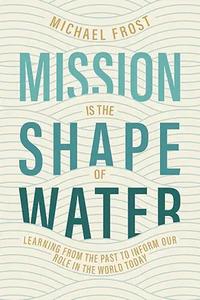 Mission is the Shape of Water
Michael Frost
100 Movements
Reviewed by Rev. Andrew Esnouf
Michael Frost has been a leading Australian voice on the theology and practice of mission in contemporary Western society for several decades and has authored numerous books on these topics. Despite this long list of publications, Mission is the Shape of Water displays a unique approach amongst his corpus of work. Frost’s recent books such as Surprise the World and Keep Christianity Weird have focussed on ways individual Christians can participate in God’s mission through everyday habits and individual flair. ‘Mission is the Shape of Water’ is distinct from these books in that it takes a wider approach, drawing upon Christian history to encourage and equip contemporary Christians in their missional endeavours.
Frost unpacks the title’s opaque imagery in the prologue. Firstly, water’s fluid nature means that it always takes the shape of whatever contains it. In a water bottle it takes the shape of a water bottle, in a bucket it takes the form of a bucket. Like water, Frost suggests, mission’s shape at a particular time and place is always determined by its context. Secondly, taking inspiration from the 2019-2020 pro-democracy protesters in Hong Kong use of the phrase “Be water!” to describe their agile and mobile protest tactics, which could at times combine into an unstoppable force. Coordinated protesters – just like water – are able to move swiftly in some contexts, to pool together into a large immovable contingent and then effortlessly disperse in some contexts, and to move forcefully together as a single force in other contexts. Mission is like water in that it is always contextually attuned to the immediate situation, and is best when a coordinated and responsive movement.
The core of the book are the ten chapters, each describing a different “shape” that water has taken throughout the history of the church, and offering some thoughts on how this shape may look in our current world. These shapes are: God slaying, peacemaking, flame bearing, spirit seeking, wordsmithing, freedom fighting, unshackling, contextualising, remissioning and unearthing. Each of these shapes arose in different contexts and functioned in different ways, and Frost presents them not as an essentialised list of permissible or essential ways to be missional, but as a smorgasbord of approaches, some of which are in tension with each other – sometimes uncomfortably. For instance, in “Spirit Seeking” shape, Frost commends the early modern Moravian missionaries for, among other things, “overlooking seemingly intractable social issues” such as polygamy and slavery in order to call people to salvation. This is in tension with the ‘Freedom Fighting’ shape of mission, in which Christians make resisting such intractable social issues as slavery and other brutalities the core of their missional endeavours. Frost is not contradictory in this, but rather is explicit that differing situations call for diverse approaches to mission.
There are further shortcomings of this book one should be aware of. Firstly, whilst this book includes many historical anecdotes, it should not be mistaken for a work of historical scholarship. Secondly, there is very little articulation of a theology or motivation for Christians or churches to be missional. Finally, there is only sparse advice for readers on how to discern the needs of their current context, and how to shape missional faithfully and effectively in their context. If the reader is seeking edification on any of these three topics, they are best to look elsewhere.
Ultimately, this book isn't perfect, and it isn’t a one-stop-shop for grounding the reader in all aspects of missional thinking and practice. And it does not claim to be. It is, however, an accessible and enjoyable jaunt through Christian history in the search for historical practices of mission that inspire and expand the imagination of the contemporary church.
Andrew Esnouf is Parish Minister (Youth) at St A's Merri-Bek in the Diocese of Melbourne
Book Review: Tidings of Comfort and Joy
- Details
- Written by: Dr Gillian Porter
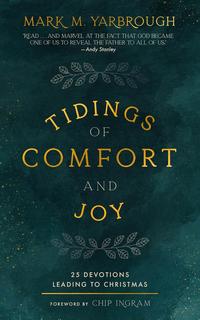 Tidings of Comfort and Joy
25 Devotions Leading to Christmas
Mark M. Yarbrough
Kirkdale Press
REVIEWED BY DR GILLIAN PORTER
In the lead up to Christmas it is easy to get sidetracked by Christmas events, buying presents, end of year activities and busy-ness. Yet the season of advent gives us an opportunity to pause and look for the hope brought in the son of God coming to be one of us. In his new Christmas devotions “tidings of comfort and joy” Mark Yarbrough brings the reader through the lead up to Christmas, providing space to reflect and be moved by the promise of Christ.
Each daily devotional draws from scripture and the author’s life to gently remind us of the powerful hope we have. He finishes each day with an Advent Application - a specific task or reflection to move the reader from a passive listener to active participant, and concludes with a prayer.
This short book of devotions is a profound and practical tool to engage mind, body and spirit in advent reflections as we prepare ourselves for Christmas to ensure we do not loose the meaning of the season.
Gillian Porter is a medical doctor in Melbourne and serves in public health mission.
Editorial Summer 2024
- Details
- Written by: Gavin Perkins
It is often easy to get locked in to our own views and interpretations, especially when it comes to our gospel reading and interpretation traditions. However, we can often most easily see our own fixatedness by approaching these areas from different locations, and indeed through different media. Each of the essays in this issue asks us to revisit biblical and theological narratives which we should know very well and view them through a different lens. Not necessarily to change our minds, nor to discard our thinking, but to be refreshed and renewed in our appreciation of the biblical narrative, and especially
Advent.
The placement of Advent at the beginning of our church liturgical calendar gives us a wonderful opportunity to examine the biblical birth narratives alongside our culture’s penchant for tinsel, carols, and kitsch. Indeed, as our Evangelical tradition is often one for words and ideas the visual and aesthetic nature of our Advent and Christmas celebrations give good opportunity for engagement and reflection from the other side of our brains.
Additionally with the cyclical nature of the church calendar, we are blessed with the possibility of annually repeated moments where our culture and church collide in fruitful explorations of the gospel. May we be surprised, refreshed, renewed, strengthened, and challenged again this advent as we engage the cultures around us with the beauty and blessings of the gospel. For: “the virgin shall conceive and bear a son, and they shall name him Emmanuel’, which means, ‘God is with us.’” (Mt 1:23, NRSVA)
CHRISTOPHER PORTER