
Essentials
Editorial - Winter 2022
- Details
- Written by: Stephen Hale
This issue of Essentials focusses on retirement. There are great contributions from some of the leaders of our church from a range of eras of retirement.
Given that most of us will be living longer lives the issue of retirement becomes even more challenging and important.
Being in the younger bracket of this phase of life I don’t really regard myself as retired! When I’m locumming I’m working full time and in between I have more flexibility!
On top of that I have the opportunity to chair a number of Boards and to coach younger leaders. As well my wife and I volunteer with a local charity and we have the privilege of playing a small part in a remarkable work that assists those most in need in our city. I’m doing this without the stress of leading a church and all the joys and challenges that that represents.
There are wonderful contributions in this issue from some of the great leaders from the past 50 years or so. What they each illustrate is that ministry continues on for each of us, but it is being expressed in a diverse range of ways. If we’re open to God’s leading then He is always open to using us in His service.
At the same time Moyra Dale has written a beautiful and honest article which captures what happens when our plans are disrupted by major illness.
There is a genuine need for more conversation about how we can continue to serve God in the unfolding phases of our lives after our ‘full time ministry’ or paid work ends.
I trust you’re refreshed by each of the articles and the book reviews.
STEPHEN HALE, EDITOR
Essentials - Winter 2022
- Details
- Written by: Stephen Hale
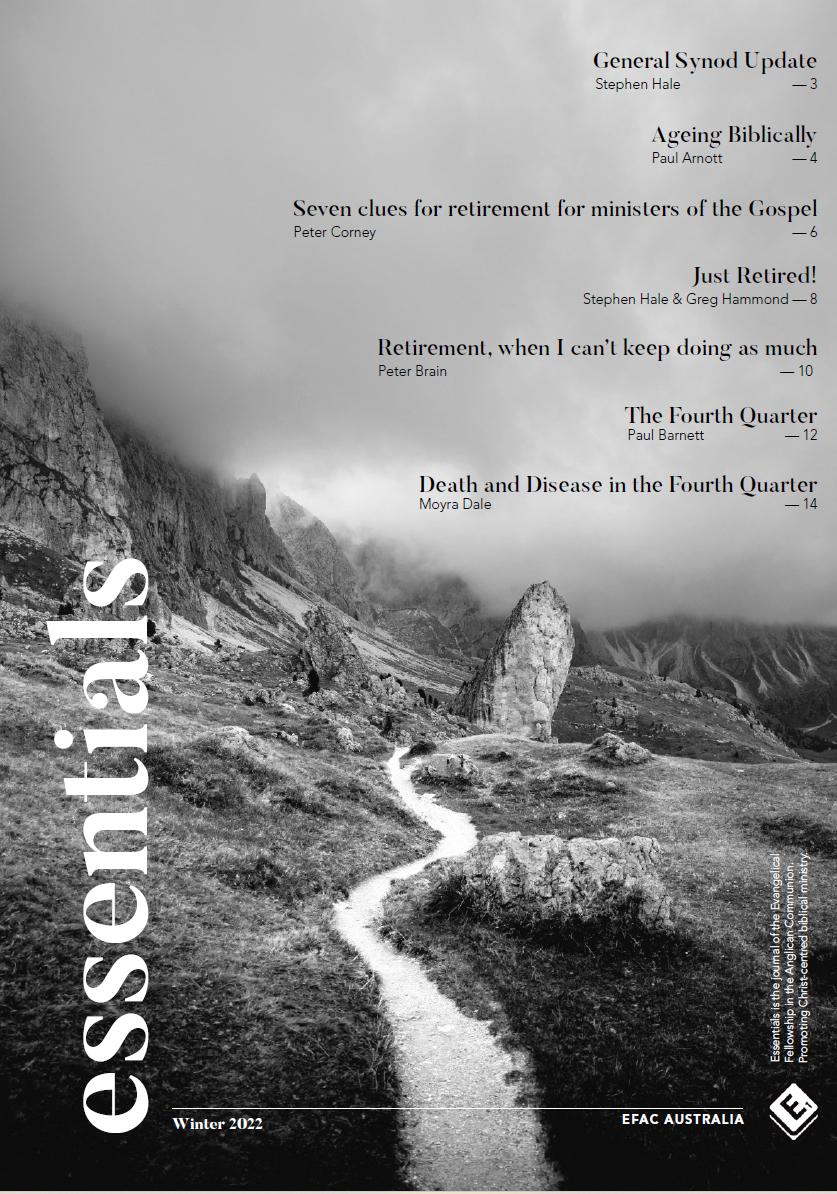
Essentials Winter 2022 pdf (4MB)
Essentials Autumn 2022 pdf (4MB)
Essentials Summer2021 pdf (3MB)
Essentials Spring 2021 pdf (3MB)
Essentials Winter 2021 pdf (3MB)
Essentials Summer 2020 pdf (3MB)
Essentials Spring 2020 pdf (1MB)
Essentials Winter 2020 pdf (1MB)
Essentials Autumn 2020 pdf (4MB)
Essentials Summer 2019 pdf (8MB)
Essentials Spring 2019 pdf (5MB)
Essentials Winter 2019 pdf (5MB)
Essentials Autumn 2019 pdf (5MB)
Essentials Summer 2018 pdf (5MB)
Essentials Spring 2018 pdf (5MB)
Essentials Winter 2018 pdf (5MB)
Essentials Autumn 2018 pdf (5MB)
Fresh Expressions Evaluation
- Details
- Written by: Guerin Tueno
In 2005 the Church of England published Mission Shaped Church.1 The Report recognised the drastic need for renewed mission work in England, but also the creative work already being done by groups that would be labelled as Fresh Expressions of Church. This term came not from their new-ness, but from their missional orientation; they were seeking to fulfil the ordinal's instruction for the ordaining of priests to proclaim the gospel afresh to each generation. It also liberated the work of mission from just the priest to the Church – looking back to Jesus' great commission in Matthew 28. Some read value judgments in the language employed – surely to call something 'fresh' is to imply 'staleness' in what already exists,2 but this is a value judgment not inherent in the name, and this led to Archbishop William's description of Anglicanism as a mixed economy3 in which the inherited and the fresh forms of church are both welcome and needed. Amid early excitement, there was an Australian adoption with Building the Mission Shaped Church in Australia.4 Sadly, this enthusiasm has waned.
What defines a Fresh Expression of Church? The Church Army in England set out ten parameters in a 2013 report:
- That the group is new (in their terminology, it was 'birthed'), rather than being a modification of an existing group.
- The group has sought to engage with non-churchgoers. They are not simply a new outreach programme of an existing church, but a new church with and for the unchurched to meet their cultural context rather than expecting them to confirm to an existing church paradigm.
- The new church community would meet at least once a month.
- The new church is to have its own name that reflects its identity, or is in the process of discerning its public nomenclature.
- The group is intended to be a church in and of itself, rather than being a bridge back into 'real church'.
- The church is Anglican – by which they mean it is accepted by the relevant Bishop as part of their 'Diocesan family'. The report stresses that being Anglican is not measured by use of centrally authorised texts or by being part of the parochial system.
- There is a system of leadership acknowledged both internally by the church itself and also from without by the Diocese and wider community.
- The majority of members see the group as their primary and major expression of being church.
- The group aspires to live out the four 'marks' of the church.
- The church is intended to be self-financing, self-governing and self-reproducing (ie, mission-shaped churches plant more mission-shaped churches, which are to be themselves 'fresh' and not simply replicating the parent church).5
ESL and Beyond: How English classes are just the beginning for gospel witness
- Details
- Written by: Mark Simon
Mark Simon with Louisa Afful, Sarah Hornidge and Kate Shrestha (Anglicare Sydney)
Mark Simon: All three of you are involved in cross cultural ministry through Anglicare. What are your particular roles?
Sarah Hornidge: I'm the Western Region crosscultural advisor. I support English as a Second Language (ESL) ministries in Western Sydney. Our team serves 100 church-based ESL classes through training, writing of resources, ongoing support for volunteers, and leading some classes myself.
Louisa Afful: As the Program Manager – Cross Cultural Services, I lead a team of eight Anglicare workers like Sarah active across all regions of Sydney and Wollongong in ESL ministry. We are also developing new initiatives to equip and support churches to widen their cross-cultural outreach beyond ESL with activities like cultural awareness training. The purpose of the team is to inspire, equip and support local churches as they reach out and respond practically to their multi-cultural communities and under God make Jesus known.
Kate Shrestha: I work in our church partnership team focused on Southwest Sydney, which is a very multicultural area. I work at building connections between churches and Anglicare, so that services like our mobile food pantry and family support programs are widely available.
Mark: What are some of the ways that churches you work with are reaching out to migrant and refugee communities?
Read more: ESL and Beyond: How English classes are just the beginning for gospel witness
Christians, Science, and Vaccinations
- Details
- Written by: Peter Corney
One of the things that has disturbed me as a Christian in the recent pandemic has been the number of Christians, and some pastors of congregations, who have questioned or sown doubts in the value and safety of the recent government national vaccination program. Sadly, this reveals a very shallow or faulty theology, and inadequate understanding of the Bible and our responsibility as stewards of the God given creation.
In our foundation story in Genesis 1:26-27 Christians learn that we are created in “the image and likeness of God”. We also learn that we are given by God the authority over creation and entrusted with the stewardship and care of it and the discovery and unfolding of its wonders.
One of the roles of scientists, and particularly bio-medical researchers is to fulfil that mandate, particularly in their work of preserving life, and in aiding the healing of the sick, and in preventing disease.
For many Christian scientists it is seen as a sacred privilege, duty, and vocation in which they engage with great dedication and care. They are also aware of the great tradition in which they stand of the Churches long commitment to compassion for, caring for, and the healing of the sick. In this they follow the example of Jesus in the Gospels. (Mark 1:29-42) This tradition has greatly influenced the medical community in general. For example, many of our public hospitals have their origins in Christian foundations. I had the privilege of serving a congregation for many years whose members included many in senior roles in the medical and scientific community, who all saw their work in this light.
Three Benefits of Fostering a Multicultural Church
- Details
- Written by: Ben Clements
Three Benefits of Fostering a Multicultural Church
Benjamin Clements Assistant Curate Deep Creek Anglican Church
If you were to ponder three or four words that describe your church or ministry, would 'multicultural' be one of them? Christians can hold a variety of views around multicultural ministry.
Perhaps you are curious about multicultural churches but aren't sure what the benefits might be. Or perhaps you've been considering pursuing a more multicultural community in your church but aren't sure how to communicate it biblically or pragmatically with others. In this article, we will consider three benefits of fostering a multicultural church.
What is a 'multicultural' church?
Before we discuss the benefits of fostering a multicultural church, it's important to consider what 'multicultural' is. Demarcations of race and ethnicity are certainly major categories which constitute a person's culture, but so are lesser considered differences, such as generational age groups, differences in income, profession, education, and gender. While it's always beneficial to consider multicultural in the broadest sense of the term, we will give particular focus to demarcations of race and ethnicity in this article.
Read more: Three Benefits of Fostering a Multicultural Church
Book Review: Changing Lanes, Crossing Cultures
- Details
- Written by: Mark Simon
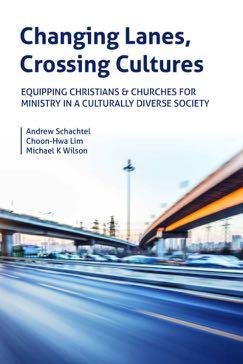 Changing Lanes, Crossing Cultures: Equipping Christians and churches for ministry in a culturally diverse society
By Andrew Schachtel, Choon-Hwa Lim and Michael K Wilson
Sydney: Great Western Press, 2016
Reviewed By Mark Simon, Lecturer In New Testament And Research Associate, Ridley College, Melbourne
Changing Lanes, Crossing Cultures is a timely and practical book for individuals and churches wishing to begin or enhance an existing cross-cultural gospel ministry within Australia. Using the analogy of good driving habits, the book seeks to outline the why, what, how, and when of reaching ethnic minorities with the gospel. The book is structured in 6 modules which are designed for study by a church leadership group such as a parish council, or a local missions task-group. The modules are (in turn):
- The biblical motivation for ministry across cultures; ‘the why’
- Ministry in an ethnically diverse society; ‘the why’
- Dealing with hindrances to ministry across cultures; ‘the what’
- Increasing your cultural intelligence and skills; ‘the how’
- The importance of leadership and management for ministry across cultures; ‘the how’ and
- Where to from here? ‘the how and when.’
Module 1 covers some of the same territory broached in Ben Clements’ article in this volume of Essentials; that is, biblical and pragmatic motivations for cross-cultural ministry.
Module 2 details the increasingly multi-ethnic nature of Australian society: over a quarter of Australia’s population come from approximately 200 different overseas countries. It elaborates how different immigrants might express their ethnicity from isolation to assimilation.
For me, modules 3 and 4 were the most practical, since they equipped me as a church leader to tackle the default ethnocentrism of my own church. Simply naming the illegitimate hindrances to ministry to ethnically-diverse communities is liberating. The book identifies the following ones: no burden for the lost; over-dependence on social factors and feeling comfortable within one’s own people group; ethnic difference; ethnocentrism and racism; painful history; lack of gospel-driven leadership; preserving church culture; confusion of gospel and culture; cultural barriers; cultural distance; lack of community; spiritual opposition. Having identified these illegitimate barriers, the book encourages us with a reflection on Peter’s cross-cultural awakening in Acts 10, and then tabulating possible solutions for each one (pages 82-86). The book is worth its price for these pages alone!
Module 4 continues by dealing with the nuts and bolts of improving cultural intelligence. It introduces six lenses through which cultural difference can be understood. This chapter also encourages all Christians to take the time to observe, listen, and learn from the ethnic groups around us. Lastly, it points out that practising hospitality is a sure-fire way to develop relationships with minority ethnic contacts, and to grow in cultural intelligence.
Modules 5 and 6 round out the book with material on the cultural dimensions of leadership, and some ways of planning to launch or enhance ministries to ethnic minorities in our own communities. Most Australian churches now periodically engage in some form of mission action planning or strategic planning for ministry. Incorporating study of this book in the next round of your church’s planning cycle would help to ensure you are not neglecting this burgeoning harvest field so close at hand to many of our churches today.