
Essentials
Editorial - Spring 2022
- Details
- Written by: Gavin Perkins
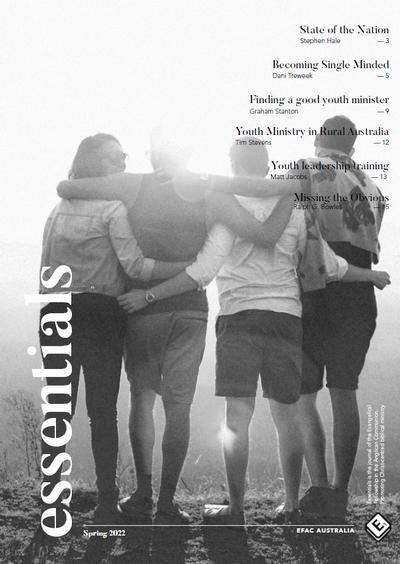
With the last edition of Essentials having a focus on retirement, we considered it highly appropriate that this edition should turn the focus onto youth ministry! Graham Stanton writes on how to find a good youth minister, while Tim Stevens and Matt Jacobs reflect on youth ministry in country and regional areas respectively. As I read over those articles it occurred to me that perhaps youth ministry and the opportunities of retirement are not so far apart after all, especially in country areas.
In a time of unsettledness and challenge for evangelical Anglicans in Australia it is vital to be reminded of the ever-present task before us of reaching, discipling, and training the next generation of servants of Christ in our churches.
It is no easy task to boil down the key insights and applications of a PhD dissertation into a feature length article, but that is precisely what Dani Treweek has done for us in this edition. She masterfully leads us in clear thinking about singleness as well as showing powerfully the pastoral challenge and mission opportunity that singleness represents in our churches and communities. While Dani’s work is a vital contribution to many ongoing debates, I read her article as a profound challenge to do better in our church at loving and reaching the single within our church and in our town.
With these contributions and others besides, I commend to you this Spring edition of Essentials.
In Christian Fellowship
Gavin Perkins
Bowral, NSW.
State of the Nation
- Details
- Written by: Stephen Hale
 What is the current state of play in the Anglican Church in Australia*? That’s a big question and the following are a few perspectives.
- Encouragements
It used to be that there were three evangelical Dioceses in Australia – Sydney, Armidale and North West Australia. It was that way for a long time. Today we can be encouraged by a big shift. Many Dioceses have changed or are changing! It is a fundamental realignment. Even in Dioceses where evangelicals are in a minority, there are great signs of change and growth. This showed up more fully at General Synod in both the range of speakers from right across the country and also in the election results.
This growth and change can be attributed to many factors (in no particular order):
- Two strong theological Colleges in Moore and Ridley (are they the two strongest Anglican Theological Colleges in the western world?)
- Healthy and encouraging episcopal ministry in many places
- The work of BCA/CMS
- EFAC’s role in being a fellowship and a place of encouragement for gospel ministry and biblical preaching. People know each other across our country because of the many Conferences held over many decades
- Healthy models of good parish ministry and good quality clergy and high calibre lay leadership
- An ongoing commitment to ministry with children and families and young people
- Strong student ministry
- Church planting and evangelism
- People’s willingness to participate in Synods both nationally and in their own Dioceses
- Community care expressed in all sorts of ways in all sorts of places
- Work in schools
- Cross cultural ministry and the growing number of language specific (non-English) churches
- Indigenous ministry and partnerships
- Challenges
There is much one could say here as well, but here are five major challenges.
- The future of the parish
In many parts of the country the parish system is struggling to survive. This is particularly the case in remote rural Australia, as well as in parts of our major cities where the demographic realities (aging congregations) are now pushing many churches into precarious places. The first step is often moving to part time ministry and then the cobbling together of unviable churches as a way of continuing on. Most people go to the church of their choosing and this has big implications as to the shape and relevance of the so-called local church. How many micro churches can a Diocese sustain and how do we manage decline while responding to new opportunities for growth? - Rebuilding during an ongoing health crisis
Generally speaking, many churches are 20% to 30% smaller in mid-2022 than in mid-2019. This has been very tough as people are having to manage two things simultaneously: maintaining ministry in a context where the impact of illness is a week in and week out reality and having less people overall. At the same time, many people are seeking to rebuild ministries that may have fallen away during these past two years. The overall sense is that many people are both exhausted and somewhat disheartened. - Children’s, Families and Youth
There has been a general decline in the number of children, families, and young people with whom churches are connecting with. While there has been a necessary focus on being child safe, this has made the task of raising volunteers much more complex and challenging. New innovative ideas are needed for connecting with non-church children and families as well as young people. Helping young people (and their parents) to navigate the complex sexual and identity issues of our day is incredibly demanding and pastorally challenging. - Ordained Ministry
At present there is an increasing concern that the number of people offering for ordination is not sufficient to meet the ongoing needs into the future. Whether this is a temporary blip, or an on-going trend is unclear. Many (one could even suggest, far too many) clergy are being asked to go into unhealthy churches in the hope of pulling off a revival. While this is possible and does happen, in many cases it leads to people being crushed and often leaving ministry. In the main, most clergy would prefer to work in a team rather than on their own. It is easier to start a new church than to turn around an established church. - Evangelism
For the last decade or more there has been a huge conversation going on about mission and how we enable our churches to become missionally effective. These conversations have been important. At the same time, it has become increasingly complex and to some extent overwhelming. There are so many ways forward being promoted that it can be confusing and disempowering for many people. In the midst of all of this discussion and ferment we seem to have lost sight of simply seeking to see people come to faith. In a context where the wider culture is seemingly running against us, this passion for the gospel and for reaching the lost needs to be recaptured and encouraged. In God’s providence the language specific (non-English) ministries set a shining example for us.
Bishop Stephen Hale
Chair, EFAC Australia and EFAC Global
*Contention around orthodoxy and marriage were addressed in my report on General Synod in the last edition.
Essentials - Spring 2022
- Details
- Written by: Gavin Perkins
Essentials Spring 2022 pdf (4MB)
Essentials Winter 2022 pdf (4MB)
Essentials Autumn 2022 pdf (4MB)
Essentials Summer2021 pdf (3MB)
Essentials Spring 2021 pdf (3MB)
Essentials Winter 2021 pdf (3MB)
Essentials Summer 2020 pdf (3MB)
Essentials Spring 2020 pdf (1MB)
Essentials Winter 2020 pdf (1MB)
Essentials Autumn 2020 pdf (4MB)
Essentials Summer 2019 pdf (8MB)
Essentials Spring 2019 pdf (5MB)
Essentials Winter 2019 pdf (5MB)
Essentials Autumn 2019 pdf (5MB)
Essentials Summer 2018 pdf (5MB)
Essentials Spring 2018 pdf (5MB)
Essentials Winter 2018 pdf (5MB)
Essentials Autumn 2018 pdf (5MB)
Webinar on US Evangelicalism
- Details
- Written by: Chris Appleby
This Webinar with Rev Dr Mike Bird and Rev Heather Cetrangolo was held at Ridley College on June 7th 2022
Book Review: Cynical Theories
- Details
- Written by: Tim Horman
Cynical Theories: How Activist Scholarship Made Everything about Race, Gender, and Identity — and Why This Harms Everybody
By Helen Pluckrose And James Lindsay, 2020.
Pitchstone Publishig, 2020
Reviewed By Tim Horman
Helen Pluckrose, editor of Aero magazine, and James Lindsay, a mathematician and cultural critic, have written Cynical Theories to explain how Critical Theory has become a driving force of the contemporary culture wars, and to propose a “philosophically liberal way to counter its manifestations in scholarship, activism, and everyday life.” Their book traces the evolution of postmodern and post-structuralist theory over the last 50 years, showing how these theories have moved beyond the academy and into popular culture, particularly the modern Social Justice Movement. Cynical Theories is a story about how the “despair and nihilism” of postmodernism found confidence, which then developed into the sort of radical conviction “normally associated with religious adherence.”
The story, as Pluckrose and Lindsay tell it, begins with the ‘postmodern turn’ of the late 1960’s. Postmodern and post-structuralist academics such as Jean Lyotard, Jacques Derrida, and Michel Foucault, began to deconstruct what the authors call the “old religions” of human thought, which included traditional religious faiths like Christianity, secular ideologies like Marxism, and “cohesive modern systems, such as scientific approaches to knowledge, philosophical liberalism, and the concept of progress.” Early postmodern theory achieved this by questioning the capacity of language to produce meaning, by rejecting the legitimacy of metanarratives, and emphasising the endless deferral of truth or objectivity, since ‘truth’ is merely the socially constructed effect of language games. Such ideas were effective at dismantling those ‘old’ modes of thought, but not particularly useful for reconstructive social change.
Retirement, when I can’t keep doing as much
- Details
- Written by: Peter Brain
 Having recently celebrated my 75th birthday means I have been retired from full-time ministry for five years. When I retired from Armidale in 2012 I joked, ‘rooster today, feather duster tomorrow’! Thankfully, someone said to me, ‘Peter, don’t forget that feather dusters are still useful!’ I value that comment because I have not found retirement an easy gig, even though it has been very fulfilling. I have had to work hard at reminding myself of truths which I have always believed – truths such as my worth not in being a pastor but as one justified by faith and adopted by God, and of the priesthood and ministry of all believers. I am also thankful to God for the example of many older believers and must be content, like them, to take a back seat and look for opportunities to minister in different ways. Retiring from stipendiary ministry does not mean retiring from ministry.
It is actually a great relief not to have all the institutional and local-church leadership responsibilities. Locum stints have reminded me of this, as I have once again felt the great pressures upon those who are serving as Rectors and Vicars. I have a growing appreciation of the demands of local-church pastoring, especially during the pandemic.
I have resolved not to fall into that most debilitating sin of being a grumpy old minister, which Hebrews 12:15 calls ‘bitterness’. The antidote that I am learning to employ is thankfulness to God for what I can do rather than moaning about what I can no longer do, for the younger pastors under whose ministry I am privileged to sit and the people in the congregations who are there because of God’s sovereign work of grace in them as in me.
Hebrews’ exhortation in 10:24-25 has reminded me that church is not about me – I am to intentionally consider how to help others to love and good deeds. It is a team game, where we run and train together, professing Christ (10:23) by turning up every week to spur each other on. Could we ever imagine Pat Cummins going fishing or water skiing when a Test is on?
We are conscripts in Christ’s service. Where did the (mistaken) concept of believers being volunteers come from? I do know that it is the source of much discouragement to local church pastors and leaders, and a danger to those who have fallen into its seductive arms. The alternative? To recognise that the greatest gift we can give our brothers and sisters in Christ is to turn up every week (planning trips away or catch-ups with friends mid-week rather than on Sundays), with an expectant and considerate heart.
Healthy congregations cannot be built on faithful preaching alone but on the backs of disciples who encourage each other with thoughtful words (Ephesians 4:29) and selfless actions (Galatians 5:13).
Many retired people have been a great blessing to me. One was Jean, whom I met in Wee Waa as she and the music team were tuning up. ‘Bishop,’ she asked, ‘what do you think of all these new tunes to the old hymns?’ I replied, ‘Jean, there are many young people around the Diocese who are singing these old hymns because of the new tunes.’ I was much encouraged when she replied, ‘Well that’s good enough for me!’
She gave up her ‘druthers’ because she was glad younger believers were benefitting from those older hymns. The second was Billy, who moved into an Armidale nursing home to be with his wife. The icing on the cake of that selflessness was his asking me to buy $100 worth of gospels and tracts so he could share Christ with the old people! I want to be like them. Retirement means I now need to consciously look for these opportunities, but they are there. Retirement gives me more time to pray for these opportunities to share, and for the people God has led me to.
I am learning to know my limits (the heart is willing but the boy is weak – oops I just noticed the typo – the body and the boy are weak) and I need to examine my motives. Mind you, if I had waited for my motives to be faultless in ministry I probably would not have done anything! So I tell Satan to get lost, whilst asking our Lord for forgiveness and grace (Hebrews 4:14-16 is so realistically encouraging). Selfcare is vital so we can work and pray well until He takes us home. The line from Morning Prayer, ‘whose service is perfect freedom’, has been on my heart for 55 years; I thank God for it and for those who have exemplified its truth to me.
W H Griffith-Thomas’s words remain true.
What I have, He claims;
What He claims, I yield;
What I yield, He takes;
What He takes, He fills;
What he fills, He uses;
What he uses, He keeps;
What he keeps, He satisfies.
Bishop Peter Brain is the former Bishop Of Armidale who these days has a great ministry as a locum. He is married to Christine and they have four adult children and multiple grandchildren. Peter published Going the Distance in 2004. Somewhat appropriately the sub title is ‘How to stay fit for a lifetime of service'.
Book Review: Jerks at Work
- Details
- Written by: Tim Foster
 Jerks at Work: Toxic Coworkers and what to do about them
JESS WEST
WHEATON: CROSSWAY, 2020
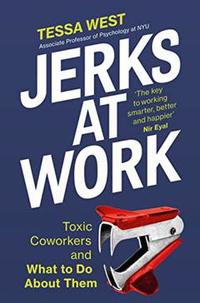
This recently published book offers excellent advice to church leaders. It’s great to see a non Christian writer who recognises the impact of sin, both on the way we lead and on the behaviours of others. You can substitute ‘parishioner’ here for ‘co-worker’ and find good advice on how to deal with challenging people who sap our time and emotional energy. As a social psychologist West categorises different kinds of toxic co-workers (the kiss up/kick downer, the free rider and the gaslighter, to name a few) and describes how best to engage with each of them.
Tim Foster is the Vice Principal of Ridley College and the Director of the Ridley Centre for Leadership.