
 Laws that outlaw speech are the biggest threat to religious freedom in Australia at the moment.
There has been a recent explosion of laws that restrict speech. In the 34 years from 1989-2023, there were 19 Bills that imposed restrictions on speech. The same number of Bills have been passed in the last 26 months.
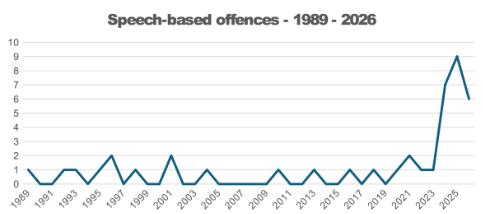
These new laws prohibit or regulate hate speech, vilification, right wing ideology, conversion practices and harmful online content.
The particular concern for religious freedom arises from moves to suppress speech merely on the basis that is hateful or offensive. Compounding this, in some jurisdictions this is assessed subjectively or from the perspective of a member of the target group. This means that hate speech becomes ‘speech that I find hateful’ and offensive speech is ‘speech that offends me’.
In the UK, it is a criminal offence to use an ‘electronic communications network’ (e.g., Facebook or WhatsApp) to send a message that is ‘grossly offensive’ or which is ‘for the purpose of causing annoyance, inconvenience or needless anxiety’.[i] In April 2025, the Times reported that the UK police were making 30 arrests a day for offensive online messages.[ii] Furthermore, under Section 4A of the Public Order Act 1986 it is a crime to use ‘threatening, abusive or insulting words’ ‘with intent to cause a person harassment, alarm or distress’. There were 11,876 prosecutions under this section in 2024/25.[iii] There have been a wave of cases of Christian street-preachers who have been arrested under this provision, including for making biblical statements about homosexuality,[iv] alleged ‘misgendering’[v] and for preaching criticising the Quran that caused distress to Muslims.[vi] The fact that in many cases the charges were eventually dropped does not undo the gross imposition on religious free speech at the point of arrest.
Criminalising so called ‘hate-speech’ is wrong, because it undercuts the principles of tolerance that underpin our western liberal democracy. It blurs the distinction between speech that is awful and speech that is unlawful. Our laws impose two types of appropriate limits on speech.
The criminal law is the mechanism used by the state to protect people against attacks on themselves or their property. In the same way that attempting to commit a crime or conspiracy to commit a crime is subject to the same maximum penalty as the crime itself, speech that incites others to commit a crime is itself a crime, and speech that threatens a criminal act is itself a crime. But if the underlying action or position is not a crime, then speech advocating for that action or position should not be a crime either.
The civil law provides a mechanism to provide redress where the actions of one party have caused harm to another. This includes speech - what I say might have consequences in defamation law, intellectual property law and anti-discrimination law. Civil law doesn’t criminalise these kinds of speech. Rather, it holds people accountable for the consequences of their speech – for slanderous comments that cause reputational harm, for example.
But if speech is not criminal because it threatens a crime or incites a crime, and there isn’t a personal or economic harm caused by that speech that warrants civil redress, then the state does not have a role to play in regulating speech.
Instead, we must tolerate speech that is merely awful, but not unlawful. Toleration is a core tenet of a liberal democracy. It is the decision not to prohibit or repress the words or actions of others that I find incorrect, undesirable or objectionable. It is captured aptly by the most famous thing Voltaire never said ‘I disapprove of what you say, but I will defend to the death your right to say it’. Historically, this Enlightenment principle arose from a religious war in the 17th century. After 30 brutal years of Protestants and Catholics killing each other over religious beliefs, people realised that the imposition of faith by force cannot work, and that religious toleration of different beliefs was essential for society. Out of this religious toleration develops the modern idea that freedom of thought, conscience and belief is intrinsic to what it is to be human.
The framework above highlights two key problems in recent legislative attempts to regulate speech.
PROBLEM 1: CRIMINALISING SPEECH WHICH SHOULD NOT BE A CRIME.
As noted above, Inciting violence is (and should be) a crime because violence is a crime. Inciting hatred should not be a crime, because it is not a crime to hate someone. Instead, inciting hatred – otherwise known as vilification – is (and should be) a civil offence (see further below). However, there have been recent moves to introduce criminal vilification provisions. In response to rising antisemitism, the NSW Government added s.93ZAA to the Crimes Act. Section 93ZAA makes it an offence, punishable by up to 2 years in prison, to intentionally incite hatred on the ground of race causing a reasonable member of the target group to ‘fear harassment, intimidation or violence’ or ‘fear for [their] safety.’
A criminal provision for hate crimes should not be determined by the fear of a reasonable member of the target group. It is unclear whether the breadth of ‘harassment, intimidation or violence’ include subjective psychological states or feelings – e.g., ‘I felt intimidated’ or ‘I felt harassed’. If so, then preachers beware! Suppose a preacher proclaims ‘Jesus is the only way to salvation. Being a Muslim won’t save you. Being Jewish won’t save you’. Would a reasonable Jew be ‘fearful’ about their eternal salvation, or feel intimidated by this? If so, then the preacher has committed a criminal offence. Section 93ZAA criminalises the exclusive claims to eternal salvation of different religions.
This concern is compounded if the protected attributes are expanded beyond race to include sexual orientation and gender identity. Traditional Biblical teaching on sexual ethics might be viewed by a member of the LGBTQI+ community as ‘intimidating’ or ‘harassing’, but this does not therefore make it appropriate to restrict free speech or the ability of a Christian church, school or parents from teaching or preaching in accordance with their doctrines, tenets and beliefs.
In January 2026, the Federal government also sought to introduce a criminal vilification provision as part of the Combatting Antisemitism Hate Extremism Bill 2026. Section 80.2BF made it an offence, punishable by up to 5 years imprisonment, to publicly promote or incite racial hatred, where ‘conduct would, in all the circumstances, cause a reasonable person who is the target, or a member of the target group, to be intimidated, to fear harassment or violence, or to fear for their safety.’ It is extraordinary that a sentence of imprisonment of up to 5 years could arise from speech that a person merely regards as ‘intimidating’ or ‘harassing’. Like section 93ZAA, this clause was directed at racial vilification, but government ministers signalled a willingness for this to be expanded to other protected attributes.
This caused provoked widespread opposition from faith leaders and free-speech advocates, and this part of the Bill was withdrawn by the government.
PROBLEM 2: ‘LOW BAR’ CIVIL OFFENCES FOR SPEECH OFFENCES.
Traditionally, civil vilification laws had a ‘high bar’. Legislation defines vilification to mean inciting hatred, serious contempt or severe ridicule. The high threshold established by this test is consistent with the role of the civil law – to provide redress where someone’s actions cause direct and material harm to another person. The law does not – and should not – exist to protect us against hurt feelings or being offended.
But there are unfortunate examples where legislators have got this wrong and made it an offence to offend or insult. In 1995, s.18C was added to the Racial Discrimination Act. Section 18C of the Racial Discrimination Act makes it unlawful for someone to do an act that is reasonably likely to ‘offend, insult, humiliate or intimidate’ someone because of their race or ethnicity.
Section 17 of the Tasmanian Anti-Discrimination Act 1998 prohibits ‘conduct which offends, humiliates, intimidates, insults or ridicules another person’ where a ‘reasonable person… would have anticipated that the other person would be offended, humiliated, intimidated, insulted or ridiculed.’ In 2014, the range of protected attributes in the Act was expanded to include, for example, gender identity. This enabled Martine Delaney, a transgender activist and Greens candidate to lodge a complaint with the Tasmanian Anti-Discrimination Commission in late 2015 against Tasmanian Catholic Archbishop Julian Porteous. The complaint was in relation to the distribution by Porteous of a leaflet entitled Don’t Mess with Marriage to the families of those attending Catholic school in Tasmania, to inform them of the church’s position on the meaning of marriage. The complaints process limited Archbishop Porteous’ ability to participate in advocating for the Catholic doctrine of marriage in the public square in the lead up to the postal vote about same-sex marriage. The complaints process dragged on for 9 months, until it was withdrawn by the complainant.[vii]
‘Insult’ and ‘offend’ provisions such as these are used by activists to silence Christians in the public square. They encourage confected outrage so as to claim victim status, which then engages the machinery of the complaints process against an opponent. Even if the complaint is ultimately unsuccessful, the process is the punishment. As Christians, what should we do in response to laws like this that threaten religious freedom?
We should strenuously oppose laws that inappropriately restrict speech. Neither criminal nor civil law should be used to impose a particular vision of the social good. We have to preserve the space for legitimate disagreement and dissent. Laws restricting speech should not be used to impose a uniformity of ideology regarding the world.
The right response to the awful speech is not to make it unlawful, and not to suppress it by deplatforming people or ‘take down’ orders for online content, but to counter it with good speech. A commitment to free speech entails a commitment to robust public debate with civility that is prepared to call out awful speech. A commitment to tolerance doesn’t mean that we applaud bad speech or stand passively on the sidelines.
The antidote to bad speech is not to suppress it but to challenge it in the free market of ideas through robust public debate, so that the truth may prevail.
The Right Reverend Dr Michael Stead is Bishop of South Sydney
[i]Section 127 of the Communications Act 2003; non-digital communication is similarly coverer by s.1 of the Malicious Communications Act 1988.
[ii] https://lordslibrary.parliament.uk/select-communicationsoffences-and-concerns-over-free-speech/
[iii] https://www.parallelparliament.co.uk/question/HL10453/public-order-offences-arrests-and-convictions
[iv] https://www.christian.org.uk/case/john-craven/
[v] https://christianconcern.com/news/win-for-street-preacher-asmisgendering-conviction-overturned/
[vi] https://persecution.org/2025/03/14/british-preacher-whopublicly-criticized-quran-found-not-guilty-of-hate-crime/
[vii] Section 127 of the Communications Act 2003; non-digital communication is similarly coverer by s.1 of the Malicious Communications Act 1988.