
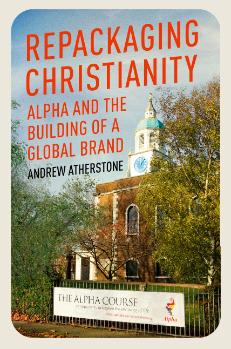
 Repackaging Christianity: Alpha and the Building of a Global Brand.
Andrew Atherstone
Hodder & Stoughton, 2023
Reviewed by Peter Macpherson
This is an easily readable account of Alpha’s origins and development over the past thirty years. The title might suggest it is a polemic but in essence it is a history. Andrew Atherstone, after all, is a serious ecclesiastical historian. He is Professor of Modern Anglicanism, Tutor in History and Doctrine at Oxford University and Latimer Research Fellow at Wycliffe Hall. He lists his major research interests as “Anglicanism and Evangelicalism between the 18th and 21st centuries.” Although this is not a long book it concludes with 53 pages of endnotes, detailing Atherstone’s reliance on archives, diaries, interviews and parish magazines.
Alpha began in the late 1970s as an in-house discipleship course at an Anglican church in London called Holy Trinity Brompton (HTB). It was described as “a course on Christian foundations … designed to help those who want to go on in the Christian life” and had six sessions. The curate, Charles Marnham, ran the course in his flat above the church hall and food was provided because those attending were often coming straight from work.
The development of Alpha over the next 15 years was tied up with the renewal of HTB as a church under the leadership of three vicars: Raymond Turvey, John Collins and Sandy Millar. Evangelism and renewal became part of the culture of the church. Collins, for example, had been a curate under John Stott, had led David Shepherd (later Bishop of Liverpool) and David Watson to faith, and also eagerly embraced the renewal of the 1960s & 1970s. It was David Watson who recommended John Wimber to Collins in 1982. Wimber became (in Atherstone’s description) the “Californian catalyst” to HTB’s growth and had a profound spiritual impact on the church, especially on then curate, Nicky Gumbel.
Gumbel took over running Alpha in 1990 and changed it from a discipleship course to an evangelistic course. 1993 marked the publication of Gumbel’s basic text Questions of Life and the launch of Apha internationally. The first conference attracted over a thousand delegates from the UK, France, Germany, Spain, Switzerland, Singapore, NZ and the USA. Over the next thirty years Alpha grew into what Atherstone describes as “a global phenomenon.” He details the annual attendance figures (over a million each year since 2003), the amount of money generated, the sales figures for Gumbel’s books, and the move from recorded talks to the film series.
A key reason to read this book is to discover why Alpha has become the “global brand” that it has. Atherstone doesn’t provide any extended analysis of this but reasons emerge as he tells the story. Alpha would not have developed without Sandy Millar and Nicky Gumbel’s leadership, determination and giftedness. Over decades at HTB the Eton and Cambridge-educated pair combined to break the mould of what a local Anglican church might achieve. In the mid 90s they started to feel impelled by God to share Alpha with the world. In just two years 9,000 church leaders attended Alpha conferences and 1,500 courses were registered (p.57). The content of the course was re-worked a number of times by Gumbel and he wrote most of the books. This was accompanied by professional marketing which was used to promote national and international Alpha campaigns. Celebrity Christians from the worlds of sport, entertainment and politics added lustre and credibility. Despite all this, both Millar and Gumbel placed the emphasis on prayer. In 2001 there were over 18,000 people involved in 600 Alpha prayer meetings. Two years later there were also Alpha prayer meetings at Anglican cathedrals in Coventry, London, Manchester, Oxford, St Albans and York. Before the 2004 campaign a giant prayer meeting was held on Clapham Common with 4,000 people attending. Prayer remained a constant characteristic of Alpha.
Another, more controversial, reason for Alpha’s growth has been the focus on the Holy Spirit. Miller, Gumbel and HTB generally have been influenced positively over the years by the charismatic renewal, the Toronto blessing and the ministries of David Watson and John Wimber. The weekend away with its focus on the Holy Spirit had profound impact on many attendees. Healing, tongues and lively worship became part of the HTB/Alpha culture. Atherstone notes, however, that Gumbel has more recently balanced a theology of blessing with a theology of suffering, shaped by experiences of illness and death in his own pastoral ministry.
The final three chapters look at Alpha’s growth among Roman Catholics, its support of social justice and its involvement in global mission. Throughout these chapters we see how Alpha has adapted and matured from “supper party evangelism in the Kensington suburbs into a global brand of Christian outreach, contextualised into multiple cultures and languages across the planet” (p.240). It is used in multiple denominations and all types of churches; it is used in prisons, schools and boardrooms; it began as cassettes and videos and is now available free online. Latest figures record that Alpha is available in over 150 countries and has been translated into over 100 languages.
Nicky Gumbel’s “studied silence” on homosexuality (p.181) has been problematic. Atherstone details how the initial conservative chapter on homosexuality in Gumbel’s Searching Issues was modified over time and finally deleted altogether. This is all part of Apha’s attempt to avoid controversy so that the gospel can be heard by as many people as possible. Perhaps HTB’s recent membership of the Church of England Alliance network will reassure some critics.
Like it or loathe it, Alpha continues to help many people come to faith in Jesus Christ. It has had its critics and although Atherstone is not shy in quoting many of them (eg “join-the-dots Christianity,” “theological vacuity,” “a toothless and sentimental gospel”) this is a generally positive telling of the story. If you love Alpha this history will inspire you. If you loathe it, you still might be inspired, inspired to develop your own evangelistic course. Anyone committed to evangelism, mission and church growth will benefit from reading this generous account.
Rev Canon Peter MacPherson is Canon of Preaching & Teaching, St Paul's Cathedral, Melbourne.