
Essentials
Organisational Faithfulness
- Details
- Written by: GREG HAMMOND OAM

It’s the exception that an organisation stays true to its mission.
The natural course - the unfortunate natural evolution of many
originally Christ-centered missions - is to drift.
This statement by Chris Crane, then President and CEO of Edify and a former President and CEO of Opportunity International, is quoted in the recent book, Keeping Faith.[i] Although Chris Crane was speaking from an American context, the secularisation of Christian organisations is a worldwide phenomenon.[ii]
The authors of Keeping Faith further note “We believe that the most important thing that God requires of Christian organisations is faithfulness to the Christian life: expressed in the Bible and modelled by Jesus. This faithfulness is maintained by ensuring an overlap between the ethos (culture, spirit) of an organisation with its Christian identity and the impact that it has.[iii]
Synodically Governed
- Details
- Written by: Timothy Arnold-Moore
 Synod is the Parliament of the Anglican Church. The word “synod” comes from the Greek synodos (σύνοδος) – a common way or path.[1] Unlike historic synods, modern Anglican synods, a largely Australian invention, have significant lay representation affirming the priesthood of all believers, and the Westminster tradition of nobility and commoners separately represented.[2] Synods are a powerful tool for oversight, governance and promoting a shared vision for the ministry and mission of the Church. As a human governance construct, it has strengths and weaknesses reflecting our fallen humanity and need for the saving love of Jesus.
A long history but a short one
Synods have been called throughout the Church’s history. Although the specific word is not used in the New Testament, many consider the Council of Jerusalem in Acts 15 to be the first synod[3] and the archetype for all future synods. Following this example, the purpose of a synod is to resolve disputes[4] and discern together the Holy Spirit’s will for the church.[5] Meetings of mostly clergy often just bishops,[6] referred to as synods and common in the early church, continue in Roman and Eastern churches agreeing on canon,[7] worship practice, and the dates of Easter, [8] and the response to the Reformation. [9] Synods continued in the Church of England as Convocations of Canterbury and York meeting regularly until 1664. [10] Once major doctrinal positions were settled, the English church was largely governed by the monarch and Parliament[11] and clergy synods met more sporadically, often without debate, until their permanent revival in 1966.[12]
EFAC Statement of Faith and Declarations
- Details
- Written by: Chris Appleby
EFAC Statement of Faith and Declarations
As members of the Anglican Communion within the one, holy, catholic and apostolic church, we affirm the faith, which is uniquely revealed in the holy Scriptures, set forth in the catholic creeds, and of which The Thirty-Nine Articles of Religion are a general exposition. Standing in the Reformed tradition, we lay special emphasis on the grace of God – his unmerited mercy – as expressed in the doctrines which follow:
-
God as the Source of Grace
In continuity with the teaching of Holy Scripture and the Christian creeds, we worship one God in three Persons – Father, Son, and Holy Spirit. God has created all things, and us in his own image; all life, truth, holiness, and beauty come from him. His Son Jesus Christ, full God and fully man, was conceived through the Holy Spirit and born of the Virgin Mary, was crucified, died, rose and ascended to reign in glory. -
The Bible as the Revelation of Grace
We receive the canonical books of the Old and New Testament as the wholly reliable revelation and record of God’s grace, given by the Holy Spirit as the true word of God written. The Bible has been given to lead us to salvation, to be the ultimate rule for Christian faith and conduct, and the supreme authority by which the Church must ever reform itself and judge its traditions. -
The Atonement as the Work of Grace
We believe that Jesus Christ came to save lost sinners. Though sinless, he bore our sins, and their judgment, on the cross, thus accomplishing our salvation. By raising Christ bodily from the dead, God vindicated him as Lord and Saviour and proclaimed his victory. Salvation is in Christ alone. -
The Church as the Community of Grace
We hold that the Church is God’s covenant community, whose members, drawn from every nation, having been justified by grace through faith, inherit the promises made to Abraham and fulfilled in Christ. As a fellowship of the Spirit manifesting his fruit and exercising his gifts, it is called to worship God grow in grace, and bear witness to him and his Kingdom. God’s Church is one body and must ever strive to discover and experience that unity in truth and love which it has in Christ, especially through its confession of the apostolic faith and in its observance of the dominical Sacraments. -
The Sacraments as the Signs and Seals of Grace
We maintain that the Sacraments of Baptism and Holy Communion proclaim the gospel as effective and visible signs of our justification and sanctification, and as true means of God’s grace to those who repent and believe. Baptism is the sign of forgiveness of sin, the gift of the Spirit, new birth to righteousness and entry into the fellowship of the People of God. Holy Communion is the sign of the living, nourishing presence of Christ through his Spirit to his people; the memorial of his one, perfect completed and all- sufficient sacrifice for sin, from whose achievement all may benefit but in whose atoning self-offering none can share; and an occasion to offer through him our sacrifice of thanksgiving and praise. -
Ministry as the Stewardship of Grace
We share, as the people of God, in a royal priesthood common to the whole Church, and in the community of the Suffering Servant. Our mission is the proclamation of the gospel by the preaching of the word, as well as by caring for the needy, challenging evil and promoting justice and a more responsible use of the world’s resources. It is the particular vocation of bishops and presbyters, together with deacons, to build up the body of Christ in truth and love, as pastors, teachers, and servants of the servants of God. -
Christ’s Return as the Triumph of Grace
We look forward expectantly to the final manifestation of Christ’s grace and glory when he comes again to raise the dead, judge the world, vindicate his chosen and bring his Kingdom to its eternal fulfilment in the new heaven and the new earth.
Declarations
- We gladly proclaim and submit to the unique and universal Lordship of Jesus Christ, the Son of God, humanity’s only Saviour from sin, judgement and hell, who lived the life we could not live and died the death that we deserve. By his atoning death and glorious resurrection, he secured the redemption of all who come to him in repentance and faith.
- We acknowledge God’s creation of humankind as male and female and the unchangeable standard of Christian marriage between one man and one woman as the proper place for sexual intimacy and the basis of the family. We repent of our failures to maintain this standard and call for a renewed commitment to lifelong fidelity in marriage and abstinence for those who are not married.
Fundamental Declarations of the Anglican Church of Australia
- The Anglican Church of Australia, being a part of the One Holy Catholic and Apostolic Church of Christ, holds the Christian Faith as professed by the Church of Christ from primitive times and in particular as set forth in the creeds known as the Nicene Creed and the Apostles' Creed.
- This Church receives all the canonical scriptures of the Old and New Testaments as being the ultimate rule and standard of faith given by inspiration of God and containing all things necessary for salvation.
- This Church will ever obey the commands of Christ, teach His doctrine, administer His sacraments of Holy Baptism and Holy Communion, follow and uphold His discipline and preserve the three orders of bishops, priests and deacons in the sacred ministry.
The Story of TIMA: Planting New Life in Old Pots
- Details
- Written by: Ben Wong
The Story of TIMA: Planting New Life in Old Pots — The Vision and Practice of "Church Repotting"
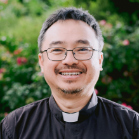 In Melbourne’s eastern suburbs, there is a developing Anglican parish — TIMA Anglican Parish. TIMA is composed of three churches: St Timothy’s Bulleen, St Mark’s Templestowe Lower, and St Stephen’s Greythorn. Across three locations and five services (two English, two Mandarin, and one Cantonese), congregants of different languages and generations are being reconnected under a single vision: not to give up on traditional churches, but to replant the "new life" of the Gospel mission within the "old pots" of existing churches.
I. BACKGROUND: WHEN ANGLICAN CHURCHES FACE DECLINE, IS "CLOSING DOWN" THE ONLY OPTION?
Over a decade ago, God began to show Ben Wong and a small team of coworkers a clear reality: many traditional local churches were facing structural dilemmas. This was not a problem unique to a single site, but a widespread phenomenon.
Can You Imagine God? Apologetics in an Age of Authenticity
- Details
- Written by: David Williams
 What is the essence of a human being? This is an important question, not least because our answer will shape our approach to evangelism and discipleship. The Enlightenment project conceptualised us as thinking beings. Our rationality and thought processes were the core of who we are, hence Rene Descartes’ famous dictum “I think, therefore I am.” James K.A. Smith has challenged this rationalist assumption and suggests that humans are driven more by our desires than our thoughts – “I am what I love”[i]. He argues that we are embodied people whose lives are focused towards an ultimate end, taking us on a journey guided by what we love. At the same time, we are also people who believe – who have hopes and dreams, who have faith.
The reality, of course, is that my thinking, believing and loving are bound together in one body, a person made in the image of God. Rather than try to separate these themes out, (a very Enlightenment project to classify and put things in boxes), we should hold them together. This article addresses ways in which we might engage in apologetics to reflect this nature of our humanity. We will begin with a definition of apologetics and explore alternative approaches. But first …
A STORY
James has been praying for his friend for years, but opportunities to talk about the Lord Jesus have been hard to find. One day, quite out of the blue, James’s friend asks, “Why do you believe in God?” James is about to launch into a logical argument for the existence of God, based on creation and revelation. But something makes him pause. Instead, he says “Why do you ask?” His friend replies: “You seem a nice person, but the Church is such a dreadful institution with its endless abuse scandals.”
James’s friend might equally well have replied: “You seem so content, your family is great, I can’t imagine why you have this need for God.” Or “you seem quite intelligent, but belief in God makes no rational sense to me.” The answer that James needs to give to his friend will depend on the question behind the question and reflect different approaches to apologetics.
APOLOGETICS
Apologetics has been defined as “the branch of Christian theology which seeks to provide a rational justification for the truth claims of the Christian faith”[ii]. It is “an apologia for the Christian faith – a presentation and defence of its claims to truth and relevance in the great market-place of ideas”[iii].
Using these definitions, it is easy to see that apologetics fits well into a world that preferences rationality and is concerned that we get our thinking straight. This approach to apologetics fits into the culture of modernity, a culture that sought to establish and understand the truth.
My own early discipleship, in the 1980’s, included a great deal of useful and practical training in apologetics. We were equipped using resources like Paul Little’s Know Why You Believe[iv], which was voted one of the 50 most influential books in the evangelical world in 2006. We thought carefully about shaping answers to questions that our friends were asking. It was wonderfully useful, because our friends were asking exactly these questions. One of the principle evangelistic tools of the early [v]1980’s was dialogue evangelism supper parties. We invited our friends over for a meal and then gave them an opportunity to ask questions of a guest speaker. Friends came and duly asked their questions. Some became Christians. In many ways, apologetics was our bread and butter. For many EFAC readers, apologetics has been a key part of our journey as we follow the Lord Jesus Christ.
LATE MODERNITY
In 2026, however, we live in late modernity. This is a very different culture to my world of the 1980’s. We live in the age of authenticity where people are pursuing their own sense of flourishing and self-fulfilment without reference to God. For many people, this sense of flourishing comes from finding and expressing our own unique sense of individuality. We are in the age of authenticity not because we are trying to be true to an external standard, but because we are being true to ourselves. I am true to myself by expressing the special and unique person that I am – the world of expressive individualism.
In 2016, late modernity gave birth to post-truth politics, where it does not matter if politicians make claims that are untrue so long as those claims resonate with how I feel the world is for me.
People in a post-truth world are more interested in personal freedom than objective truth. They tend to be sceptical about big institutions, such as the church, but optimistic about an individual’s ability to know what is best for themselves. Rather than conforming to external standards such as society or traditional family values or religious traditions, authenticity values my feelings, my creativity and my unique way of living my own life. What does apologetics look like in late modernity?
APOLOGETICS AND THE IMAGINATION
Justin Ariel Bailey suggests two other ways that we can think about apologetics in our late modern world, in addition to the historic approach[vi]. The first of these is what Bailey calls church-oriented apologetics, where “the church’s communal witness and proclamation of the gospel” defends and promotes Christian faith to a watching world[vii]. If the historic approach to apologetics is challenging the unbeliever to ‘think it through’, church oriented apologetics invites the unbeliever to ‘come and see’. This approach echoes Leslie Newbigin’s argument that the local church is the hermeneutic of the gospel[viii], and is rooted in the words of the Lord Jesus: “By this everyone will know that you are my disciples, if you love one another” (John 13:35).
The practical demonstration of self-sacrificing love became a compelling witness for the early church, exemplified by the Roman Emperor Julian’s exasperation at the way Christians cared for the poor.[ix] The sacrificial love demonstrated by God’s people to a wider world remains compelling in 2026. However, we face challenges in this area. In many Western cultures, churches are considered a force for harm in society, so that our witness is easily misconstrued. And sadly, our witness is terribly mixed: it seems that despite many everyday acts of love by ordinary Christians, there are regular abuse scandals from Christian leaders that discredit the gospel.
The second approach to apologetics that Bailey focuses on is “the apologetics of authenticity: an apologetic that begins by exploring our intuitive and imaginative sense of our place in the world, locating the appeal of faith in the aesthetic dimension”[x]. Rather than ‘think it through’ or ‘come and see’ this approach asks the unbeliever ‘can you imagine?’ Bailey’s approach is based on a conviction that in the late modern world, the challenge we face is not just loss of belief, but a fundamental change in the way belief is conceived. As we’ve already seen, we have moved from a world where ‘if something is true you should believe it’ to world where ‘if something is untrue, you can still believe it if it feels right’. Bailey shows that in late modernity the conditions under which belief is even considered possible have changed. Faith must first be imaginable before it can be arguable. This in turn relates to Smith’s argument that we are what we love. If people are formed more by what they love than by what they argue, then apologetics must also address the visions of the good life that are being offered by our culture’s rival liturgies. For Smith, going to the shopping mall is a cultural liturgy that shapes and forms us to imagine that consumption will satisfy us. Can we imagine something different?
Bailey suggests that just as our minds are God-given, impacted by sin, but capable with God’s help of understanding God’s truth; so, our imaginations are God-given, impacted by sin, but capable with God’s help of imagining God’s beauty. This approach to apologetics seeks to enable people to imagine the world as belonging to God. Or as C.S. Lewis put it, to allow our eyes to travel up the sunbeam to see the sun[xi]. The imagination does not replace revelation; it is the faculty by which, with God’s help, it becomes possible to engage with revelation.
The apologetics of authenticity engages with human beings as people who love, people who desire a better future. It aims to show that believing in God is beautiful and opens hopes and dreams that are worth living for. It wants to help people imagine a world where faith in Jesus makes sense of life. One way to engage people’s imaginations is to share Bible stories with them, to invite them into narratives that shows the majesty and beauty of the Lord Jesus. Storytelling is a useful tool, but the apologetics of authenticity is about more than this. It aims to help people imagine a world in which grace, forgiveness, transcendence and hope are even possible.
This is not simply preparing the ground for later rational argument, but a way in which the truth of the gospel is encountered as good and real.
CONCLUSION
When James’s friend asks him, “Why do you believe in God?”, James is wise to pause and establish the question behind the question. Perhaps his friend thinks that faith is irrational and lacks an evidential base, in which case traditional apologetics will help James a great deal. But if the question is generated by a sense that the church has been a force for harm in society, then James might do better to invite his friend to come and visit his local church’s social outreach. And if the question is a bemused wondering about why on earth anyone could possibly believe anything in 2026, then the apologetics of authenticity might be the way to go. James might reply to the question “Why do you believe in God?” by saying “Can I tell you a story…” In each case, whether through rational argument, modelling love, or engaging the imagination, it is the Holy Spirit who opens blind eyes, not merely better techniques.
David Williams is Director of Training and Development at St Andrew’s Hall.
[i] Smith, James K.A. 2009. Desiring the Kingdom: Worship, Worldview, and Cultural Formation (Baker Academic: Grand Rapids, MI).
[ii] Craig, William Lane. 2008. Reasonable Faith: Christian Truth and Apologetics (Crossway: Wheaton, IL) p15
[iii] McGrath, Alister. 1992. Bridge Building: Communicating Christianity Effectively (InterVarsity Press: Downers Grove IL).
[iv] Little, Paul E. 2008. Know Why You Believe (InterVarsity Press: Downers Grove IL).
[v] Taylor, Charles. 2007. A Secular Age (Belknap Press: Cambridge, MA)
[vi] Bailey, Justin Ariel. 2020. Reimagining Apologetics: The Beauty of Faith in a Secular Age (InterVarsity Press: Downers Grove IL).
[vii] Bailey, p58.
[viii] Newbigin, Lesslie. 1989. The Gospel in a pluralist society (Eerdmans: Grand Rapids, MI). Chapter 18.
[ix] See for example: Amid Plague, their “Deeds Were on Everyone’s Lips”: How Christianity Conquered Rome - BibleMesh
[x] Bailey, p58
[xi] Lewis, Clive Staples. 1964. Letters to Malcolm: Chiefly on Prayer (Geoffrey Bles: London).
Seeking the Welfare of the City
- Details
- Written by: Herbert Um
Seeking the Welfare of the City: Religious Literacy, Love of Neighbour and Social Cohesion
“Seek the welfare of the city where I have sent you… for in its welfare you will find your welfare.” (Jeremiah 29:7)
For generations, evangelicals have wrestled with what it means to be faithful in societies that do not share their convictions. Jeremiah’s instruction to Israel in exile remains instructive. God’s people are not called to withdraw from the life of the city, nor to dominate it, but to seek its shalom - its peace, wholeness and flourishing. What might that look like in contemporary Australia?
In the months following the tragedy at Bondi, religion has once again returned to the centre of public conversation. Questions about extremism, belief and social cohesion have resurfaced with urgency. While investigations continue and public debate unfolds, one thing has become clear: Australians are grappling with how religion fits within our shared civic life.
In moments like these, immediate responses are necessary. Remediation, reassurance and action to quell fear and insecurity are essential in the present. Yet we must also ask a deeper question. Beyond today’s response, what longer term strategy are we investing in to shape the next generation of Australian school students to be better equipped in intercultural and interfaith understanding?
Moments of crisis often expose deeper currents. Beyond the headlines lies a quieter and more enduring challenge. Australia has become more religiously diverse and less religiously literate at the same time. We live in one of the most multicultural societies in the world. In our suburbs and classrooms, students encounter Christianity, Islam, Hinduism, Judaism, Buddhism, Sikhism, secular humanism and many other belief systems as part of ordinary daily life. Yet many lack even a basic understanding of what these traditions actually teach, how they shape identity, and why they matter so deeply to those who hold them.
In the absence of informed engagement, stereotypes and misunderstandings tend to fill the void. Religion is often encountered through headlines or moments of crisis rather than through careful explanation. As a result, rich and complex traditions that shape millions of lives are quickly reduced to simplistic narratives, and unfamiliar beliefs seem threatening rather than merely unfamiliar. This challenge is intensified by the role of social and mainstream media. Research into Australian media representation shows that religion is frequently framed through narrow institutional lenses and often associated with controversy or moral conflict.[i] Media processes do not merely report religion; they construct and sustain public perceptions of it. As religious literacy within journalism declines, complex faith traditions are easily reduced to simplified narratives. In an age of rapid communication, stereotypes can travel further than careful explanation.
As someone born in Australia to South Korean immigrants, I have long been aware of the complexity of belonging. Growing up between cultures sharpened my sensitivity to questions of identity, meaning and purpose, questions that many young Australians are now navigating in their own way. These challenges are not theoretical; they are lived daily in families, communities and classrooms.
Schools and classrooms are where this reality is most visible. Teachers recognise that religions and worldviews shape the lives of many of their students, yet many feel under-equipped to address these topics with confidence. With increasing curriculum demands, administrative pressures and complex behavioural challenges, engaging thoughtfully with religion can feel daunting. This is not limited to government schools. Across the education sector (Government, Independent and Catholic), leaders and educators are asking how best to prepare young Australians to live well in a religiously diverse society.
In this environment, the classroom becomes one of the few shared spaces where young people can engage religion critically, carefully and constructively, building bridges of intercultural and interfaith understanding.
How we address these challenges will have a lasting impact on how our young people and future leaders understand their place in the world and, just as importantly, how they engage with others for the common good.
These questions are not only external. Within Christianity in Australia, 24% of churchgoers speak a language other than English at home and 37% were born overseas, which highlights the rich cultural and linguistic diversity among Christians here.[ii] Our own diversity of language and culture prompts us to ask how well we have bridged differences within our own communities.
ILLITERACY, TRUST AND THE FRAGILITY OF FREEDOM
One such challenge for our educators and students is coming to terms with the reality that ‘nobody stands nowhere’.[iii] There is no neutral vantage point from which to observe religion as well as other non-religious worldviews. When religious literacy is absent, neutrality does not emerge. What emerges is stereotypes and misrepresentations of the ‘other’. This can leave our young people without the opportunity to critically examine the various worldviews that shape Australian society. It also can leave them without a framework to better understand their own personal worldviews as well as the worldviews of those around them.
Yet there is reason for encouragement.
Research into the religious literacy of Australia’s Generation Z suggests that many young people are not hostile to religion, but curious. They express openness to learning about diverse beliefs and recognise that such education can strengthen diversity and social inclusion.[iv] They are growing up in plural environments and are generally comfortable with difference.
Yet curiosity alone does not guarantee understanding. Openness creates the opportunity. Formation is what shapes the outcome.
The same national study found that students who had received General Religious Education (GRE) demonstrated significantly more positive views toward Australia’s religious minorities. By contrast, students who had received no GRE were approximately twice as likely to hold neutral or negative perceptions, even when controlling for age, gender, school type, socio-economic background and religious identity.[v] The findings suggest that structured engagement with religion in the classroom is associated with greater social inclusion and reduced prejudice.
If young Australians are to live well in a religiously diverse society, they must be formed not merely in tolerance, but in understanding. Generation Z’s openness suggests that such formation would not be imposed upon them, but welcomed.
Research into student wellbeing reinforces this. A strong sense of belonging is closely linked to academic success and mental health.[vi] When students feel seen and
respected, they flourish. Religious literacy, delivered with care and rigour, can contribute to that belonging by equipping students to navigate difference with confidence rather than fear. In other words, understanding appears to shape attitudes.
This matters because in a plural democracy, misunderstanding does more than create discomfort; it erodes trust. Trust is the fabric of social cohesion. It binds citizens to shared institutions and public norms. When trust weakens, suspicion hardens and division deepens.
In his 2025 Lowy Lecture, ASIO Director-General Mike Burgess warned: “You cannot spy your way to greater cohesion or arrest your way to fewer grievances. It requires a whole of community, whole of society response… Every one of us has a role to play protecting our social cohesion. In an age with unprecedented avenues for communication, I fear we are losing our ability to converse — or at least losing the ability to converse with civility, debate with respect, disagree with restraint. To have an exchange of ideas rather than an exchange of diatribes or slogans or rhetorical blows. To be right without being righteous. To compromise.”[vii]
His warning is instructive. Social cohesion cannot be enforced. It must be cultivated through our interactions with one another, across tribal lines and throughout our institutions.
Religious freedom, in this context, is sustained not only by law but by understanding. Where understanding is thin, freedom becomes fragile.
LOVING GOD, LOVING NEIGHBOUR AND SEEKING SHALOM
For Christians, this moment is an opportunity for faithful engagement underpinned with theological clarity.
When Jesus was asked about the greatest commandment, he replied: “Love the Lord your God with all your heart and with all your soul and with all your mind… and love your neighbour as yourself ” (Matthew 22:37–39). These twin commands shape not only private devotion, but public engagement.
To love God is to honour truth. To love our neighbour is to seek their good. In a diverse society, that includes pursuing understanding rather than stereotyping, and building trust rather than suspicion.
Jeremiah’s call to seek the shalom of the city reminds us that God’s people flourish when the society around them flourishes. Shalom is more than the absence of conflict; it is the presence of right relationships with God and with one another.
The apostle Paul offers a compelling example in Acts 17. In Athens, surrounded by unfamiliar beliefs and practices, Paul did not retreat in fear nor respond with hostility. He observed carefully. He reasoned thoughtfully. He quoted local poets. He began from shared understanding before proclaiming truth. His engagement was informed, attentive and confident. Careful study of other beliefs was not a compromise of faith; it was an expression of love and clarity.
Our confidence in such engagement rests in the Lordship of Christ. As Abraham Kuyper famously declared, “There is not a square inch in the whole domain of our human existence over which Christ, who is Sovereign over all, does not cry: ‘Mine!’” Yet Christ’s Lordship is not a mandate for control, but a call to faithful service. If he is Lord over every sphere of life including education and public discourse, then our presence in those spheres should be marked not by domination, but by humility, integrity and love.
Every person bears the image of God (Genesis 1:27). To diminish another through stereotype or hostility is to forget that dignity. The virtues that sustain a healthy democracy such as humility, patience, courage and self restraint are not accidental social conventions. They are rooted in the Christian vision of shalom and are embodied in the life of Christ himself.
If misunderstanding erodes trust, and trust undergirds social cohesion, then investing in understanding is one practical way Christians can love their neighbour and seek the peace of the city.
A COLLABORATIVE RESPONSE: FAITH VALUES AND RWE
Faith Values is a Melbourne-based Christian not-for-profit organisation working with multifaith communities to help educators engage their students with diverse worldviews, beliefs and religions – strengthening community connections and social cohesion through informed, respectful dialogue. Our vision is to see every student in Australia provided quality curriculum-aligned Religions and Worldviews Education to contribute towards flourishing cohesive multicultural and multifaith society. For the past five years, Faith Values has served as the secretariat for the Multi-Faith Education Collaboration (MFEC), convening leaders from Christian, Jewish, Muslim, Hindu, Sikh and other faith communities, alongside multicultural organisations. Auspiced by the Faith Communities Council of Victoria, Victoria’s peak multifaith body, this collaboration reflects a shared commitment to strengthening social cohesion through education.
Through sustained dialogue and trust-building, MFEC has worked to move beyond reactive debates about religion in schools toward constructive solutions grounded in educational best practice.
Out of this collaboration emerged the Religions and Worldviews Education (RWE) initiative.
RWE draws on a worldviews approach that recognises every individual, whether religious or not, interprets life through a framework of beliefs, values and assumptions. Rather than reducing religions to static doctrines, it invites students to explore the “big questions” of human existence: How do we see the world? What is life all about? What is right and what’s wrong? How do I right my wrongs? What responsibilities do I have? What do people believe about a spiritual world?
The pilot unit is aligned with the Australian and Victorian Curriculum, particularly Civics and Citizenship and the General Capabilities. At its heart is a pressing civic question: How do we get along well living in a diverse society?
Students are not merely asked to learn about religions. They are equipped to disagree well. to articulate convictions clearly, listen respectfully and engage difference without hostility. And the impact is already visible.
One teacher recently shared that after a lesson, a student from a Sikh background approached her quietly and said, “I saw myself for the first time in the classroom.” For that student, learning about worldviews was not abstract theory, it was recognition. It was belonging. Other students have said:
- “It made me think more critically about how media influences our beliefs.”
- “It made me think about how everyone sees things differently depending on their background or position.”
- “It helped me understand that our views are often shaped by where we come from.”
Teachers have responded similarly:
- “These resources are long overdue.”
- “I appreciated how each lesson was framed around a big question.”
- “The academic background underpinning the worldviews approach gives confidence.”
When education leads to belonging, something of shalom is glimpsed; not uniformity, but mutual recognition.
The RWE pilot is delivered in partnership with the University of Melbourne’s Faculty of Education supporting independent evaluation. Support from Templeton World Charity Foundation, Collier Charitable Foundation and others has enabled pilot curriculum resource development, professional learning and structured research. Schools across sectors are now being invited to participate in the pilot phase.
This is not an attempt to privilege religion or blur theological distinctives. It is a response to a literacy gap. It recognises that students are already navigating complex questions of belief. The classroom can either leave those questions unexplored and silenced, or engage them with intellectual rigour and care.
A HOPEFUL INVITATION
Shalom does not emerge automatically. It must be pursued. If we desire an Australia where freedom is resilient, where disagreement does not devolve into division, and where communities flourish together, then investing in religious literacy is one way we obey Christ’s command to love God and love our neighbour.
So, I invite you pray for our schools. Pray for students navigating identity in a complex age. Pray for our educators as they navigate complex classrooms and carry the responsibility of shaping young minds. Pray for wisdom for those engaged in the work of RWE. Pray for openness and favour as Faith Values seeks to serve in this space.
To learn more about Faith Values and the Religions and Worldviews Education initiative, visit our websites and explore the pilot program underway. In seeking the welfare of the city, we trust that even small, faithful acts including investing in understanding will contribute to God’s larger work of shalom in our society.
Herbert Um is the CEO of Faith Values (faithvalues. org.au), a Melbourne-based Christian not-for-profit organisation committed to strengthening quality Religions and Worldviews Education in Australian schools. He is the Project Director of Religions and Worldviews Education (reworldviews.org.au) and serves as secretariat to the Multi-Faith Education Collaboration. He is currently undertaking a Master of Theological Studies at Ridley College.
[i] Enqi Weng, Media Perceptions of Religious Changes in Australia: Of Dominance and Diversity, 1st ed. (Abingdon: Routledge, 2019).
[ii] NCLS Research, Australian Church Attendance Report (Sydney: NCLS Research, 2021).
[iii] Theos Think Tank, “Nobody Stands Nowhere,” YouTube video, https://www.youtube.com/watch?v=AFRxKF-Jdos.
[iv] Andrew Singleton et al., The Religious Literacy of Australia’s Gen Z Teens: Diversity and Social Inclusion (Melbourne: Monash University, 2020).
[v] Andrew Singleton et al., The Religious Literacy of Australia’s Gen Z Teens: Diversity and Social Inclusion (Melbourne: Monash University, 2020).
[vi] University of Technology Sydney, “Sense of Belonging Helps Students Thrive at School,” https://www.uts.edu.au/for-industry/ how-to-partner-with-uts/giving/impact-of-giving/sense-ofbelonging-helps-students-thrive-at-school.
[vii] Mike Burgess, “Lowy Lecture,” Lowy Institute, 2025. https://www.lowyinstitute.org/2025-lowy-lecture-delivered-directorgeneral-security-mike-burgess-am
Hate Speech laws threaten Religious Freedom
- Details
- Written by: Michael Stead
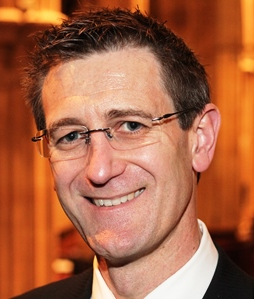 Laws that outlaw speech are the biggest threat to religious freedom in Australia at the moment.
There has been a recent explosion of laws that restrict speech. In the 34 years from 1989-2023, there were 19 Bills that imposed restrictions on speech. The same number of Bills have been passed in the last 26 months.
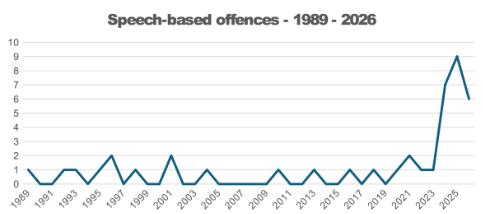
These new laws prohibit or regulate hate speech, vilification, right wing ideology, conversion practices and harmful online content.
The particular concern for religious freedom arises from moves to suppress speech merely on the basis that is hateful or offensive. Compounding this, in some jurisdictions this is assessed subjectively or from the perspective of a member of the target group. This means that hate speech becomes ‘speech that I find hateful’ and offensive speech is ‘speech that offends me’.
In the UK, it is a criminal offence to use an ‘electronic communications network’ (e.g., Facebook or WhatsApp) to send a message that is ‘grossly offensive’ or which is ‘for the purpose of causing annoyance, inconvenience or needless anxiety’.[i] In April 2025, the Times reported that the UK police were making 30 arrests a day for offensive online messages.[ii] Furthermore, under Section 4A of the Public Order Act 1986 it is a crime to use ‘threatening, abusive or insulting words’ ‘with intent to cause a person harassment, alarm or distress’. There were 11,876 prosecutions under this section in 2024/25.[iii] There have been a wave of cases of Christian street-preachers who have been arrested under this provision, including for making biblical statements about homosexuality,[iv] alleged ‘misgendering’[v] and for preaching criticising the Quran that caused distress to Muslims.[vi] The fact that in many cases the charges were eventually dropped does not undo the gross imposition on religious free speech at the point of arrest.
Criminalising so called ‘hate-speech’ is wrong, because it undercuts the principles of tolerance that underpin our western liberal democracy. It blurs the distinction between speech that is awful and speech that is unlawful. Our laws impose two types of appropriate limits on speech.
The criminal law is the mechanism used by the state to protect people against attacks on themselves or their property. In the same way that attempting to commit a crime or conspiracy to commit a crime is subject to the same maximum penalty as the crime itself, speech that incites others to commit a crime is itself a crime, and speech that threatens a criminal act is itself a crime. But if the underlying action or position is not a crime, then speech advocating for that action or position should not be a crime either.
The civil law provides a mechanism to provide redress where the actions of one party have caused harm to another. This includes speech - what I say might have consequences in defamation law, intellectual property law and anti-discrimination law. Civil law doesn’t criminalise these kinds of speech. Rather, it holds people accountable for the consequences of their speech – for slanderous comments that cause reputational harm, for example.
But if speech is not criminal because it threatens a crime or incites a crime, and there isn’t a personal or economic harm caused by that speech that warrants civil redress, then the state does not have a role to play in regulating speech.
Instead, we must tolerate speech that is merely awful, but not unlawful. Toleration is a core tenet of a liberal democracy. It is the decision not to prohibit or repress the words or actions of others that I find incorrect, undesirable or objectionable. It is captured aptly by the most famous thing Voltaire never said ‘I disapprove of what you say, but I will defend to the death your right to say it’. Historically, this Enlightenment principle arose from a religious war in the 17th century. After 30 brutal years of Protestants and Catholics killing each other over religious beliefs, people realised that the imposition of faith by force cannot work, and that religious toleration of different beliefs was essential for society. Out of this religious toleration develops the modern idea that freedom of thought, conscience and belief is intrinsic to what it is to be human.
The framework above highlights two key problems in recent legislative attempts to regulate speech.
PROBLEM 1: CRIMINALISING SPEECH WHICH SHOULD NOT BE A CRIME.
As noted above, Inciting violence is (and should be) a crime because violence is a crime. Inciting hatred should not be a crime, because it is not a crime to hate someone. Instead, inciting hatred – otherwise known as vilification – is (and should be) a civil offence (see further below). However, there have been recent moves to introduce criminal vilification provisions. In response to rising antisemitism, the NSW Government added s.93ZAA to the Crimes Act. Section 93ZAA makes it an offence, punishable by up to 2 years in prison, to intentionally incite hatred on the ground of race causing a reasonable member of the target group to ‘fear harassment, intimidation or violence’ or ‘fear for [their] safety.’
A criminal provision for hate crimes should not be determined by the fear of a reasonable member of the target group. It is unclear whether the breadth of ‘harassment, intimidation or violence’ include subjective psychological states or feelings – e.g., ‘I felt intimidated’ or ‘I felt harassed’. If so, then preachers beware! Suppose a preacher proclaims ‘Jesus is the only way to salvation. Being a Muslim won’t save you. Being Jewish won’t save you’. Would a reasonable Jew be ‘fearful’ about their eternal salvation, or feel intimidated by this? If so, then the preacher has committed a criminal offence. Section 93ZAA criminalises the exclusive claims to eternal salvation of different religions.
This concern is compounded if the protected attributes are expanded beyond race to include sexual orientation and gender identity. Traditional Biblical teaching on sexual ethics might be viewed by a member of the LGBTQI+ community as ‘intimidating’ or ‘harassing’, but this does not therefore make it appropriate to restrict free speech or the ability of a Christian church, school or parents from teaching or preaching in accordance with their doctrines, tenets and beliefs.
In January 2026, the Federal government also sought to introduce a criminal vilification provision as part of the Combatting Antisemitism Hate Extremism Bill 2026. Section 80.2BF made it an offence, punishable by up to 5 years imprisonment, to publicly promote or incite racial hatred, where ‘conduct would, in all the circumstances, cause a reasonable person who is the target, or a member of the target group, to be intimidated, to fear harassment or violence, or to fear for their safety.’ It is extraordinary that a sentence of imprisonment of up to 5 years could arise from speech that a person merely regards as ‘intimidating’ or ‘harassing’. Like section 93ZAA, this clause was directed at racial vilification, but government ministers signalled a willingness for this to be expanded to other protected attributes.
This caused provoked widespread opposition from faith leaders and free-speech advocates, and this part of the Bill was withdrawn by the government.
PROBLEM 2: ‘LOW BAR’ CIVIL OFFENCES FOR SPEECH OFFENCES.
Traditionally, civil vilification laws had a ‘high bar’. Legislation defines vilification to mean inciting hatred, serious contempt or severe ridicule. The high threshold established by this test is consistent with the role of the civil law – to provide redress where someone’s actions cause direct and material harm to another person. The law does not – and should not – exist to protect us against hurt feelings or being offended.
But there are unfortunate examples where legislators have got this wrong and made it an offence to offend or insult. In 1995, s.18C was added to the Racial Discrimination Act. Section 18C of the Racial Discrimination Act makes it unlawful for someone to do an act that is reasonably likely to ‘offend, insult, humiliate or intimidate’ someone because of their race or ethnicity.
Section 17 of the Tasmanian Anti-Discrimination Act 1998 prohibits ‘conduct which offends, humiliates, intimidates, insults or ridicules another person’ where a ‘reasonable person… would have anticipated that the other person would be offended, humiliated, intimidated, insulted or ridiculed.’ In 2014, the range of protected attributes in the Act was expanded to include, for example, gender identity. This enabled Martine Delaney, a transgender activist and Greens candidate to lodge a complaint with the Tasmanian Anti-Discrimination Commission in late 2015 against Tasmanian Catholic Archbishop Julian Porteous. The complaint was in relation to the distribution by Porteous of a leaflet entitled Don’t Mess with Marriage to the families of those attending Catholic school in Tasmania, to inform them of the church’s position on the meaning of marriage. The complaints process limited Archbishop Porteous’ ability to participate in advocating for the Catholic doctrine of marriage in the public square in the lead up to the postal vote about same-sex marriage. The complaints process dragged on for 9 months, until it was withdrawn by the complainant.[vii]
‘Insult’ and ‘offend’ provisions such as these are used by activists to silence Christians in the public square. They encourage confected outrage so as to claim victim status, which then engages the machinery of the complaints process against an opponent. Even if the complaint is ultimately unsuccessful, the process is the punishment. As Christians, what should we do in response to laws like this that threaten religious freedom?
We should strenuously oppose laws that inappropriately restrict speech. Neither criminal nor civil law should be used to impose a particular vision of the social good. We have to preserve the space for legitimate disagreement and dissent. Laws restricting speech should not be used to impose a uniformity of ideology regarding the world.
The right response to the awful speech is not to make it unlawful, and not to suppress it by deplatforming people or ‘take down’ orders for online content, but to counter it with good speech. A commitment to free speech entails a commitment to robust public debate with civility that is prepared to call out awful speech. A commitment to tolerance doesn’t mean that we applaud bad speech or stand passively on the sidelines.
The antidote to bad speech is not to suppress it but to challenge it in the free market of ideas through robust public debate, so that the truth may prevail.
The Right Reverend Dr Michael Stead is Bishop of South Sydney
[i]Section 127 of the Communications Act 2003; non-digital communication is similarly coverer by s.1 of the Malicious Communications Act 1988.
[ii] https://lordslibrary.parliament.uk/select-communicationsoffences-and-concerns-over-free-speech/
[iii] https://www.parallelparliament.co.uk/question/HL10453/public-order-offences-arrests-and-convictions
[iv] https://www.christian.org.uk/case/john-craven/
[v] https://christianconcern.com/news/win-for-street-preacher-asmisgendering-conviction-overturned/
[vi] https://persecution.org/2025/03/14/british-preacher-whopublicly-criticized-quran-found-not-guilty-of-hate-crime/
[vii] Section 127 of the Communications Act 2003; non-digital communication is similarly coverer by s.1 of the Malicious Communications Act 1988.