
Essentials
Being an Anglo-Catholic in Australia
- Details
- Written by: Jack Lindsay
Being an Anglo-Catholic in Australia.What does it mean, and why on earth do it?
‘Anglo-Catholic’. For many Australian Anglicans, there are perhaps only a handful of other words in the ‘ecclesial vocabulary’ so guaranteed to raise an eyebrow as this. For some, it has become a distinctly loaded term, conveying images of anything from liturgical fussiness to classist exclusivity, from doctrinal liberalism to papalist pretensions. For others, it may simply be synonymous with something perhaps peculiarly foreign, maybe even rather odd, and certainly ‘un-Anglican’. For a large part of my life, it was a blend of all these views that had shaped my perception of Anglo-Catholicism as, at best, rather confusing, and at worst, to be avoided. In this short piece, I intend to present something of an apology – albeit one based solely on personal experience – for that tradition in which I have now found my home, and perhaps explain a little of what drew a cradle Evangelical to the ‘other side’.
In preparing this article, I found myself reflecting on how I might define my childhood ecclesial or denominational identity. On the whole, I think it may be best described as ‘simply Protestant’. By this, I mean that my family – like so many others, in similar circles – was not especially concerned about whether the church we attended was Anglican, or Baptist, or Charismatic, or just broadly Reformed, so long as there was good Bible teaching, an engaging service, an active children’s and youth ministry, and a solid system of pastoral care. Beyond that, most other defining features of a given denomination were, to us, ancillary. This remained the case for me up until the later years of high school when, in the course of experimenting with a variety of church traditions in an attempt to develop my faith and life of discipleship as an increasingly independent young adult, I found myself one Sunday attending a well known Anglo-Catholic parish here in Melbourne.
This was, for the most part, my first real engagement with a tradition that was in some ways so familiar, and in others totally alien, to my childhood experience of Anglicanism. Yes, many of the same prayers were being said, and the broad outline of the liturgy was consistent with what I knew, but the service nonetheless stood out as strikingly and engrossingly unique, in comparison to anything I had seen before.
The first thing that struck me in it all was something I have sometimes referred to as a ‘sensory physicality’. By this, I mean that the worship into which one was drawn possessed a remarkable (and emotion-inducing) ability to take up one’s whole body into the experience of praise. From the dazzling sight of beautifully adorned vestments and frontals, bright candles and flowers, with the quiet dignity of ordered and calm movements, to the heady smell of incense and rosemary and oil, to the mesmerising sound of voices in harmony and a thundering organ, to the touch of wood and fabric and marble as we stood and sat and knelt, to the rich taste of the bread and wine from the altar; every sense was in some way involved in the act of worship. Perhaps more than anything else, it was this ‘sensory physicality’ that first drew me in, and sparked what began as a curiosity in, and has since developed into a deep love for, worship in the Anglo- Catholic tradition. And it is this word, ‘worship’, that is so important here. Because, for all the ceremonial and care taken in every aspect of the liturgy, it is all for naught if it does not first and foremost bring the people of God into a closer relationship with Him. If it exists for its own sake, and not for the sake of the gospel, then it is nothing. However, when done well, unselfconsciously, and ‘un-fussily’, I find myself most keenly and viscerally able to encounter the Lord, and (as the beloved hymn goes) be “lost in wonder, love, and praise”.
It could appear from all this, though, that Anglo-Catholicism is simply a ritualist movement, that it is only concerned with the liturgy. This is, of course, not true. Rather, if we take seriously that typically Anglican maxim, lex orandi, lex credendi, then we find that that which is expressed in the liturgy is nothing more and nothing less than a reflection of the theology which underpins it. Without the lex credendi, the lex orandi would be almost entirely immaterial. It is, therefore, from this ‘law of belief ’ – or, better, theology – that all our practices (should) spring. It is by this theology that they (should) be informed. And it is against this theology that they (should) be checked. Naturally then, all this begs the question: what exactly is distinctive about ‘Anglo-Catholic theology’? Is there even such a thing as a single, cohesive, ‘established’ theology of Anglo-Catholicism.
Well, perhaps slightly frustratingly, yes and no. The first thing to note is that, as I hope the reader will understand, I do not have nearly enough space in this short piece to give a full breakdown of the particulars of Anglo-Catholic theology. That would, and does, quite literally require tomes. And, even then, the author is presented with the decidedly fraught task of attempting to speak on behalf of the entire body of a particular tradition. And this problem is not unique to Anglo-Catholicism. As we will be well aware, one of the great blessings and curses of Anglicanism is its lack of a distinct confessional document, by which the distinctive theology of the denomination is clearly spelled out.
Yes, we all have the Prayer Book, and the Ordinal, and the Articles. But, if the past 450-odd years of Reformed Anglicanism have taught us anything, it is that these ‘base level’ unifiers still leave a great deal of scope for both individual and corporate variation. Accordingly, just as much as there does not exist a single, agreed-upon statement defining Evangelical Anglicanism (in anything more than broad, general fundamentals), neither does such a document exist for the Anglo-Catholics. Nonetheless, in the space remaining, I will seek to present a brief outline of those things which I understand to be characteristic, core elements of Anglo-Catholic theology.
First, and the distinctive feature from which most other beliefs flow, is a high doctrine of the Church. As Scripture tells us, the Church is both the Body of Christ on earth and His Bride. It is both that for which he died, and that into which he poured his Spirit at Pentecost. And, we are promised, it is that which waits expectantly for the blessed consummation of the Kingdom at the Day of Judgement. Further, as we affirm in the Nicene Creed, we believe the Church to be One, Holy, Catholic, and Apostolic. Accordingly, this great treasure given us by Christ, this Body by which His gospel is spread and into which we are baptised, must be preserved and safeguarded.
While, as Anglicans, this guardianship of the Church is expressed most manifestly by our bishops – those to whom we look as the focus of our unity and pastors in the faith – it nonetheless remains the responsibility of all the faithful to take their part in the ministry, mission, and care of the Church. And it is here that a core element of this high doctrine of the Church may be found. Principally, this concerns how one understands the phrase ‘the faithful’. In a commentary on the nature of change in the Church, on matters of doctrine and faith, the great 20th century Anglo-Catholic theologian Eric Mascall wrote: “the voices in the room are never enough.” This somewhat perplexing phrase actually goes to the heart of the Anglo-Catholic view of the Church. Namely that, as members in this mystical Body, we here on earth (the Church militant) are but a small part of the Church, and that in worship and mission we are mysteriously joined with all those who have gone before, and now form that great cloud of witnesses (the Church triumphant). We continue, together with them, as active members of the Church of God.
In an Anglo-Catholic context, we believe this mystical union across the ages to be most keenly displayed in the Eucharist, wherein we join our worship to that of heaven, and trust with confidence that our sacrifice of praise and thanksgiving may be one with theirs. We believe that, as we partake of the Body and Blood of Christ in the Sacrament, we do so, and are joined into one Body, with the saints who have gone before. As such, Anglo-Catholicism has historically had a tendency to lean towards conservatism; in a nutshell, given this view of the Body of Christ as united through the ages, there has to be a pretty convincing argument in favour of changing the received wisdom and (tried and tested) practice of our forebears in the faith. This is, of course, not to say that change must be avoided! That would be totally antithetical to our Anglican principle of ecclesia reformata, semper reformanda secundum verbum Dei. Rather, it simply stresses that change (particularly on matters of doctrine and polity) must be done cautiously, prayerfully, and with appropriate discernment.
It is through this ‘lens’ of a high ecclesiology that the rest of characteristically Anglo-Catholic theology is, and must be, viewed. From the belief in the real presence of Jesus in the Blessed Sacrament, while not presuming to try to explain how this occurs, to our trust in the Holy Scriptures as the authoritative Word of God, to the grounding of church life in the sacramental system, to asking for the prayers of the saints (especially, the Blessed Virgin Mary), to a high view of episcopacy and the sacred priesthood within the threefold order; all these, while but a few of those views typically identified as ‘Anglo-Catholic’, arise ultimately from the high doctrine of the Church, discussed above.
At a personal level, it was precisely this particular ecclesiological outlook that turned my heart to this tradition. Yes, the ‘sensory physicality’ I mentioned earlier, and the intention to express liturgically something of the beauty of God’s holiness, are those things that first caught my attention and drew me in. But it is quite particularly this high ecclesiology that helped me sit most comfortably within this tradition. For me, the knowledge that my attempts to live as a disciple of Jesus (however faltering they may be), and the struggles I face in living out the Christian life, have not only been experienced by a numberless host before me, but that those same witnesses who dwell with the Lord pray for me to Him (and, I hope, cheer me on, every now and then), touches my heart so deeply and gives me more consolation than I can ever express.
I began my life as an Evangelical, and the Holy Scriptures were at the heart of everything. I have discovered that the embracing of the Eucharist as the central action of my life has taken me closer to Scriptures. For, of course, both flow from the same Word who was made flesh.
This is why I am an Anglo-Catholic.

Rev Jack Lindsay is an Assistant Curate at Christ Church Brunswick in Melbourne
The Disappearing Church?
- Details
- Written by: Chris Swann
I wonder what leaps to mind for you when you see the question “Is the church is disappearing?”
Perhaps it is the numerous financial, membership, and leadership challenges facing churches after a two year global pandemic. In fact, you may be experiencing such challenges personally, and I’d by no means underestimate the pain and difficulty of the prospect of this disappearance.
Alternatively, it may be the broader question of the disappearance of the church (heralding its possible reappearance) in the cultural moment in which we find ourselves in the post-Christian, secular West. Whether this disappearance is hailed as a missional opportunity, or something to be lamented and chafed against, all of us have had contact with the way the church and Christian faith seems to be increasingly squeezed towards the margins in Australian society. Here, too, the pandemic is significant, albeit as a revealer and accelerator of existing trends.
However, in this article I want to draw attention to a different disappearance—although one that is, once again, tied to the pandemic. Over the past two years I have noticed something curious. What I have noticed is that the church—and specifically the reality of the church—tends to disappear from the way we talk and think about Christian community by many within the church, including many of its leaders.
Book Review: A Church Called Tov
- Details
- Written by: Karen Winsemius
A Church Called Tov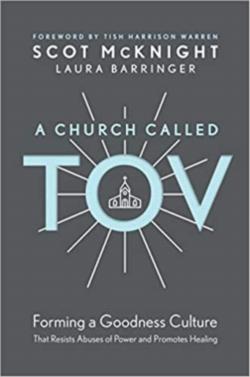
by Scot McKnight and Laura Barringer
Tyndale Momentum
REVIEWED BY REV. KAREN WINSEMIUS
My name is Karen. Chances are that you know someone called Karen.
But over the last few years, Karens have had a bit of a raw deal. Because Karen is no longer just a name. Karen is
particular person. There is ‘Karen who wants to speak to the manager’. Bunnings Karen. Karen from Brighton (It should be noted that that particular Karen moved to Queensland). Karen is a bossy, entitled woman. She wants everything to go her own way, even if it puts others out. How did one name come to represent so much? And what do all the rest of us Karens do?
The cultural phenomenon that is ‘Karen’ is fascinating, and I’m sure someone will write a PhD in years to come on why our generation feel the need to associate certain characteristics with particular names. In the meantime, as I have been reading ‘A Church Called Tov’ by Scot McKnight and Laura Barringer, I couldn’t help but ponder certain similarities about the challenges the church faces, albeit on a much larger scale. As I and other Karen’s seek to reclaim their name as standing for good, so must the church.
McKnight and Barringer seek to pull apart and investigate this Goodness Challenge in their book. They explore the Hebrew word Tov, meaning ‘good’ or ‘goodness’, found in the scriptures, pointing back to the goodness of God as the primary example, highlighting the many examples of Tov promises, and offering hope as we look forward to redemption. Tov is not a one-time act, but an ongoing, sustaining, beautiful characteristic of God, and one that we as Christians should emulate, both individually and as the church.
However, the church hasn’t and doesn’t always get Tov right. McKnight and Barringer take time to acknowledge the pain that so many of us have experienced in the church. They are honest in their naming of the hardship, dysfunction, abuse and toxic relationships that have been allowed to fester and wound so many. This dysfunction has torn apart relationships, and broken apart churches. It has even led to people walking away from Jesus, assuming that the abuse they have experienced is what Jesus must be like as well. McKnight and Barringer offer words of insight into how these unhealthy church cultures form, and helpfully give many practical tips and advice on what signs to look for that a church culture might be unhealthy. But they don’t stay in a place of dysfunction, or despair. They move to a place of Tov, of nurturing habits of goodness, and encouraging churches to put these into practice. McKnight and Barringer identify seven key elements of a Tov culture:
- Nurture Empathy (and resist a narcissist’s culture)
- Nurture Grace (and resist a fear culture)
- Put People First (and resist institutional creep)
- Tell the Truth (and resist false narratives)
- Nurture Justice (and resist the loyalty culture)
- Nurture Service (and resist the celebrity culture)
- Nurture Christlikeness (and resist the leader culture)
We can’t do all of this in our own strength, and yet we’re reminded in 1 Peter 2:9 that, ‘you are a chosen race, a royal priesthood, a holy nation, a people for his possession, so that you may proclaim the praises of the one who called you out of darkness into his marvellous light.’ We are called to be God’s people, to serve as ambassadors for Jesus in the world and as members of one body, the church. On our own, this is overwhelming, but with the indwelling of the Holy Spirit, we can work out this calling, living out a Tov life in our own lives and in the churches we worship in.
What I enjoyed most about ‘A Church Called Tov’ is how encouraging it is. It points us forward, gives us hope; that the church can develop a healthy Tov culture. Both in its theology and its practice, ‘A Church Called Tov’, gives us the big picture and the next step to get there.
Let us be a Tov people, practicing goodness each day. And when you next see your friend Karen, give her a high five of encouragement – she is also working on redeeming her own name for good too!
Rev Karen Winsemius is Assistant Minister at Oaktree Anglican, Caulfield, Melbourne
Book Review: Together for the City
- Details
- Written by: Steve Boxwell
Together for the City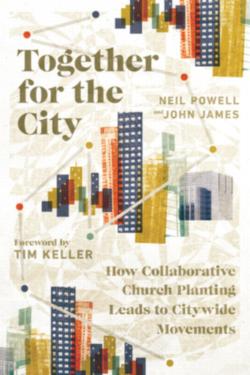
by Neil Powell and John James
IVP 2019
Wouldn’t it be great if the body of Christ in a particular area was a bit more coordinated! If our deaneries were more purposeful, if our minister’s fraternals were more strategic? Wouldn’t it be great if we could hear of the success of a church down the road or a church plant in the suburb along without an ugly defensiveness rising within us?
If you’ve got a fire in your belly to see more churches grow and be planted in your region; if you’ve got the uncomfortable sense that your church floats a foot above your locality and your people aren’t burdened to see your specific town/suburb/city reached for Jesus; and if you’ve got an inkling that this is a project that is going to need a vision bigger than any one parish, or even (perish the thought) any one denomination, then this is the book for you.
Together for the City is a book best read with a group of like-hearted pastors. It claims to be provocative. I found it provocative in the way that the smell of fresh-baked croissants in my kitchen provokes me out of my bedroom in the morning.
Neil Powell and John James both share that rarest of characteristics – people who can both do something well and explain how they did it. The book, in part, gives the narrative of how 2020Birmingham came to be with their vision to see 20 new churches planted by 2020, now extended to 30 planted by 2030 and 100 in their lifetime. But in laying out this story, they’re also offering a guidebook for how we might establish similar networks in our context to attempt the gospel goals that we couldn’t achieve working on our own.
The book breaks up into three sections, the first paints a vivid picture of the scale of the task before us, suggesting it’s akin to the Dunkirk evacuation of WW2. But rather than leaving us feeling exhausted before we’ve begun, it also suggests that the gospel not only requires, but enables collaboration across difference.
The practical meat of the book comes in the middle as they lay out a framework for the ‘how’ of collaboration using the equation: core + cause + code = collaboration. That is, although we may share a theological affinity with another church (core) that, in and of itself, is not collaboration. Collaboration comes when churches in a locality who share a gospel core also share a theological vision for what could be achieved in that area (cause) and flesh out a shared DNA (code) that energises a movement and carries it to action.
Having laid this all out, the third section offers several case-studies in the UK and abroad. It’s hard not to be excited reading this section, imagining similar partnerships and collaborations emerging in one’s own context.
It’s fair to say I came to this book suspiciously. “Are you asking me, a convinced Anglican, to give up my distinctives and plant churches with the [insert denomination I find disagreeable here] church down the road?” I protested. “I’m really busy – like Covid busy – and I’m not sure this is a good use of my time!” I complained. But at each turn I found both the argument and the narrative utterly disarming. They showed that they weren’t arguing that we plant churches together, but ‘to be together as we plant churches’ which is a masterful difference. It means that we can genuinely celebrate God doing new things in our area without experiencing threat or competitiveness. They also make the strong theological case for prioritising this work and can bear witness to how it has been life giving for pastors in collaborative partnerships around the world.
I hope there are many editions of Together for the City, and that with each the case studies section swells with stories of pastors who bravely worked together and, therefore, achieved what they couldn’t have alone for the cause of Christ in their region.
Steve Boxwell leads a church plant in Tuggeranong, Canberra
Book Review: Evangelicals and the End of Christendom
- Details
- Written by: Rhys Bezzant
Evangelicals and the End of Christendom: Religion, Australia, and the Crises of the 1960s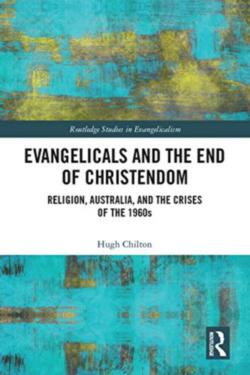
Hugh Chilton.
Routledge
With the soundtrack of the 1960s and 1970s as some of my earliest musical memories, I heard them again (metaphorically not literally) when reading Hugh Chilton’s magnificent book Evangelicals and the End of Christendom: Helen Reddy’s “I am woman,” Whitlam’s “It’s time” jingle, and “Leaving on a jet plane” by the trio of Peter, Paul and Mary. Indeed, the period which Chilton investigates will not only bring back ear-worms like these, but for some readers difficult debates, lost opportunities, perhaps even a sense of gratitude. These were decades in Australia that witnessed the rapid dismantling of the British Empire, Cold War conflicts in south-east Asia, a new sense of national purpose in Australia impacted by multicultural migration, and technologies which changed our quotidian lives. How evangelical Christians responded to or contributed to these tumultuous changes is Chilton’s goal in this book, which in other words is to summarise the place of evangelicals in the story of Australia at the end of Christendom. These are highly contested categories, but when they are placed here within the concrete framework of Billy Graham’s visits to Australia in 1959 and 1968-69, and 1979, they gain in clarity. If Graham is seen as a leading representative of post-war evangelicalism, reactions to him are a kind of bellwether, signalling a change of wind direction.
Indeed, concrete exploration of six leading figures in this period constitutes the substance of the book. Chilton has not begun with an ideological frame of reference into which these historical figures are shoe-horned, but rather he allows for complexity and nuance in the story he tells. The six chapters treat Fred Nile and the (youth movement) World’s Christian Endeavour, Han Mol the Presbyterian sociologist of secularisation, Billy Graham and Australian engagement with the American pseudoempire, Archbishop Marcus Loane in the context of the 1970 Cook Bicentenary, the Christian counter-culture and the Jesus People of the 1970s, and the substantial contribution of Bishop Jack Dain and Athol Gill to the Lausanne Congress, its backstory and impact (the selfconsciousness of indigenous Australians is an especially important dimension here). The introduction to these chapters expound the secularisation thesis in the light of the rupture of the 1960s, and the conclusion provides a bird’s eye view of the whole, important when there are so many layers to the story. Firstly, how evangelicals have positioned themselves in the nation, secondly how they have pursued an international network, and thirdly how they have managed tensions on the home front are the three dimensions to the presentation (p205).
This book, though not uncritical of the sins of the movement which reflect the sins of the nation, is however a respectful account of the part evangelicals have played in our national narrative focussed on the 1960s as a window into that story. To tell the story, Chilton takes up Bebbington’s language of conversionism, activism, crucicentrism and biblicism which have proved so enduring as markers of evangelical identity, but he is not beholden to them. Many commentators disconnect them from any longer narrative and therefore disconnect them from eschatology. Not so Chilton. In fact, he implicitly critiques their reductionism when he describes evangelicalism not merely as a set of abstract theological commitments, but sets these commitments within the bigger story of populist protest against nominal Christianity since the 1730s.
Evangelicalism promotes vital piety as a protest against the notion of establishment Christianity and navigates themes within the mental map of national understanding, therefore reflecting providential themes as well. Indeed, evangelicals have been nation builders and agents of cultural renewal. We have found ourselves engaged with the life of the nation when we have accepted the conditions of British imperial advance, or defined ourselves over and against Roman Catholic immigration, or taken sides during the Vietnam War. Our place in constructing modern Australia is not easy to narrate, nor is the contribution of evangelicals without tensions, but resoundingly our involvement has not been marginal, even when it has suited our temperament or theological convictions to speak prophetically from the edge.
Evangelical Christians have been carriers of modernity as well as leading opponents, which reminds us that our movement, one of the most vital in the Christian world today, is not merely defined by Trump activists or hyperspiritual separatists. It maintains a tradition of significant spiritual stature and philosophical pedigree.
Some surprising facts. After the Lausanne Congress of 1974, The Australian ran a four-page spread on the event, paid for by the Evangelical Alliance. Chilton notes – perhaps needlessly – that this is well-nigh inconceivable today (p186)! Church attendance per month in Australia is double the number of people who attend all kinds of football (p213). Billy Graham heard of the assassination of Martin Luther King Jnr in 1968 while playing golf in Brisbane, so his tour was shrouded by a sense of crisis in the US (p83). In an address in the presence of the Queen during her visit in 1973, Sir Marcus Loane amended Psalm 137:5 by replacing the word “Zion”: “If I forget thee, O England, may my right hand forget all her skill” (p133). Australia has perhaps the longest running survey of Christian beliefs in the world (p56). A global youth ministry network, the Christian Endeavor organisation was perhaps “one of the largest voluntary associations in the world” (p27) in the first half of the twentieth century and profoundly shaped the leadership of Fred Nile. The march on Canberra in 1973 by the Jesus People gathered under the banner of “Kairos,” meaning the appointed time, to rival Whitlam’s election slogan (p143). This book does double service by addressing questions concerning the metanarrative of Western history and by sifting through the granular details of personalities and events, a witness to much time and effort spent in archives. No wonder with so much fresh material, and with Chilton’s sure prose, this book is stimulating to read.
Now with this panoptic account in our hands, many other articles or books can now be written, taking up Chilton’s framework and exploring other people or moments. I would have liked to see some exploration of the work of David Penman in this period during his time labouring for the CMS and the IFES in the Middle East, given that his work in Pakistan especially was to influence his later ministry as Archbishop of Melbourne. The work of the Australian Fellowship of Evangelical Students in the 1960s and 1970s is worthy of much further historical attention, as would be the impact of new assumptions concerning authority on theological education. How church-planting fared at the perimeters of our cities after the boom of the 1950s is surely a doctoral dissertation in the waiting as well! This wish list aside, there can be no denying the value of the breadth of the material included in this volume, along with the groovy photos to anchor the text. I dare you to read and not find something to sing along to.

Rev Dr Rhys Bezzant is Dean, Anglican Institute, and Senior Lecturer Ridley College, Mebourne
Will we embrace Anglican micro churches?
- Details
- Written by: Breeana Mills
Anglican priest John Wesley was convicted of the need to preach to English miners who were not engaged in local churches. These gatherings drew the poor and marginalised in every town, seeing many choosing to follow Jesus. So, Wesley created different structures of classes, small bands, and societies, to facilitate discipleship and evangelism within these people groups. So began the Methodist revival.
Mary Sumner experienced the difficulty of motherhood in 19th Century England, where Christian values were coming up against the industrial revolution. Driven by a conviction to support mothers, she gathered women from different social classes together to encourage them in motherhood and faith. Women with no church connections came to faith, worshipped together, and sought to reach other mothers. These meetings multiplied throughout England and were in 9 countries within 7 years. Mother’s Union was born.
Simple forms of church are not new. They have been happening for generations and bringing revival to the traditional church in different ways. Some we have embraced; some we have cast aside. Today’s movements of missional communities, micro churches or simple churches are no different. The question is, will we embrace or case aside such expressions of church?
Long before language of micro church became prevalent, missiologist Lesslie Newbigin offered two critiques of church structures of his times. Firstly, that the fundamental ecclesial unit was too large, and secondly that the current structure of the church emerged from an undifferentiated society, which is no longer descriptive of our modern society (Goheen, 2018, 123–126).
Missiologist Ralph Winter also noted in the early 1990’s that the majority of American churches currently exists for the middle class, and a cross-cultural mission approach will be need to reach the “unreached peoples” of America (Winter, 1990, 98–105). It follows that we see new and different forms of church emerging within the Anglican communion to reach unreached Australians.
Throughout history the Anglican church has adapted to changing circumstances, and in a post-covid world this will be no different.
Recently, the Archbishop of Canterbury faced a similar question with the rise of many fresh expressions with the Church of England. Instead of resisting these new expressions, the Archbishop of Canterbury suggested:
“It is clear to us that the parochial system remains an essential and central part of the national Church's strategy to deliver incarnational mission. But the existing parochial system alone is no longer able fully to deliver its underlying mission purpose. We need to recognize that a variety of integrated missionary approaches is required. A mixed economy of parish churches and network churches will be necessary, in an active partnership across a wider area, perhaps a deanery" (cited in Cray, 2009, x).
As we look through scripture it’s clear that ekklesia did not designate a single form, the focus is instead on a gathering of people. It is used in scripture to refer to larger public gatherings, such as in Solomon’s colonnade (Acts 5:12) as well as household gatherings, such as those who met at Priscilla and Aquila’s house among others (1 Cor 16:19, Phil 2, Col 4:15). Both approaches were held together in the early church, where believers met in the temple courts and in their homes (Acts 2:46). Paul’s letter to the Corinthians also demonstrates that these house churches often came together for larger gatherings (1 Cor 11:17, 22). While some may be tempted to see a modern church and small group network in these two structures, Paul is clear that both were a place of discipleship and evangelism (Acts 5:42). The early church used a variety of structures as needed in their context. Perhaps once again, in a post-covid world it is once again a fitting season for a movement of small Anglican churches?
So, what is a simple church or micro church?
Thom Rainer defines a simple church as “a congregation designed around a straightforward and strategic process that moves people through the stages of spiritual growth.” (Rainer, 2006, 60) Brian Sanders defines church Rev as a “worshipping community on mission,” a group of people engaging together in regular rhythms of worship, community and mission, seeking to be a blessing towards a particular network or neighbourhood (Sanders, 2019, 34). These forms of churches are stripped back and simple. They are accessible not only to the dechurched, but predominately to the unchurched. Like John Wesley and Mary Sumner, these churches seek to take the church to the people, rather than asking the people to come to church. They seek to make disciples, and to multiply disciple-makers. While many of today’s churches seek to grow larger in number, these churches seek to go wider in reach, remaining small by continuing to multiply.
Micro churches are Jesus-centred communities, birthed when a small group of disciples collectively sense a call from God to love and serve a particular community in their area. Whether this is a geographical space or an affinity network, everything they do comes from a genuine desire to love this particular community. Yet, unlike a typical small group or even some house churches who engage together in times of worship and fellowship in community, a micro church also engages regularly in mission together. It’s a part of their identity, they exist for a missional purpose. This purpose shapes the way they engage in worship and fellowship as a community. Their worship still includes regular Anglican practices of the Lord’s Supper, baptism, confession, and intercessory prayer, but seeks to do so in a way accessible to those within their missional focus.
Micro churches seek to be a community conformed to the image of Christ. Graham Hill rightly suggests that the greatest issue in the Australian church today is our lack of conformity to Christ (Hill, 2020, 22). While it may be possible to hide within a larger community, within a smaller group, discipleship or the lack therefore becomes evident quickly. Jesus said people would know we are his disciples by the way we love one another (John 13:35). Micro churches believe that this is an essential part of their witness. As micro churches reach out into the community, they seek to demonstrate Christ and make disciples, multiplying into every corner of our nation to the glory of God.
Finally, these communities are called to unity and collaboration with the mainstream Anglican church. In the early church it’s evident that there is partnership between house churches, and city-wide churches. As a church we are called to unity, but not necessarily uniformity. Our unity should transcend differences in practices, music, and structures, while holding tightly together to gospel truths. The Spirit is equally at work in the mainstream church, as in the many Anglican micro churches already in existence across Australia. Today as micro churches are becoming more prominent within and alongside our churches, the question is will we embrace them?
The micro church movement, by God’s grace, has gained increasing interest, traction, and fruitfulness throughout the pandemic. Whether the Anglican church chooses to accept these expressions or not, they will continue to engage in gospel-centred, Kingdom-focused ministry, taking the church to the unreached peoples of Australia. My hope is that in the future we would see them do so as representatives of the Anglican church of Australia, and we would partner with them as they go.
Recently, a small traditional Anglican church in Melbourne’s east has entered a partnership with a new micro church network church plant. The partnership is hoping that this church plant, primarily of young adults, will learn from the maturity, traditions, and experience of the existing Anglican church, while the existing church will be invigorated by the missional fervour of the church plant. While it is still very much in its infancy, it provides a picture of a possible way forward for the Anglican church of Australia. Micro churches and mainstream churches working together for God’s glory.

Rev Breeana Mills is Assistant Curate at St Philips Mt Waverly, Melbourne and leader of a nearby micro church network church plant.
Bible Study: Breaking Down Walls
- Details
- Written by: Chris Porter
REV DR CHRIS PORTER
“I now realise how true it is that God does not show favouritism” Acts 10:34
In the book of Acts, Luke repeatedly recounts situations where social boundaries and barriers are broken down by the gospel that is rapidly spreading throughout the Levant. But within the narrative these boundaries are not so easily dissolved, and one particularly pernicious division repeatedly returns to the early church: the distinction between Jew and Gentile. Readers first encounter this distinction and subsequent dissolution of the barrier in Acts 10 and 11, as Peter entertains a visitation request from a Gentile God-fearer—Cornelius—and is subsequently challenged in Jerusalem.
Indeed, this first encounter provides a good paradigm for how social boundaries are broken down, and it occurs at two levels. First, at a human level, the degree of inter-group prejudice is confronted at a personal level and reduced from inter-group interaction to inter-personal interaction by face-to-face contact and conversation. Peter dares to enter Cornelius’ house and eat with him—in transgression of the law (Acts 10:28).
Second, at a level out of human control, the dissolution of the previous inter-group boundary is initially challenged by Peter’s dreams and then confirmed by the presence of the Spirit. We read that just like the other disciples the Spirit was poured out on these Gentile believers (Acts 10:45-46).
Subsequently the dissolution of the inter-group boundary is further confirmed by group witness and consultation (Acts 11:15-18).
While one of these tiers—the sending of the Spirit— is clearly out of human control, the other provides a helpful paradigm for reducing inter-group conflict and boundaries in our world, especially for Christians as we are called to be peace makers and to love one another. This is particularly valuable in this time with the increase of social media silos and ongoing interpersonal isolation from pandemic lockdowns. Truly, it appears that our societies are going to emerge from this pandemic more fractured than united.
The paradigm for reducing social conflict that Acts sets forth is helpful here, and indeed it is strongly reinforced by a series of studies on inter-group conflict and prejudice reduction from Matthew Hornsey and Michael Hogg (1999, 2000a, 2000b, 2000c).
But what does it look like in practice? One approachable example comes from the Boogie-woogie singer and pianist Daryl Davis, who found himself as a lone African-American in close friendship with many members and ex-members of the Klu Klux Klan— despite his obvious Blackness.
In Accidental Courtesy, a documentary on his life, one poignant moment comes when he talks about his motivation for cultivating friendships with Klansmen. There the overriding question he asks is “How can you hate me if you don’t even know me?” From sitting down in a bar with Klansmen, to being invited into their home, this question—and the associated interpersonal interaction—drives the conversation at hand. The results show how successful it is, as Davis displays a wardrobe full of Klan robes that were given to him after members had left the Klan.
Daryl Davis follows the pattern set out in Acts, of reducing inter-group prejudice to the level of personal interaction.
As we engage in evangelism with friends and neighbours, we too can follow the pattern of Acts in interacting with others as individuals, rather than as group representatives. Perhaps even more critically we can interact with members of other traditions as individuals as well, to understand them and their motivations rather than caricaturing them as a stereotype
We—above all—are called to be peacemakers in our society fractured by social media silos and isolation, and to love one another as Christ has loved us. By this everyone will know what we are His disciples.

Rev Dr Chris Porter is a Postdoctoral Research Fellow at Trinity College, Melbourne