
Essentials
Book Review: God of All things
- Details
- Written by: Stephen Hale
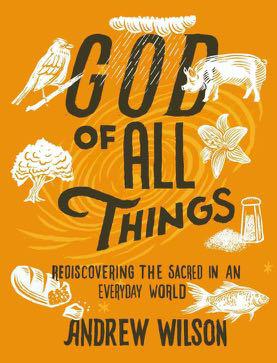 God of All things: Rediscovering the sacred in an everyday worldBy Andrew Wilson - Teaching Pastor at Kings Church London and Author
Zondervan 2021
Reviewed By Stephen Hale, Chair EFAC Global and Australia
God of All things is a wonderful book and I commend it to you. Wilson seeks to explore the reality that our world is full of things. Each of those things point to the creator who put it all together. ‘The earth is the Lord’s and everything in it’ Psalm 24.1
The book comprises a short introduction and conclusion and in between 30 short chapters split between the Old and New Testaments. Each chapter looks at one thing – dust, earthquakes, pigs, livestock, tools, horns, sex, salt, rain, trumpets, viruses etc etc.
It is a fascinating book. Each of the short chapters talks about the object/thing and captures how they are referenced in Scripture and also how they are described in contemporary science. Along the way there are lots of wonderful insights. As Wilson says, they may well lift one’s sight to reflect on the place of each of these objects in our world and what they point us to. He makes links like these:
- Dust: the image of God
- Horns: the salvation of God
- Donkeys: the peace of God
- Water: the life of God
- Viruses: the problem of God
- Cities: the kingdom of God
We live at a time when many people have given up on God and believe that science has all the answers. The fascinating and awe-inspiring wonders of the created world are inspiring in themselves, not because of what they point to. My wife teaches both Christian studies and science in an Anglican school and says that most of her students are essentially materialists, even if they have never heard of the term.
I chose to read the book as a chapter each day, given that most of the 30 chapters are around 5 or 6 pages. I found the book to be genuinely inspiring as well as fresh and interesting. Each chapter contained surprising revelations from either creation or Scripture. In Romans 1 Paul says that creation reveals God’s invisible power and divine nature. C S Lewis talks about following sunbeams back to the sun so that we enjoy not just the object of goodness but the source of the good. As Wilson says, ‘Creation preaches to us. The things of God reveal the God of things.’ (page 3).
I really enjoyed God of All things and found it refreshing and original. I’ve given it to a few people who also loved it.
Bible Study - Psalm 96
- Details
- Written by: Len Firth
In the summer, after the Christmas season, I have noted that many churches turn to preach from the Psalms. A number of factors may influence this choice. Psalms are often seen as stand-alone units, so useful in a season when members may be coming and going, away from church for reasons of rest and recreation or mission and ministry. CMS Summer Schools, SU Beach Missions and the like are some excellent reasons why people may not be on church on a particular Sunday. This can make preaching problematic, if each seeks to build on and connect with those which have gone before. Preaching a series of psalms may avoid this. Visiting or occasional preachers may more readily accept an invitation if they have a Psalm sermon or two in their preaching kitbag. However one problem with this approach is that the psalms are removed from their canonical context. This serves to denature important developmental themes, such as the interplay between lament and trust. See for example the placement of Psalm 23 affirming the Lord as protector provider, immediately following Psalm 22’s lament ‘My God, my God why have you abandoned me?’ It also ignores the arrangement of the Psalter into five books. So I want to consider Psalm 96 first of all in its canonical context.
Psalm 96 is one of a group of “the Lord reigns” or “Kingship of Yahweh” psalms which occur early in Book IV of the Psalter. These have been seen by some scholars as enthronement psalms. The evidence for this as a psalm category is not strong, but most of this particular psalm is used (reused?) in 1 Chronicles 16 to accompany the celebration of the ark being taken into Jerusalem. Kidner observed, ‘The symbolism of the march, in which God crowned his victories by planting his throne in the enemy’s former citadel, is matched by the theme of the psalm.’ (Derek Kidner, Psalms 73–150: An Introduction and Commentary, vol. 16, TOTC (Downers Grove: IVP, 1975), 379.)
Another characteristic of the psalm in its canonical context is the more universal view, beyond the community of God’s OT people, Israel and Judah. This psalm belongs with a group (92-101) which explicitly refer to singing and call on people(s) to worship the Lord (Yhwh).
It can aid our interpretation to also consider this psalm from the perspective of its use in the worship of God’s people, both from its use before and after the coming of Jesus the Christ. Often Psalms used liturgically can be read antiphonally, and if we consider the first three verses, the psalm reads like a conversation of mutual encouragement. Paul seems to have something like this in mind when he urges Christians to speak to one another with psalms, hymns, and spiritual songs (Eph. 5:19). The first part of these Psalm verse, has a comparable and developing response in the second half.
- Sing to the Lord a new song;
sing to the Lord, all the earth. - Sing to the Lord, praise his name;
proclaim his salvation day after day. - Declare his glory among the nations,
his marvellous deeds among all peoples.
The verses begin with a series of imperatives, and urging to sing and worship the Lord (Yhwh). Note the thrice repeated Yhwh, the specific Name of the revealed God of Israel. There is a development in the verses. God’s people are not just urging each other on in song and words of worship and praise, but further into proclamation and declaration among the nations and all peoples (Christians could use the language of evangelism and mission). This wider view was actually implicitly present in verse 1 where all the earth was called to sing to the Lord.
The next three verses give reasons for singing, worship and declaration. The Lord is great, worthy, and to be feared in contrast to all other rival ‘gods’. It is the Lord who is creator of the heavens. Use of the heavens may help users of this psalm to see the wider scope of God as Lord of all who are under the heavens. He also created the land but this would possibly narrow our view, a more human and particular perspective.
Verse seven begins to call on all the families of nations to join in this great corporate recognition of the Lord’s glory and strength. The vision is of all peoples flowing to the Lord’s sanctuary (temple?), bringing offerings in worship and recognition of God’s glory and holiness.
Who is being addressed in verse 10 is open to interpretation. Is it God’s people, or the nations / all the earth? I lean to thinking this psalm is calling on all peoples to be affirming to one another that the Lord is reigning. The rationale for the call is the solidity of the created world and God’s equitable judgment of the peoples. These are reasons which apply more broadly than with Israel and Judah of the OT or the church of the NT era and beyond until the Lord’s return. It is verse 10 which unites this psalm with others nearby as a “Lord reigns” psalm.
The final verses of the psalm are a continuing call to worship, but now the call goes out beyond all humanity. Every aspect of creation: heavens, earth, sea, fields and all living things they contain, the trees of the bush are called to worship, in fact ‘Let all creation rejoice before the Lord.’ God coming as judge is the reason appended to this final call to worship the Lord.
As Christians we read this psalm through the lens of Christ and his coming. It is the salvation brought by Jesus’ death and resurrection, which we proclaim and which is our reason for worship and gospel proclamation. Jesus’ return, his coming as Lord and righteous judge, is our ultimate perspective. When we use this psalm, we should call on one another, the whole world, and indeed all peoples, to acknowledge the one true God and saviour. We are called to worship this God and to declare his greatness and glory in mission. This call and the mission of God’s people goes beyond our own local gathering and looks to all that God has made resounding in the worship and celebration of God.
Len Firth is Lecturer in Professional Supervision for Ridley College; Pastoral Supervisor and Ministry Coach; Associate Minister St John’s West Brunswick. Former Archdeacon for Multi-cultural Ministry in the Anglican Diocese of Melbourne.
Interview with Ben Wong
- Details
- Written by: Mark Simon
Interview with Ben Wong - Chinese Ministry Coordinator in the Anglican Diocese of Melbourne
Mark Simon speaks with Rev. Canon. Ben Lui Wong, Chinese Ministry Coordinator, Anglican Diocese of Melbourne, and Senior Minister, St. Timothy’s Bulleen and St Mark’s Templestowe Anglican Churches.
Mark: How did you become a Christian?
Ben: I was born in China, grew up in Hong Kong, then came to Melbourne for study. It was here I met Ivy, who later became my wife. She was a Christian, and in the early years of marriage, I just dropped her off at church but never went in. One day a woman specifically came to me and invited me in. During that first service I attended, a very strong voice came to my mind saying, ‘you will be like that person on the stage speaking to others.’ The minister encouraged me to get to know Jesus before taking steps to become a preacher! So I joined a course, and came to put my faith in Jesus, and 8 or 9 years later, I did become ‘that person’ proclaiming the gospel to others.
Mark: Have you always had a cross-cultural ministry, or did you grow into it?
Ben: When I first graduated from Bible College, I thought I would primarily use Cantonese and Mandarin, and reach native speakers of those languages in Melbourne. But when I became a Youth Minister in the Chinese congregation I needed to relate to Australian-born Chinese kids, who were using English as much as Chinese. So my vision widened. Now I am the minister of a multi-site church with English, Cantonese, and Mandarin services. If God had shown me that too early, I might have run away from it.
Mark: Do you think Chinese or other immigrants in Australia are more open to the gospel at the moment than Anglo-Australians? Why might that be?
Editorial - Autumn 2022
- Details
- Written by: Mark Simon
Essentials - Autumn 2022
- Details
- Written by: Gavin Perkins
Essentials Autumn 2022 pdf (1MB)
Essentials Summer2021 pdf (3MB)
Essentials Spring 2021 pdf (3MB)
Essentials Winter 2021 pdf (3MB)
Essentials Summer 2020 pdf (3MB)
Essentials Spring 2020 pdf (1MB)
Essentials Winter 2020 pdf (1MB)
Essentials Autumn 2020 pdf (4MB)
Essentials Summer 2019 pdf (8MB)
Essentials Spring 2019 pdf (5MB)
Essentials Winter 2019 pdf (5MB)
Essentials Autumn 2019 pdf (5MB)
Essentials Summer 2018 pdf (5MB)
Essentials Spring 2018 pdf (5MB)
Essentials Winter 2018 pdf (5MB)
Essentials Autumn 2018 pdf (5MB)
Evangelicalism’s Social Action: The Temptation of Political Tribalism
- Details
- Written by: Mike Bird
Evangelicals have traditionally been socially engaged, in faithfulness to biblical requirements to do justice and to show compassion for those suffering, and as a missional necessity, to demonstrate that we have good works to match our faith. A faith that is lived out, among and for others, is what it means to be a Christian. Evangelical faith is Christological in that Christ is proclaimed as Saviour and we do everything we can to save persons in body, mind, and soul and to bring into the warm embrace of Christ himself. This is why we do things like advocate for action on climate change, run Alpha courses, support refugees, have a Church Missionary Society, oppose the predatory gambling lobby, fund City Bible Forums, and have Anglican Overseas Aid. So, for us evangelicals, our evangelistic energy goes hand in hand with our social concerns, advocacy, and programs.
One problem is the temptation to focus on one or the other. To be an Alpha-Church or a tearfund church. To focus on the evangelistic side or to go all in on social action. A false dichotomy if you ask me, but the temptation is real for either side. But even for those of us who believe in a healthy balance, declaring the word of the gospel while donning the apron of a servant, even our social advocacy/actions face the temptation of being politically partisan.
For me, personally, my two social action passion projects are advocacy for destroying the gambling lobby and advocating for religious freedom. The former aligns neatly with the political left and the later sits more squarely with the political right. It means I get some curious glances from people.
My Tear Fund friends love my opposition to the gambling barons but look at me with confusion and disgust as if I might be a quasi-fascist if I retweet an Australian Christian Lobby article about religious freedom. By the same token, my Australian Christian Lobby friends incorporate my voice into the religious freedom debate but look at me with suspicion that I might be a Marxist sympathiser if I post on Facebook critical of the Liberal party’s stance on refugees and climate change.
I think most evangelicals are committed to a program of social action, and we each have our own pet causes, the one’s that burn our hearts with righteous rage or fill us with pity for those suffering. The temptation is that our interest in social action is exercised partly as an outworking of Christian faith, but partly as a way of aligning ourselves with particular political tribes. The temptation is then, that our social ethic becomes tied less to the Christian church and more to the political tribes that we resonate with. My thesis is that our social engagements, balanced with our promotion of the gospel, must never be neatly aligned with any political tribe, whether conservative or progressive. Otherwise we run the risk that our social action becomes more an act of political affiliation than Christian action.
We are compelled by the love of God to proclaim the gospel of salvation in Jesus Christ. And it is our Lord himself who tells us to care for the poor, to show mercy, and to act justly. Social action and social justice are a necessity. But let us not get fall into the temptation of engaging in the social action that is trendy on social media or presages our status in a political tribe.
Let justice roll down like a river, irrespective if those rivers break towards the left or to the right.

Michael Bird is Academic Dean and Lecturer in New Testament at Ridley
Together for the West
- Details
- Written by: Peter Greenwood
Earlier this year I had the opportunity to ask a senior Melbourne evangelical leader a question. He had just spoken on the theme of church leadership and repentance, and I was curious. “What would you see as a characteristic sin of the Melbourne Church? His answer came quickly, and was not a particularly surprising one. Tribalism. As a whole, Melbourne Christians stick to their denominational and theological groups, and have little time for others. I came to Melbourne in 2010 to study for ministry at Ridley College. Since then I’ve heard the same diagnosis made countless times. Sometimes accompanied with other words to the effect that they would love things to be different, at other times with the unspoken sentiment that this is just the way it is and things won’t change.
Not once have I ever heard someone posit a solution. Of course ‘ecumenicalism’ - cross-denominational relationship - has always been a thing. There are pastors networks all over the city doing good work in encouraging each other and occasionally collaborating together. But I think it would be fair to say they are not making much dent in changing the tribalistic culture of Melbourne.
A few years ago I was at a conference hosted by City to City Australia. The speaker was Neil Powell, a pastor from Birmingham, UK. Ten years ago Birmingham had few healthy churches, and no culture of church planting. A random meeting between Powell and John James, pastor of a charismatic church just a short walk away from Powell’s church, led to a conversation about what would happen if dozens of churches across denomination and tribe began partnering together in a new way for the sake of the city. From that conversation came a church planting movement – 2020 Birmingham - and a book - Together for the City.
Powell’s story really captured my imagination, and got me thinking about my own context. I planted a church in the inner west of Melbourne in 2015, and I soon realised how under-resourced the western suburbs are when it comes to Gospel ministry. Churches are few and far between and there are some newer suburbs that do not have a church at all. Pastors I met were generally unaware of what other churches are doing to see the Gospel go out, and there is very little communication outside of denominations.
Inspired by Neil Powell, in late 2019 I decided to email every western pastor I knew and invite them to a meeting. Eighteen turned up, some of them people I didn’t know, from churches I didn’t know existed. That meeting sparked something we now call Together for the West - a movement of pastors, planters and leaders with a clear vision to see 20 new churches, 20 renewed churches and 1000 new Christians in the western suburbs by 2031. Currently we meet weekly to pray for revival in the west and look for ways to partner together for the sake of the Gospel. We deliberately put aside issues of secondary disagreement to build genuine friendships out of a commitment that so much will not happen, unless we do it together.
Tim Keller, founder of Redeemer Presbyterian Church and Co-Founder of Redeemer City to City, has said on numerous occasions that it takes a movement to reach a city. Movement is a buzzword at the moment, but in Keller’s definition no single church, network or denomination can be a movement. A movement of the Gospel happens when the churches of a city move from being in ignorance and competition to cooperation and collaboration. It’s when the Holy Spirit convicts us that, far more important than our differences, is what we share in common - the same God, the same Gospel, and the same Mission.
The church is the Body of Christ - made up of many members with essential gifts. This is true, not just of the universal Church, nor just of the local church, but also the church of a city. We count Presbyterians, CCCVAT, Churches of Christ, Australian Christian Churches, Gideons, AFES, Anglicans and FIEC as members of Together for the West, and each one adds something unique and wonderful to the movement. Yet we are not satisfied, we long to welcome members of all tribes who share our vision for the West.
Perhaps tribalism is not just the way things are. And perhaps the solution is not actually that complicated. It can start with a coffee, or with an email, or with a Zoom call. To quote Andrew Katay, CEO of City to City Australia, it starts with the dangerous question, “What won’t happen if we don’t do it together?” Then it continues with a determination to chase after a razor sharp vision of what God just might do if we do do it together.

Rev Peter Greenwood is the minister at Inner West Church, Melbourne