
Essentials
Editorial Summer 2023
- Details
- Written by: Gavin Perkins
Training and equipping Christian ministers, workers, and the church is the endeavour of the whole of the church working together. From ministers to expound scriptures and pastorally care for their congregations, mentors to come alongside and together with sisters and brothers in all stages of life, and those extra-congregational and para- church groups and organisations who support the building up of local churches and mission.
However, in this ecosystem the work of theological colleges is often shrouded in mystery, either seen as some hallowed ivory tower or a strange realm far removed from the realities of the local church. Indeed, at times there has been significant distrust of theological colleges for these very reasons.
Yet the work of theological colleges is important on two fronts, and neither are of the chalk and talk variety. First, the work of theological education helps our churches to see the breadth of God’s mission for His world, across the scope of human history and through the various means He engages through the church. Second, as a third space outside of the local church it draws together members of local churches to gather around a shared goal of understanding God better. Both of these —amongst many more—aim to keep us from myopia and also from the challenges of hubris.
This edition of Essentials aims to peel back the curtain somewhat, to reveal the great scope of theological education around our world.
Unfortunately—and ironically—the length of this issue is slightly shorter than normal, owing to an eleventh hour withdrawal of one article, due to a very sad situation in a theological college which only reinforces the distrust of these institutions.
Nevertheless, those articles that remain serve to lift our eyes to the scope of God’s work in theological education.
Rev Dr Christopher Porter, Melbourne Editor
The Challenge of, and the Challenge to, GAFCON
- Details
- Written by: Peter Jensen
 In speaking of the challenge of GAFCON, I ought to indicate, of course, that I myself was present when the idea of GAFCON was born in December 2007 and helped organise the first Jerusalem Conference in June the next year. Following that I became the General Secretary of GAFCON, a position I held until 2018. Thus, I am no uncommitted bystander, although I am no longer present at the key policy-making decisions. However, I can speak with some knowledge about the history and significance of the movement, and I want to discuss something of the challenge that GAFCON represents in the Anglican Communion and a particular challenge that GAFCON faces.
Among bishops and the keen observers of the Anglican Communion, the phrase ‘Lambeth 1.10’ refers to something so well known that it needs little introduction or explanation. It is, of course, a reference to the famous (or, for some, infamous) Resolution of the Lambeth Conference in 1998 on the subject of human sexuality and especially homosexuality. The Resolution was passed by an overwhelming majority of those present and voting, namely 526 to 70.
How Are We Going with Evangelism?
- Details
- Written by: Julie-Anne Laird
 Recently, in my role as Chair of Lausanne Australia, we gathered 330 key leaders around Australia and I asked people to vote on how we're going with evangelism? In each State, the agreed amount was either 2/10 or 3/10. People really feel like we are failing in evangelism. In my other role as the Specialist Consultant for Evangelism and Mission for City to City Australia, I've been going around to Churches and helping them try and turn around with evangelism. This has been so good! But similarly, people really feel like we are not doing well with evangelism. Here's a few things that I've observed...
1. We Need To Pray
The thing to note is that Christians have a real heart for their non-Christian friends and would love them to know Jesus, but they feel inadequate to speak and they have lost the burden to pray. I often say, it's like we've given up on God, that he could possibly draw our friend or family member to Himself. All revivals start with prayer, and I feel like things are shifting in Australia. We know we are not doing that well now, which is a good posture to have because we know we need God. Really, this should have always been our posture but somehow, we think we can do it without God if we are not praying.
Book Review: Shedding Light
- Details
- Written by: Stephen Hale
Shedding Light: a history of St Columb’s Anglican Church Hawthorn through its stained glass windows
MALCOLM WOOLRICH
Port Adelaide: Green Hill Publishing, 2023
REVIEWED BY STEPHEN HALE
Malcolm Woolrich’s history of St Columb’s Anglican Church, Hawthorn is a remarkable achievement. There are many church histories of particular parishes and each in their own way are useful records of the life of a particular church. Most are reasonably modest publications for understandable reasons.
Shedding Light is remarkable in both its scale, quality and ambition! 500 pages, full colour, meticulous research from a wide range of sources, hundreds of pictures. I was tempted to weigh it on the scales because it is in every sense weighty!
Malcom initially set out to write a book about the 32 stained glass windows in the church. This evolved into using the windows to tell the story of the church and to use the windows to thematically capture the many different aspects of the church and its life, worship and witness since it was founded in 1883. More especially it is a wonderful reflection on the Christian faith as captured in each of the windows.
The book starts with a fascinating introduction on the place of stained glass windows in church history and the journey from the 3rd century to today. It is then broken up into 7 chapters that thematically reflect on the key themes reflected in the 32 windows in the church. If it was just a beautiful book with lovely photos and a description of each window that would have been good, but one could suggest, of limited interest. Rather each of the windows is put into its context and then connected with what was happening in the world (especially two world wars), society and the church in Melbourne and Hawthorn.
Hawthorn in 1883 was an outer suburb and it grew rapidly. As the suburb grew so did the church. In its heyday over 500 people filled the pews at each of the three Sunday services. It had a huge Sunday School and groups for just about anything you can think of – sporting, social, welfare, musical, educational, women and men, the wealthy and the needy. We all know it was a different world from today and it is a remarkable insight into the nature of that era. We tend to assume that it was a time when church attendance and involvement was not connected to deep faith, but more a standard part of middle-class society. The book dispels that myth with the stories and depictions of mission endeavour, both local and abroad. There was a keen sense of worship, growing in faith, as well as a desire to serve and actively support the needy and the marginalised.
The book is full of surprises like the outreach to the Chinese market gardeners and the challenges offered by the clergy in responding to our first nations people, which must have been controversial in their day. I did like the line on page 241 ‘parish leadership appeared unconducive to good health’, which went on to describe a bout of illness suffered by Rev Nash.
The book tells the stories of hundreds of people and their lives, faith and actions. The decline of St Columb’s in the late 20th Century is described as well as its renewal under the leadership of Rev Neil Bach and those who have followed on from him. St Columb’s distinctive and unbroken commitment to being an evangelical church is also captured. A fascinating appendix tells of the Nash controversy in the 1930’s!
Shedding Light is full of theological and pastoral insight, especially as it describes the wonderful windows which capture the range of the words and actions of Jesus. As such it is more than history, but a beautiful work of devotion as we seek to respond to and live out Christ’s example and teachings today.
Bishop Stephen Hale is Chair of EFAC Australia and EFAC Global.
Book Review: Biblical Critical Theory
- Details
- Written by: Tim Collison
 Biblical Critical Theory
Christopher Watkin
Zondervan Academic, 2022
Reviewed by Tim Collison
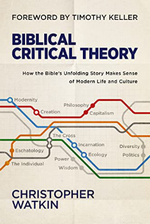
I was in Koorong with every Australian Christian’s favourite present: a Koorong Gift Card. I’d recently heard Dr Christopher Watkin speak about why Augustine’s ‘City of God’ was the first critical theory. My plan was to buy his most recent book, which I had heard many good things about. In my memory it is the most talked about book in Evangelical circles since Timothy Keller’s ‘Reason for God’.
This seemed to be borne out when I went to the counter to request a copy, after finding none on the shelves. The sales assistant thought they had put a lot out that day. They were selling fast. It is difficult for any book to live up to such pressure!
My short review is that ‘Biblical Critical Theory’ is worth reading. It may take six or seven weeks, but it rewards the time spent in it. Dr Watkin defines what he wants to do in his introduction: a critique of our culture. Then how the story of the Bible helps us understand, unpack, and critique it. He does this by ‘interweaving reflections on the unfolding biblical storyline with examinations of modern life and culture’ (p.25).
Dr Watkin’s pedagogical background shows in how he scaffolds understanding. Each chapter has a series of questions to help the reader engage with and reflect on what they have read. It also means some (very intense) small groups would find this an interesting way to explore this book.
All readers will find something that will interest them in this book. Dr Watkin builds his narrative through the book, but it is possible readers could read a section out of order.
The usefulness of this book is also found in its ability to make the reader think. There will be ideas or thoughts which may be new to the reader, or difficult to understand. The reading will stick with you and provoke new ideas and pathways of thinking. Or at least it did for this reader! The final quarter of the book was where I found the most mileage. Dr Watkin has the same ability as Timothy Keller to synthesise and share from his own engagement with authors many of us would never read. Many people will be familiar with the inevitable quoting of C.S. Lewis, but he also engages with and exposes the reader to a wide range of other thinkers running from Arendt to Zizek. In the final quarter I found his engagement with Foucault around the idea that ‘sexuality has become more important to us than our soul’ (p.515) particularly compelling.
While Dr Watkin hopes that this book will also help non- Christians engage in a fresh way with Christianity. Like Keller’s ‘Reason for God’ and Lewis’ ‘Mere Christianity’ it will be most helpful shaping the thinking of Christians for their discussions with those who don’t yet know Jesus.
Tim Collison, is curate at St Mark’s Camberwell, Melbourne
Book Review: Who is God: The Big Bible Series for Kids
- Details
- Written by: Ben Underwood
 Who is God: The Big Bible Series for Kids
Vanessa Chappell. Illustrated by Poppy Lindsell.
www.whoisgod.com.au
Reviewed By Ben Underwood
While involved in church playgroup ministries for over 20 years, Vanessa Chappell wanted to read the young families an unadorned Bible story that stayed close to the biblical text; stories that were well illustrated but without any framing, and a series long enough to extend through the whole year, but she could not find it. And so began the work of creating accessible Bible stories that minimised paraphrasing and application, and instead, built familiarity week by week, were short enough to captivate the attention of the very young child, and ultimately revealed God’s gift of grace in Jesus.
The result of her labours, and those of illustrator Poppy Lindsell, is Who is God? The Big Bible Series for Kids. The four books align with the four school terms and provide a big picture overview of the Bible. They are produced at a good size for use in read-aloud Bible Storytime in school, church, or home environments. With these uses in mind, Vanessa has also developed digital colouring-in pages for further engagement with the story, and eBook formats for easier projection or display on screens. The illustrations are colourful and lively.
Check out the website www.whoisgod.com.au to shop directly or find out stockists.
Ben Underwood is Rector of St Edmund’s Anglican Church, Wembley, WA
Servant Evangelism in Luke-Acts
- Details
- Written by: Gavin Perkins
 Luke declares at the beginning of his gospel that he writes of “the things that have been fulfilled among us” (Luke 1:1). In Luke and then Acts he then makes it clear that the people of God’s evangelistic task of global mission is a crucial fulfilment of the Old Testament hope, particularly as expressed in the prophecy of Isaiah. In Isa. 42:6 it is promised that the Servant of the Lord will be a light to the nations. This is expanded upon in Isa. 49:6 where the Servant is to be a light to the Gentiles “that my salvation may reach to the ends of the earth.” With Jesus in his arms, Simeon proclaims that in seeing Christ, God has brought about this salvation long-prepared (Luke 2:30–32). Accordingly, in Luke’s schema the proclamation of forgiveness in the name of the resurrected Christ to the ends of the earth is as much the goal of prophetic hope as the death and resurrection of the Christ.
In Luke 24:45–47, the resurrected Lord Jesus gives his disciples the essence of Old Testament scriptural hope as fulfilled through his ministry. The necessity of prophetic hope created a necessity that shaped his own ministry—it was “everything that must be fulfilled that is written about me in the Law of Moses, the Prophets and the Psalms” (Luke 24:44). The suffering of the Messiah and the resurrection of the Messiah both took place just as had been prophesied as a fulfilment of Old Testament hope (Luke 24:46). However, Jesus adds a next step of necessary fulfilment, one which still lies in the future as he speaks to his disciples: “repentance for the forgiveness of sins will be preached in his name to all nations, beginning at Jerusalem” (Luke 24:47). Just as much a part of the prophetic hope as his own death and resurrection, just as vital to God’s plan, and just as certain to be fulfilled, is the proclamation to the ends of the earth of the gospel of repentance and forgiveness in the name of Jesus.
Furthermore, Jesus promises empowerment by his Holy Spirit for the work (Luke 24:49). In this promise Jesus links the ongoing proclamation mission of the church with his own preaching ministry. Isa. 61:1–2 had promised the Spirit would be on the Servant of the Lord, anointing him to “proclaim the gospel to the poor.” This gospel proclamation would bring spiritual comfort, freedom, sight, and a season of favour and blessing from the Lord. Jesus began his public ministry at the synagogue in Nazareth by preaching these verses from Isaiah, declaring those words to be fulfilled in his ministry (Luke 4:21). Jesus is the Spirit-empowered gospel preacher bringing freedom and spiritual sight as he breaks the chains of oppression. Accordingly, the promise in Luke 24:49 of divine empowerment for mission links Jesus’ evangelistic mission with that of his people. In Acts 2:1– 12 Luke makes it clear that this empowerment is the Holy Spirit, and that power drives forth the church in mission, not just to the nation Israel but to all the tribes and tongues of the earth.
As Luke follows the growth of the gospel word in the book of Acts, he continues to draw on the prophesy of Isaiah as central in shaping the essential and necessary nature of the church’s ongoing mission. Luke recounts a crucial turning point in Paul’s ministry during which he defends his evangelistic strategy by quoting Isa. 49:6 (Acts 13:47). Paul and Barnabas’ heightened focus on Gentile mission was driven by theological and not just strategic or pragmatic considerations. In quoting from Isa. 49:6 Paul declares, “For this is what the Lord has commanded us: ‘I have made you a light for the Gentiles, that you may bring salvation to the ends of the earth’” (Acts 13:47; emphasis added). In Isaiah 49 the “you” refers to the Suffering Servant, but in Acts 13 Paul and Barnabas take it as directly referring to them. It is “what the Lord has commanded us” (Acts 13:47; emphasis added)—that is, Paul and his missionary co-workers. The commission to the Servant has become for them a command to engage in Gentile mission. As he and Barnabas are engaged in that ministry of the Servant as they plant Gentile churches, Paul unequivocally sees them as fulfilling the ministry of the Suffering Servant to be a light for the nations and bring salvation to the ends of the earth. In his commission God set Paul apart to proclaim the gospel to the ends of the earth, and he does the work of the Servant, so he will also bear the stripes of the Servant (Acts 9:15–16). Furthermore, he includes in that commission those who partner with him in the work.
An examination of two key passages in Paul’s letters confirm this link. Paul retells the story of his own calling in Galatians writing, “God, who set me apart from my mother’s womb and called me by his grace, was pleased to reveal his Son in me so that I might preach him among the Gentiles,” and in so doing recalls the words from Isaiah, “the Lord called me; from my mother’s womb he has spoken my name” (Isa. 49:1). The commission Paul received to preach the Son among the Gentiles (Gal. 1:16) is in fulfilment of the promise in Isaiah that God would bring saving light to the Gentiles. Also, in Romans 15:19 Paul could boldly claim, “from Jerusalem and all the way around to Illyricum I have fulfilled the gospel of Christ.” Paul continues in Romans 15 by quoting another of Isaiah’s Suffering Servant songs: “It has always been my ambition to preach the gospel where Christ was not known, so that I would not be building on someone else’s foundation. Rather, as it is written: ‘Those who were not told about him will see, and those who have not heard will understand.’” (Rom. 15:20–21, quoting Isa. 52:15). Once again Isaiah provides Paul with a self-understanding that informs his missionary strategy. The Suffering Servant has come and was pierced for the transgressions of the whole world, and so Paul will go to those who have not heard. In this sense Paul is completing the work of Christ as he carries on the work of the Suffering Servant in bringing light to the nations. In all of this, Paul is clear that it is Christ the Suffering Servant who works through him in his own suffering and ministry; it is all “what Christ has accomplished through me” (Rom. 15:18). Strengthened by Christ, and with Christ speaking through him, Paul proclaims light to the nations.
In the second half of the book of Acts (read alongside Paul’s letters) it is clear that the Spirit-empowered proclamation of salvation in Christ becomes not just the task of the apostolic eyewitnesses but also of the churches established through their ministry. The mission strategy of the Apostle Paul is to plant key churches as training and mission centres to further the evangelisation of a wider region, and so has built within that strategic plan an expectation that local church members would follow his lead in using their gifts and opportunities to proclaim Christ to their family, friends, and acquaintances. His aim was to firmly plant the gospel in the key cities of each region through ceaseless work in evangelism and faithful nurturing of the emerging churches into an established maturity. His pattern was then to return to those churches, appointing and training leaders, and envisioning for sustained faithfulness and mission (cf. Acts 20:28ff.). As Paul writes his letter to Rome, he can look out over that great area from Jerusalem to Illyricum and can say, ‘my work here is done’ (Romans 15:19). For Paul, at this point, the gospel has been fulfilled amongst the Gentiles of the East and they are now able to continue the task themselves. He aims to leave churches mature enough to get on with the task of preaching the gospel and furthering the mission without Paul’s ongoing direct support.
In Paul’s ministry as recorded by Luke there is an expected and normal link between proclaiming Christ and enduring hardship. This is important for the church in every age to grasp as they continue on mission. In his letter to the Colossians, Paul writes strikingly, “I rejoice in what I am suffering for you, and I fill up in my flesh what is still lacking in regard to Christ’s afflictions, for the sake of his body, which is the church” (Col. 1:24). The sufferings of the Apostle for the Gentiles are in continuity with the sufferings of the Christ, not in terms of atonement but in terms of mission. Christ suffered as the source of the gospel message, Paul (and those who follow him) suffer in the proclamation of that gospel message. The suffering that is the source of grace is that of Jesus and is perfect and complete, however, the suffering that is the necessary accompaniment to the proclamation of the gospel is incomplete. Both sufferings were anticipated by Isaiah, and so the figure of the Servant finds fulfilment not solely in Christ’s sufferings for the church, but also in the sufferings of those who proclaim the light of the gospel to the nations. In the era of salvation history between the resurrection and the return, the gospel must be proclaimed to the nations, however this proclamation is not done by the Suffering Servant himself (as Isaiah 49 seemed to indicate) but is through the church acting by his commission and power. Christ will proclaim light to the Gentiles as Isaiah anticipated, but it is through his church. As Paul conducts a mission to Gentiles he fills up in his “flesh what is still lacking in regard to Christ’s afflictions” (Col. 1:29) as his toil, struggle and suffering for the Gentile church become a necessary part of his continuation of the ministry of the Suffering Servant, whose energy works within him. In continuing the ministry of the Suffering Servant, Paul was the pioneer, but others joined him in the task. Barnabas was designated as one who alongside Paul fulfilled the song of the Suffering Servant, and as Paul taught and trained others he made it clear that the link between suffering and mission was not unique to him. In writing to his young protégé Timothy, Paul reminds him of his teaching and the persecution and suffering that it produced, “You, however, know all about my teaching, my way of life, my purpose, faith, patience, love, endurance, persecutions, sufferings—what kinds of things happened to me in Antioch, Iconium and Lystra, the persecutions I endured” (2 Tim. 3:10–11). Having seen Paul’s ministry up close, there is no doubt that Timothy understood what Paul meant when he writes, “everyone who wants to live a godly life in Christ Jesus will be persecuted” (2 Tim. 3:12). The faithful ministry of the word of God involves persecution and suffering. As Paul stands at the finish line exhausted, but victorious in Christ, he calls back to Timothy, “keep your head in all situations, endure hardship, do the work of an evangelist, discharge all the duties of your ministry” (2 Tim. 3:5). Timothy was part of the fruit of Paul’s pioneering mission, and now he is called to share both its joys and its trials as he carries on that same mission. Paul planted churches in the Gentile world, but having laid a foundation in Christ, he handed over responsibility for the development of that mission to those young churches. Believers today are recipients of the gospel to the nations and stand in this line of responsibility as the present generation to whom the mission has been entrusted.
As Luke writes his two-volume work to show what has been fulfilled through the ministry of Jesus he also displays what is continuing to be fulfilled by Christ through his church, empowered by his Spirit. Evangelism is at the heart of the life and purpose of the church, even as it leads believers directly into the types of hardship that Paul and his apostolic band endured.