
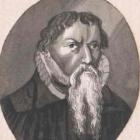
 Theology is a practical discipline.’ So says Amandus Polanus (1561-1610), a scholastic theologian of the Reformed Orthodox school with whom I have become acquainted through doing Master’s research. I imagine few of you have read much Reformed Scholasticism lately (or ever), and perhaps even fewer have heard of Polanus (let alone read anything he wrote). He was a Professor of Old Testament at Basel, and he also wrote systematic theology rather voluminously. Study of the Protestant Scholastic theologians is on trend at present in some circles, and they are not always quite as dry and logico-rational as you might imagine. Hence, I thought I might share a couple of his perspectives which I found striking, and that struck for me an existential and pastoral note.
First, Polanus argues that theology is aimed at action, so that human beings might reach the best and highest blessings possible for us. He says,
‘the purpose of theology is not bare and idle speculation or contemplation, but practice, but action. This is what humanity is fitted for by God, redeemed for by Christ, sanctified for by the Holy Spirit. This action is the glorification of God and the everlasting blessedness of humanity. […] So action is the purpose even of the most theoretical doctrines about the unity of the divine essence and the Threeness of the divine persons.’
The action at which theology is aimed is that we glorify God and are made blessed through having that faith in God that is expressed in the good works of love. He says,
‘For why does God make himself known to us unless that he be glorified by us, and that we might be made blessed by fellowship with him?’
To make the nature of this glorification and blessedness— and the way to it—more concrete, Polanus asks,
‘Now what are the means with which we strive towards this end? Are they not faith and good works? Surely we glorify God by faith and good works; by living faith effective through love, that is, which produces good works as its fruit, we obtain eternal blessedness.’
Polanus says God’s glory and our blessedness are in the actions of our knowing and believing the gospel of Jesus and the teaching of his apostles, and in living out this faith by doing the good works that spring from it. This proves that we’ve truly learned our theology. Polanus points to the Philippian jailer who, upon believing in Jesus as Lord, washed the wounds of Paul and Silas his captives (Acts 16:29-34). For Polanus, this jailer is the complete theologian, the whole package, because his theology produced action. When I encountered in Polanus this kind of simple, direct and practical analysis of the purpose and proper outcome of theological knowledge, it struck me. This was not least because Polanus took me to the earthy scene in the Phillippian jail where Paul and Silas sang songs, shared the gospel with the jailer and received his grateful ministrations. Faith taking hold of proclaimed theology, and actively expressing itself in good works is summed up in that vivid human story. Would that we were theologians like that jailer, day by day.
Next, and in this vein, Polanus has a practical, personal and pastoral take on the use of the Apostles’ Creed. When we say the Apostles’ Creed in church, service leaders sometimes introduce it by saying words like these: ‘This ancient statement of Christian faith has been said by believers for centuries. Let’s join with one another and with them in professing our common faith’. This communal use of the creed is well known. But for Polanus the creed should find a place in your individual Christian devotion as your watchword and your spiritual tonic, girding your loins for action in the everyday struggle of the Christian.
Polanus quotes and endorses a tradition that thinks of the creed as the watchword of the soldiers of Christ, the formula which identifies us as belonging to the Lord’s forces. More than that, recounting the creed to ourselves daily—and whenever we are afraid—orients and galvanises us for the spiritual war we are caught up in.
Polanus first quotes St Ambrose, who says,
‘The creed, too, especially, we should recite at the pre-dawn hour everyday as the seal of our hearts. It should be gone over in the mind, when, for instance, we dread anything. When, for instance, is the soldier in the tent, the warrior in battle, without the oath of military service?’
The soldier’s oath of military service told him who he was, to what he belonged and what his duty was. To recite it was to remind the soldier of all these things, to inscribe them on his heart and to focus him on what he must do, no matter the circumstances. Likewise, says Ambrose, the Apostles’ Creed should be used ‘at the pre-dawn hour everyday as the seal of our hearts’. It is not a mere list of orthodox beliefs, but a way of arming yourself for the spiritual battle the day will bring.
Polanus then continues, drawing inferences from Ambrose:
‘Therefore the Apostles’ Creed is to be professed and remembered everyday:
- because it is our watchword given to us by God through Christ, with which we must be in daily and continuous warfare against Satan, the world, sin, the flesh and the Antichrist: For it is necessary that we be distinguished from our foes against whom we must fight, that it may be settled with which party we stand.
- because it reminds us, by our examination every day, whether we are in the faith.
- because it urges us towards fervent zeal in asking God for the growth and preservation of faith in us.
- because it recalls into memory for us our baptism, in which we were baptised in the name of the Father, the Son and the Holy Spirit, in which we were bound to believe in this God and to serve him.
- because it provides to us many consolations which we need everyday against so many temptations to which we are subject.
- I commend this use of the Apostles’ Creed to you: It is there for you in the pre-dawn hour, and whenever you need a shot of gospel faith in the arm! ‘I believe in God, the Father Almighty, creator of heaven and earth…’
Filidex Subsilva has a mission to revive appreciation of Amandus Polanus von Polansdorf and his theology.