
General
Wei-Han Kuan interviews Chris Mulherin.
- Details
- Written by: Wei-Han Kuan
Hi Chris, what have you been up to over the last couple of years or decades?
Hi Wei-Han. It's nice to see you. I've been travelling the world at CMS's expense for most of the last 15 years actually. Almost 3 years ago we got back from our time in Argentina working with students and the Anglican Church. Since then I spent a year working at St Jude's, I’ve done some study, and our oldest son Ben died of cancer.
...what are you up to now?
Right now I'm taking a sabbatical actually. With the ups and downs of the last while it's a good time to slow down. I'm doing a doctorate in theology relating theological knowledge and scientific knowledge: Hans-Georg Gadamer, Michael Polanyi and Richard Rorty to be precise.
Polanyi - isn't that the name of an inlet to the Russian submarine base in the Arctic?
Could be... though I somehow think you made that up.
So why so interested in these dudes with thoughts?
In a nutshell: I think that one of the key challenges which we face is defending orthodox Christian faith in the face of what we could loosely call postmodernism. It's an apologetic challenge which ranges from the very philosophical to the content of our Sunday preaching.
So where is the problem?
In the light of the success and so called certain knowledge of science, one problem is that some Christians have thought that a way forward lies in making our faith appear more scientific. But it is dangerous for Christians to buy the enlightenment view of scientific knowledge and certainty. It was Descartes' attractive project to ground belief on foundations that could not be doubted, but it turned out to be a foundation of shifting sand.
Can you give us an example?
I think the creation science movement is an extreme example of Christians accepting the norms of science. In their zeal to defend the truth of the Gospel they try to squeeze the faith into a scientific straitjacket. But ironically, at the same time that some Christians took a turn towards the security of scientific certainty, that very view of science was being called into question. And of course when the edifice which makes up that particular view of science starts to crumble, then so does the view of faith that is wedded to it. In the last 40 or 50 years, critiques of science and of the possibility of absolute and certain knowledge have led to much of what goes by the name of postmodernism.
And that's a bad thing, yes?
Well, yes and no. In one sense postmodernism is an affirmation of human humility. And theologically we ought to affirm that as a welcome challenge to human pride. But on the other hand, if such 'postmodern humility' leads to a sort of pathetic inability to affirm anything as true then it has thrown the baby out with the bathwater. So the challenge is to both affirm the possibility of holding fast to truth and at the same time to recognize what is called in the trade 'human finitude'.
It sounds dangerously like relativism to me. Does that mean that one belief is as good as another?
No. Relativism is normally the view that there is no ultimate truth, but only interpretations. Sure we are all interpreters, but some interpretations are right and some are wrong. There are many interpretations of 'the Christ event' but in the end either the resurrection occurred or it didn't. As evangelicals we are convinced that there is good reason to believe in the resurrection. But as I said: sure and certain proof along the lines of the (mistaken) model of science is not to be had.
So how is any of this relevant to say... the mission-shaped church? Or general pastoral care for a congregation?
Well I think it is relevant in a number of ways. One way is simply the trickle down effect: as we think about these things at a theological and philosophical level the conversations eventually shape the thinking of the church as a whole. More immediately, my own preaching and apologetic conversations are informed by thinking about the relationships between philosophical hermeneutics and scientific and theological knowledge. And in all of this, I don’t think there is any doubt that the huge challenge is to defend the uniqueness of Christ. We live in a context where tolerance is a creed that paints uniqueness as both an offensive and a naive concept.
Yes but hold on… What would you say to non-philosophical types who think, ‘Just explain the Gospel and convert people will you?!’
I say, great! I believe Romans 1:16. So preach it brothers and sisters! But at the same time there are many people, both non-Christians and others who have been Christians for years, who want solid answers to some of the questions that are part and parcel of recent Western thinking. We have a responsibility to them and to God to defend the Gospel in a pluralist society. And don't forget these things do hit the level of conversations in the street.
You mean today’s experimental university philosophy is tomorrow’s experiential school-gate conversation?
Yes, that’s well put. And as you said earlier, few people understood Foucault or Derrida when they lectured, but today children grow up with postmodern blood in their veins.
You mean: "What's true for you is not necessarily true for me"?
Exactly. That sort of thinking is simply normal nowadays and anyone who thinks differently is politically incorrect and considered downright rude. Of course the internal contradictions of relativism are numerous but that doesn’t stop such fuzzy thinking taking hold. It also serves as a very effective way of avoiding facing up to the rub of sin. But enough from me: I’m moving into preaching mode!
So should members of EFAC be bothered to think about these issues?
Absolutely! As evangelicals we want to boldly affirm and proclaim Jesus Christ as the truth. And we don't want to do that in a way that is intellectually ignorant. I think one of our greatest apologetic opportunities is to discern the truths and falsities of all that goes under the postmodern banner and to help people understand, that rather than being a dire threat to faith, there is much that affirms our Christian convictions. Not least that the truth is found in a person and reveals itself in relationship.
OK, can you recommend a place to start reading or looking?
Mmm… well I think the place I started years ago is a great place. The first few chapters of Lesslie Newbigin's The Gospel in a Pluralist Society are excellent. Highly recommended. Then there are Polanyi's works: Personal Knowledge is the big one. It's heavy going but fascinating for those interested. But I'm afraid I'm not up with the latest books in the bookshops. And after Sam McGeown's recent article in Essentials I might stick to books that have that old musty smell to them! I’m also happy for people to contact me personally for more suggestions.
What next after the studies?
A good question. I'm ordained and Anglican. I also enjoy teaching and I enjoy wrestling with the issues we've been talking about. My expectation was to return to parish life, but the upheavals of late need some time to settle down before embarking on the next step. God will lead in his good time I guess.
Chris Mulherin grew up in Melbourne, worked for Scripture Union and lectured in engineering and philosophy before moving to Argentina with CMS. In Argentina he worked with university students and was minister of the Anglican church in Tucumán. Married to Lindy, they had 5 boys until Ben died last December. He can be contacted at
The Curate s Egg: To be sure, to be sure
- Details
- Written by: Rob Imberger
Indeed the whole ‘selection for ordination’ process is designed to confirm the confident and alarm the antsy; designed to make you sure that ordination isn’t some self-deluded masterplan of your own mini-kingdom’s making. And, to be sure, I was left humbled, awed, charged with responsibility, and more or less certain that I was clear of such delusions.
Praise the Lord! He put it in my heart when I was just 15 to be a minister of his Word & Spirit. Praise the Lord for godly men and women who affirmed my gifts & call, from then till now. Praise the Lord for Ridley Melbourne where I was trained for ministry and mission (even when ministry and mission weren’t in the title!). Praise the Lord for employing me in His harvest field of Diamond Creek. To be sure, I was sure this was the Lord’s place for me.
The Practice of Puritan Meditation (Part 1)
- Details
- Written by: Jill Firth
The Puritans valued meditation on theological doctrines and key propositions of Scripture. They sought to fill their mind, imagination, consciousness and memory with God and his purposes. Richard Baxter (d 1691) is representative of the Puritans in seeing heaven as the foremost subject of meditation. John Owen (d 1683) particularly prized meditation ‘on the person of Christ, and the glory of Christ’s kingdom, and of His love’.
Lambeth: Bishop Hale
- Details
- Written by: C Appleby
LAMBETH CONFERENCE 2008
REPORT BY
BISHOP STEPHEN HALE
EASTERN REGION, MELBOURNE
The Lambeth Conference was held from 16th July to 3rd August 2008. Around 620 Bishops attended with a parallel Conference for Spouses. The Conference commenced with a full acknowledgement of the current division in the Communion and prayer for those who chose not to attend. The first three days were given over to a Retreat for Bishops. We met in Canterbury Cathedral and the Archbishop of Canterbury gave five addresses on five Pauline themes. It was a great way to start with lots of insight and time for prayer and reflection.
Christian ministry to people affected by disability- Summer 08/09
- Details
- Written by: Lindsay Gale
More than ninety percent of people with significant disabilities do not attend or participate in church life[1], yet it is estimated that less than five percent of Australian churches have any kind of intentional disability ministry or outreach.[2]
God’s perspective on disability
One of the major aspects of Jesus’ ministry on earth was his outreach to people with disabilities, who also played a prominent role in witnessing to the fact that he was the Messiah. In Luke 14, Jesus has given the church a mandate to make every effort to reach out to people with disabilities and ensure that they also have the opportunity to hear the gospel and find a place of belonging and ministry in the church.[3] He concludes by saying that his house will not be full without their inclusion (Luke 14:23). They are an indispensable part of God’s family.
The idea that those we may be seeing as of lower priority, are not so in God’s economy is a theme also found in Paul’s letters. As he reminded the Corinthian church, every member of the church has gifts to be used for the common good (1 Corinthians 12:7) and every part of the body of Christ is needed for the body to function. In fact, he goes on to say that “those parts which seem to be weaker are indispensable” (1 Corinthians 12:22). It seems entirely appropriate to include in this group of weaker members, those ‘weakened’ by significant disability or those who care for them. Elsewhere Paul speaks about learning through the experience of a disabling “thorn in the flesh” to boast in his own weakness and incapacity, because through that weakness God’s power was able to work and be “made perfect” (2 Corinthians 12:7-10).
Joni Eareckson-Tada speaks of this learning being available to the church that ministers to and alongside people with disabilities and their families, through which we discover that “God’s power shows up best in weakness.” She speaks of the life and faith shaping gift of disability in her life, through which she has learnt obedience, recognized the extent of her sin and poverty before God, experienced God’s strength and sufficiency working in the midst of her weakness and seen God work through her in her church to deepen its capacity for love and service. She concludes that “People with disabilities are the way to creating a caring church that truly reflects the love of God, as well as his power.”[4] Could it be that our church communities are less caring and overall weaker than any of us would like, because we have not been including and learning from people with disabilities?
Certainly in the context of evangelistic strategies that focus on reaching the ‘influencers’ and those that are deemed most strategic for taking the work of God forward in the world, ministry to and with people who live with significant disability is going to be thought of as a lesser priority. But this kind of thinking possibly has more in common with the performance-oriented thinking of the world, than with a biblical worldview. As J. I. Packer states, “God doesn’t want us for the sake of the things we can do for Him. He wants our love. He wants our fellowship. He wants our worship. And any of us – rich or poor, healthy or ill – can offer Him this.”[5]
It is an interesting exercise to look at the images of believers on the websites of Sydney’s Connect ’09 and that of NCLS (National Church Life Survey). Both depict the church in terms of able-bodied people:

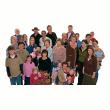
When we look at the images of church these websites promote, are we inadvertently sending a message to people who are blind for example, or who live with degenerating illness, or who care for children who have Down’s syndrome or schizophrenia or cerebral palsy that they are not as welcome in the church? I think quite likely we are.
What is disability ministry?
Disability ministry is an activity of Christians with and without disabilities working together to reach people affected by disabilities (including their caring families) with the gospel of God’s grace in Christ.
Disability ministry is a holistic word-and-deed ministry that involves considering spiritual, physical, social and emotional needs. It aims to integrate people into the church and to meet their needs in a way that serves as a witness to the surrounding community (Matthew 5:16)
Disability ministry is not a charity response that focuses primarily on a person’s limitations, but a mutual ministry that supports people with disabilities to utilise their God-given gifts and talents in the church for the benefit of others.
Disability ministry – whether large or small – is made up of many small and ordinary acts of kindness expressed by one person to another, and so is within the reach and capacity of every church. And the benefits to all are substantial. New people are brought to Christ, the church is strengthened as everyone is given the opportunity to use his or her spiritual gifts, and the community sees God at work in real and practical ways, ultimately bringing glory to him.
Where is disability ministry happening?
In America, through Joni and Friends and other organizations, disability ministry is growing in evangelical churches, and both the lives of people with disabilities and the culture of churches are being changed as a result.[6]
In the UK, through the organization Through the Roof, similar ministry is taking place that is equipping evangelical churches to remove barriers of architecture, communication and attitude that prevent people with disabilities from attending a local church and responding to the gospel.[7]
In New Zealand through Christian Ministries with the Disabled Trust, a camping program is bringing together people with disabilities and church members as their support people, to hear about Jesus and grow in their faith.[8] Church members are returning to their local churches at the end of these camps equipped and inspired to seek out people with disabilities living in their local communities, and by word and example to commend God’s love in Jesus to them.
Why the absence of evangelical disability ministry in Australia?
So why is it that Australian evangelicals have largely ignored this group of people, who according to Lausanne, are one of the most unreached people groups in the world today?[9]
- Are we unaware of being unwelcoming? Surely when we say everyone is welcome in our church, we mean everyone. Why does there need to be a special invitation or effort?
- Are we uncertain how to imitate Jesus in this area, who responded to disability in most cases with miraculous healing? The question of healing is a difficult area for people with disabilities as well as for us. Many have been hurt by Christian assumptions and ‘healing’ attempts.
- Are we uncomfortable with ministry that involves works of service, because our evangelical focus is largely on proclaiming the gospel through preaching and word-based ministries?
- Do we assume that God wants us to reach people who understand and reason as we do? Perhaps we don’t think that a person with intellectual disability can understand the gospel of grace.
- Do we think we need formal training? There is a bewildering array of disabilities after all, and who knows how many legal restrictions and obligations to getting involved.
- Do we see church as a place to recharge and receive ministry rather than to give?
- Do we think that people living with significant disability are spiritually innocent, with a free ticket to heaven because of their disability?
- Are we motivated by pity and unable to see any productive purpose or usefulness to the church in disability?
- Being time-poor like everyone else, do we decline involvement in a ministry that might require more time than we have to give?
- Are we worried about the cost?
- Do we feel afraid, ignorant, challenged in our faith? How can we minister to a person or family whose road is so much harder than ours? Are we ignorant of the number of people with disabilities in our neighbourhoods, and the extent of their isolation within both our communities and our churches? Disability still causes isolation today. People who lose physical capacity through degenerating illness stay at home. Children with significant physical disability require special transport to travel anywhere, and so largely stay at home. Parents of children with significant disabilities experience what some have called the cruellest form of isolation. People who once held responsible full-time jobs find caring means they can’t work, are financially poor, often sleep-deprived, and lose heart, motivation and self-confidence. For all these reasons, people affected by disability are absent from the ‘common-room’ places that typically our church outreach attempts target.
- Have we assumed that people with disabilities don’t come to our programs and services because they don’t want to, just like everyone else who stays away?
Whatever the answer to these questions, our lack of involvement in this area is resulting in the ongoing absence from our churches of people with disabilities and their families. When we don’t actively reach out to hidden and forgotten people as Jesus commanded us to do, we are responsible for limiting their access to the gospel. For people with disabilities this is a significant issue, because there is such minimal gospel ministry happening in this area.
What might disability ministry involve?
a. Raising awareness in the church
An excellent awareness raising tool is the six week bible study series Hearts in Motion, which explores a biblical perspective on disability. Perhaps the small groups of your church could work through this material.
Your church might decide to run a Disability Awareness Sunday, perhaps coinciding with Carers week (October) or the International Day for People with Disabilities (December 3rd). CBM has a wealth of resources to equip churches to run such an event.
b. Starting small
Disability ministry starts best when it starts small. When one church member or family living with disability is helped to greater participation and belonging, disability ministry in your church has begun. What can you do to facilitate greater inclusion and shared ministry?
An informal study of churches with vibrant disability ministries in America has revealed that everything grows from this compassionate response to the needs of one. The opposite has also been observed – where churches lack this kind of compassionate attention to the needs of the individual, no amount of accessible renovation of the building brings people with disabilities to the church.
c. A ministry that always combines word and compassionate action
Developed disability ministries may include:
- providing respite opportunities for parents who are full-time carers;
- providing ‘buddies’ and assistance for children with disabilities to attend the kids programs on Sunday mornings, or youth group and young adults activities;
- providing support groups and fellowship opportunities for the whole family;
- providing support and activities for siblings who often receive less attention because of the demands of the disability on the parents;
- working on the accessibility of church programs;
- ensuring the same opportunities for people with disabilities to minister in the church according to their gifts and interests.
So who is there in your church that you know but don’t know, who may be saying, “We are always on the fringe of the church, not a true part of the body”? What can you do today and tomorrow to help relieve a burden and enable a person or a whole family to take their place in ministry and service beside you?
d .Engaging with people and families with disabilities in the community
In the community the church may be involved in:
- teaching religious education in the local special development schools;
- reaching out to isolated people living in group homes who lack family support or community connection;
- outreach and evangelistic events that are inclusive of everybody.
CBM Australia has employed me to help churches begin or develop Christian ministry to and with people with disabilities, through supplying resources, training and support. Contact me on FREE Call 1800 678 069 or email
Lindsey Gale is Disability Access Officer for CBM Australia and a member of EFAC. She is married to Phil Gale, vicar of the Anglican parish of Wandin, Seville and Mount Evelyn in Melbourne’s outer east.
[1] ABS – 6.8% of people with moderate to profound disability attend church regularly.
[2] This is an estimate based on US figures where less than 10% of churches have intentional disability ministry – Joni and Friends, 2007.
[3] In particular Luke 14:21, 23 – “Go out quickly to the streets and alleys… bring in the lame and the blind… and make them come in, so that my house will be full.”
[4] Stephanie Hubarch, 2006, Same Lake, Different Boat, P&R Publishing.
[5] J I Packer, 1973, Knowing God, Downers Grove, Ill.: InterVarsity – see the chapter ‘These Inward Trials’; quoted in J. Eareckson Tada and Steve Miller, 2006, Through the Roof – Assisting Churches in Developing an Effective Disability Ministry and Outreach, Joni and Friends International Disability Centre, California.
[9] Lausanne Occasional Paper 35B, 2004 – Hidden and Forgotten People – Ministry Among People with Disabilities.